Choosing a reaction pathway from several kinds of evidence — Higher
By UK GCSE Chemistry · independent study · myAudience
myAudience original generated teaching illustration. Image: illustration, not a documentary photograph. · Original generated teaching illustration; no exam-board or textbook artwork copied.
Choosing a reaction pathway from several kinds of evidence — Higher
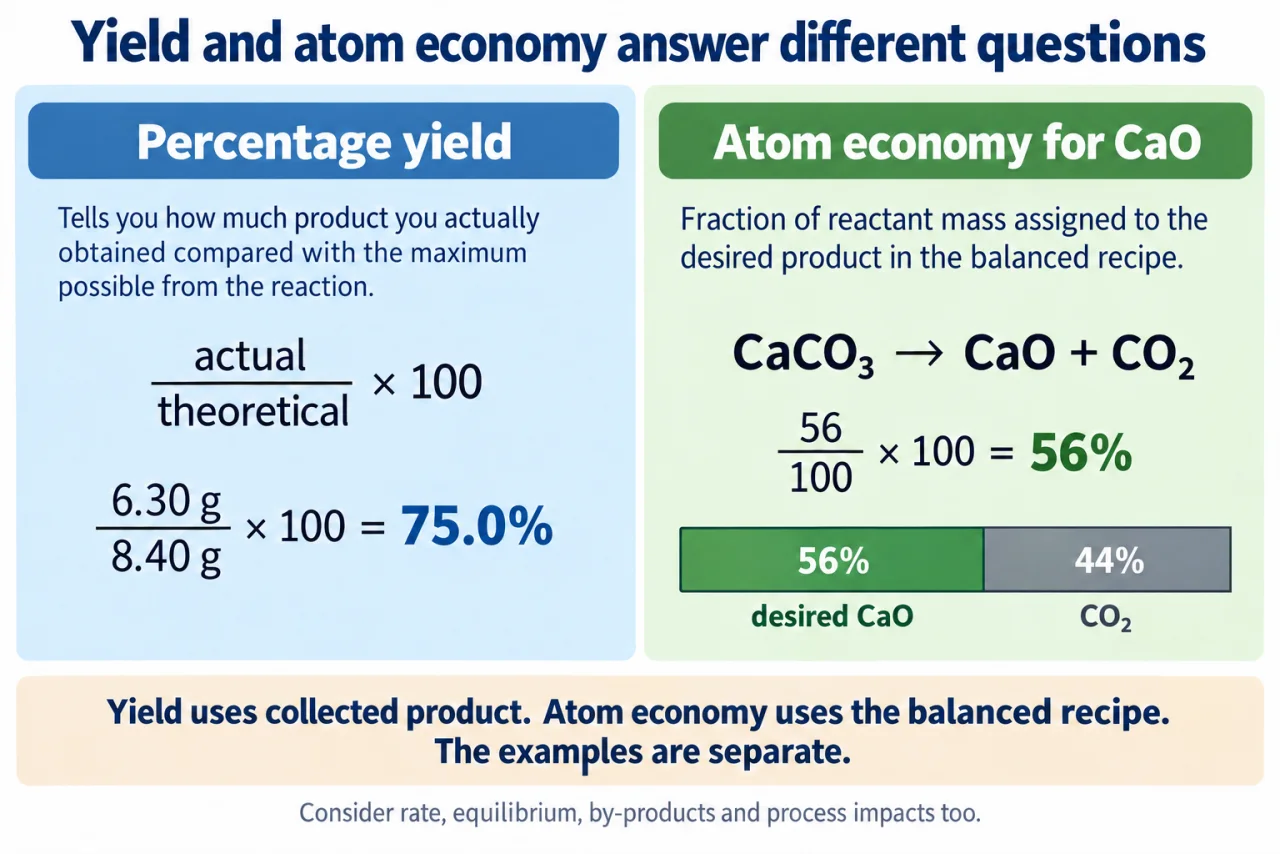
A pathway is a route of chemical changes used to obtain a product. Comparing pathways requires a stated purpose and evidence, not a rule that the largest atom-economy percentage always wins. Atom economy describes where reactant mass goes in the balanced recipe. Yield describes how much target product is actually obtained relative to the theoretical maximum. Rate describes how quickly change occurs, while equilibrium position limits conversion in a reversible step.
Consider two invented candidate routes to the same product. Route A has 100% atom economy, 55% isolated yield and slow production. Route B has 75% atom economy, 90% isolated yield and faster production; its other product has a stated useful market. Those data support several comparisons. A wastes less mass in its ideal reaction equation, while B returns a larger fraction of its theoretical target and can meet a short production deadline more easily. The usefulness of B's by-product depends on the given evidence, not an assumed buyer.
For a fixed starting-material mass and otherwise comparable ideal accounts, atom economy multiplied by fractional yield estimates isolated desired-product mass fraction. A's estimate is 1.00 × 0.55 = 0.55; B's is 0.75 × 0.90 = 0.675. This deliberately simplified comparison excludes solvent, excess reagents, purification aids and energy. It is a reasoning aid for the constructed data, not a new definition of atom economy or a full industrial environmental assessment.
Equilibrium position matters because a fast reversible reaction can quickly reach a state with substantial reactant remaining. Faster approach does not by itself mean a larger eventual yield. Changing conditions or removing products can alter a practical process, but the proposed choice needs data about feasibility and costs. An explanation should connect each criterion to its consequence: low yield may require recycling; slow rate may reduce output per day; unwanted by-products may require treatment.
A reasoned recommendation states both its objective and its limits. Choosing B for dependable near-term supply can be justified by its higher measured yield and faster rate, while acknowledging lower atom economy and missing hazard and energy data. Choosing A for a waste-minimisation research project can also be rational if improving conversion is feasible. These are conditional decisions from supplied information, not universal rankings or endorsements of invented processes.
The shared efficiency plate separates yield from atom economy but does not supply the invented route A/B comparison data. Use the numerical route table described in the prose for that decision. The footer’s additional criteria remind you that the largest single percentage cannot establish the best practical pathway.
Worked example: For the invented routes A and B above, compare estimated desired-product mass from 100 g stoichiometric reactants, then recommend a route if immediate output is the priority.
A: theoretical desired mass = 100 × 1.00 = 100 g; isolated estimate = 100 × 0.55 = 55.0 g.
B: theoretical desired mass = 100 × 0.75 = 75.0 g; isolated estimate = 75.0 × 0.90 = 67.5 g.
B also has the supplied faster rate. Check hazards, energy, purification and whether the by-product actually has a use before a real decision.
Answer: B is supported for the stated immediate-output objective: 67.5 g versus 55.0 g in the simplified comparison. Missing process data prevent a complete environmental judgement.
Check your understanding: Does a faster reaction necessarily give a greater final yield when both routes are reversible?
Answer: No.
Why: Rate concerns speed; equilibrium position concerns the eventual composition under specified conditions. Both need evidence, along with separation losses and side reactions.