Connecting molar concentration, solute mass and volume — Higher
By UK GCSE Chemistry · independent study · myAudience
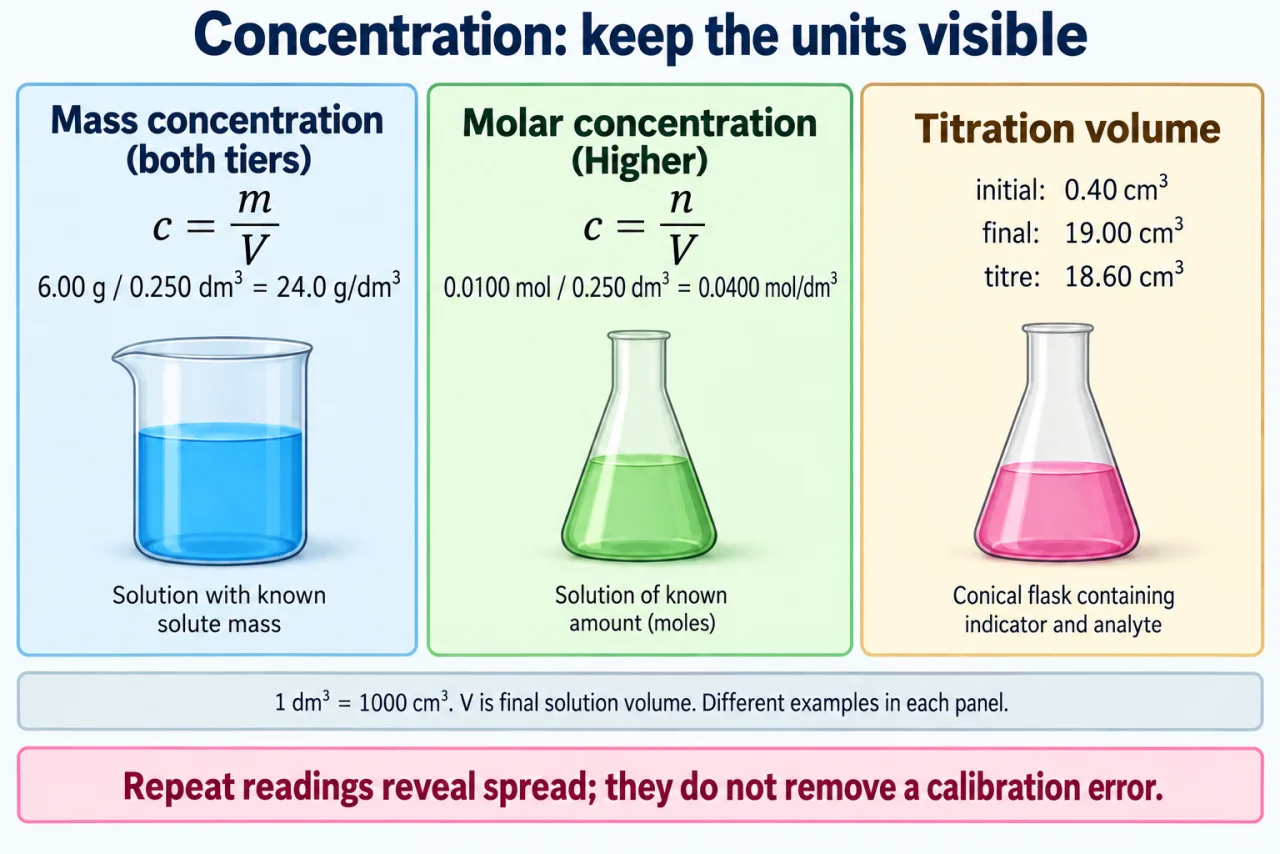
myAudience original generated teaching illustration. Image: illustration, not a documentary photograph. · Original generated teaching illustration; no exam-board or textbook artwork copied.
Connecting molar concentration, solute mass and volume — Higher
Molar concentration measures solute amount per solution volume, in mol/dm3. It differs from mass concentration in g/dm3 because one counts moles and the other counts grams. Solutions with equal mass concentrations of different compounds need not contain equal solute amounts: their molar masses differ. The unit written beside c tells you which definition a calculation is using, so do not move an unlabelled concentration between equations.
For molar concentration c = n/V, use n in mol and final solution volume V in dm3. Rearrangements give n = cV and V = n/c. If 0.0100 mol solute occupies 0.250 dm3, c = 0.0400 mol/dm3. Doubling the amount at fixed volume doubles c; doubling volume while keeping the amount unchanged halves c. These relationships are about the concentration of the final solution, not the size of the solute particles.
To connect mass and molar concentration, substitute n = m/M into c = n/V, giving c = m/(MV). Rearranging gives m = cVM. A hypothetical NaOH solution at 0.200 mol/dm3 with final volume 0.250 dm3 contains 0.0500 mol NaOH, corresponding to 2.00 g when M = 40 g/mol. Its mass concentration is 8.00 g/dm3. Dissociation does not change the amount of NaOH used for this analytical concentration label.
A supervised preparation would dissolve the weighed solute and bring the solution to a specified final volume, mixing thoroughly. It would not assume that the original solvent volume equals the final solution volume. Actual concentration depends on purity, quantitative transfer and correct volume reading as well as the equation. Some solutes react with air or absorb water, so a nominal preparation may require further standardisation; a calculation alone does not certify an actual bottle's concentration.
Dilution conserves the amount of the named solute if no reaction or loss occurs. In that restricted case c1V1 = c2V2 follows from n being equal before and after. This equality is not a general titration equation, because two reacting solutes can have different amounts according to the balanced ratio. Name the substance, state the condition and convert cm3 to dm3 before using either relation.
The concentration plate’s middle panel uses 0.0100 mol in 0.250 dm3 to give 0.0400 mol/dm3. Its coloured flask identifies a solution only; colour and drawn liquid level do not measure concentration or a final volumetric mark. The left panel uses a separate mass-concentration example.
Worked example: What solute mass is needed for 400 cm3 of 0.150 mol/dm3 Na2CO3 solution? Use Na = 23, C = 12 and O = 16. Treat the solute as pure anhydrous Na2CO3.
M(Na2CO3) = 106 g/mol; final V = 0.400 dm3.
n = cV = 0.150 × 0.400 = 0.0600 mol.
m = nM = 0.0600 × 106 = 6.36 g; mass concentration = 6.36/0.400 = 15.9 g/dm3.
Answer: 6.36 g pure anhydrous Na2CO3, for the stated final solution volume.
Check your understanding: A 0.0800 mol solute amount has molar concentration 0.200 mol/dm3. Find its final solution volume in cm3.
Answer: 400 cm3.
Why: V = n/c = 0.0800/0.200 = 0.400 dm3. Multiplying by 1000 converts dm3 to cm3.