Reacting volumes reveal an unknown concentration — Higher
By UK GCSE Chemistry · independent study · myAudience
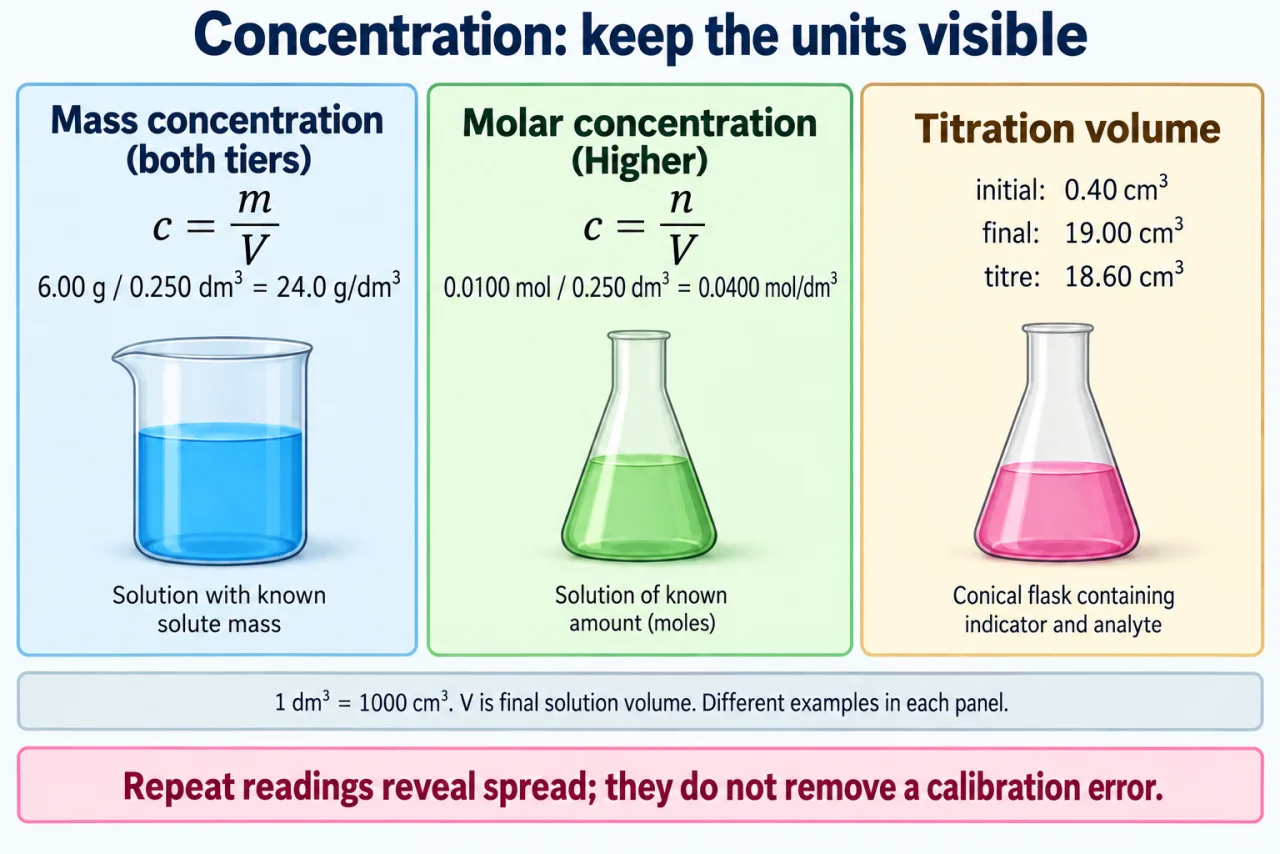
myAudience original generated teaching illustration. Image: illustration, not a documentary photograph. · Original generated teaching illustration; no exam-board or textbook artwork copied.
Reacting volumes reveal an unknown concentration — Higher
Titration measures the volume of one solution required to react with a known volume of another. An aliquot is the measured portion placed in the flask; a titre is the volume delivered from the burette. A suitable indicator gives an observable endpoint near the chemically equivalent reacting ratio. Endpoint and exact equivalence are conceptually different, so the indicator must suit the reaction. This lesson introduces a strong-acid/strong-alkali model for the practical study; it does not record laboratory completion.
In supervised work a volumetric pipette and filler transfer a fixed aliquot to a conical flask. A burette allows a variable delivered volume to be measured from final minus initial readings, with the meniscus read at eye level and the tip free from an air bubble. Condition the burette with its titrant and the pipette with its aliquot solution so residual water does not dilute them. Distilled water used to rinse the flask walls changes the volume there but not the transferred amount of reacting solute.
A rough titration locates the endpoint region. Subsequent careful trials approach it with small additions and swirling, using a suitable indicator and a white background to aid detection. Record readings and titres, then apply the stated concordance criterion rather than inventing a universal tolerance. In the constructed data 18.55, 18.60 and 18.65 cm3 lie within a total spread of 0.10 cm3. Their mean is 18.60 cm3; a rough overshot reading would not be averaged in as if equally reliable.
The calculation begins with the balanced neutralisation equation. For H2SO4 + 2NaOH → Na2SO4 + 2H2O, one mole of acid reacts with two moles of alkali. If 25.00 cm3 of unknown acid requires 18.60 cm3 of 0.200 mol/dm3 NaOH, the delivered alkali amount is 0.00372 mol, so acid amount is 0.00186 mol. Dividing that acid amount by its own 0.02500 dm3 aliquot volume gives 0.0744 mol/dm3. Equal reacting volumes would not imply equal concentrations for this 1:2 ratio.
Uncertainty and technique affect the inferred result. An overshot endpoint increases the recorded alkali titre and therefore overestimates acid concentration in this setup. A reproducible endpoint bias can persist even when titres agree closely. Appropriate eye protection, a pipette filler and teacher-directed handling address the hazards of solutions and glassware; never use mouth pipetting. Foundation students also require practical reacting-volume reasoning, but the molar and mass concentration calculation taught here is the Higher part of 8.2.2.
The concentration plate states initial and final burette readings, with 18.60 cm3 as their difference; it does not depict a burette scale or meniscus. The drawn conical flask contains the reacting aliquot and indicator. Full apparatus identification, scale reading and observed endpoint practice still require their own teaching and supervised work.
Worked example: 25.00 cm3 unknown H2SO4 reacts with 18.60 cm3 of 0.200 mol/dm3 NaOH. Find acid concentration in mol/dm3 and g/dm3. Use H = 1, S = 32 and O = 16.
Use H2SO4 + 2NaOH → Na2SO4 + 2H2O; convert NaOH volume to 0.01860 dm3.
n(NaOH) = 0.200 × 0.01860 = 0.00372 mol; n(H2SO4) = 0.00372/2 = 0.00186 mol.
Acid concentration = 0.00186/0.02500 = 0.0744 mol/dm3.
M(H2SO4) = 98 g/mol; mass concentration = 0.0744 × 98 = 7.2912 g/dm3.
Answer: 0.0744 mol/dm3 and 7.29 g/dm3 H2SO4 to three significant figures.
Check your understanding: A burette initially reads 0.40 cm3 and finally 19.00 cm3. What titre was delivered, and does adding distilled water to the conical flask change the acid amount already pipetted into it?
Answer: 18.60 cm3; adding only distilled water does not change the acid amount.
Why: Delivered volume is the difference between readings. Water dilutes the aliquot in the flask but contributes no acid, so its reacting amount remains the same.