Gas volumes are mole ratios under matched conditions — Higher
By UK GCSE Chemistry · independent study · myAudience
myAudience original generated teaching illustration. Image: illustration, not a documentary photograph. · Original generated teaching illustration; no exam-board or textbook artwork copied.
Gas volumes are mole ratios under matched conditions — Higher
Equal amounts of gases occupy equal volumes when temperature and pressure are the same, within the gas model used at GCSE. uses a molar gas volume of 24 dm3/mol at room temperature and pressure, specified as 20°C and one atmosphere. This is a rounded teaching value. It is not the 22.4 dm3/mol often associated with older standard-temperature examples, and it does not apply to liquids, solids or every possible gas condition.
The relation V = n × 24 gives gas volume in dm3 for n in mol at those conditions. Rearranging gives n = V/24. Combining with n = m/M gives V = (m/M) × 24; reversing gives m = (V/24)M. For 4.40 g CO2 with M = 44 g/mol, the amount is 0.100 mol and volume is 2.40 dm3, equivalent to 2400 cm3. A different gas with the same amount would have the same modelled volume despite a different mass.
For gaseous reactants and products measured under matched conditions, coefficients give volume ratios as well as mole ratios. In N2(g) + 3H2(g) → 2NH3(g), 1.20 dm3 nitrogen would require 3.60 dm3 hydrogen and could form 2.40 dm3 ammonia in the ideal complete-conversion account. If only 2.40 dm3 hydrogen were supplied, hydrogen would limit the maximum ammonia to 1.60 dm3. Gas volume ratios do not remove the need to check excess and limiting quantities.
Water illustrates an important boundary. In a combustion equation, liquid water at room temperature cannot be assigned the gaseous product volume ratio; only a stated water-vapour product at a suitable common temperature can be treated that way. Gas collected over water may contain water vapour, and measured gas volume changes with temperature and pressure. This lesson uses dry named gas at the stated conditions and does not claim that the rounded 24 value corrects every collection method.
A gas calculation should state the model, identify the substance and report units. Real gases can deviate from the ideal model, especially under conditions unlike dilute gases near room temperature. In supervised collection, leaks, dissolved gas and changing conditions can also affect readings. Separating model predictions from laboratory observations explains why a beautifully balanced equation is necessary for a volume ratio but does not guarantee an actual measured volume.
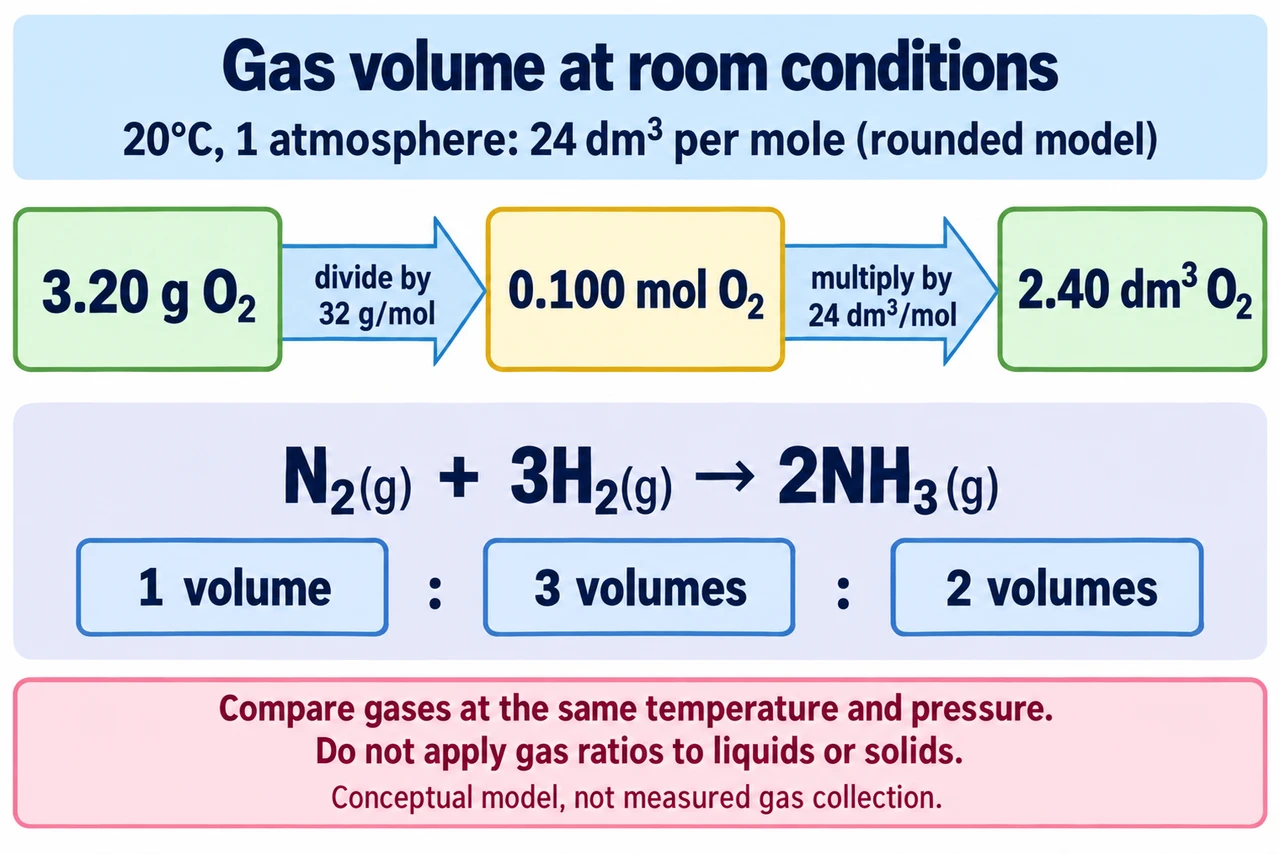
The gas plate first converts an oxygen mass to amount, then uses the rounded RTP molar volume. Its separate 1:3:2 ammonia gas-volume ratio applies only at common temperature and pressure in the ideal complete-conversion model. The same coefficient ratio cannot be assigned to a liquid-water product at room temperature.
Worked example: Calculate the RTP volume of 3.20 g O2 using O = 16. Separately, in N2(g) + 3H2(g) → 2NH3(g), predict maximum NH3 volume from 3.60 dm3 H2 with excess N2 under matched conditions.
M(O2) = 32 g/mol; n = 3.20/32 = 0.100 mol.
V(O2) = 0.100 × 24 = 2.40 dm3 = 2400 cm3.
For the separate reaction, V(NH3) = 3.60 × 2/3 = 2.40 dm3 in the ideal complete-conversion model.
Answer: O2 occupies 2.40 dm3 at stated RTP; theoretical NH3 volume is also 2.40 dm3 in the separate example.
Check your understanding: A dry CO2 sample has RTP volume 600 cm3 (given to three significant figures). Find its mass using M = 44 g/mol and 24 dm3/mol.
Answer: 1.10 g.
Why: 600 cm3 = 0.600 dm3; n = 0.600/24 = 0.0250 mol; m = 0.0250 × 44 = 1.10 g.