A growing city can have a falling urban share
By UK GCSE Geography · independent study · myAudience
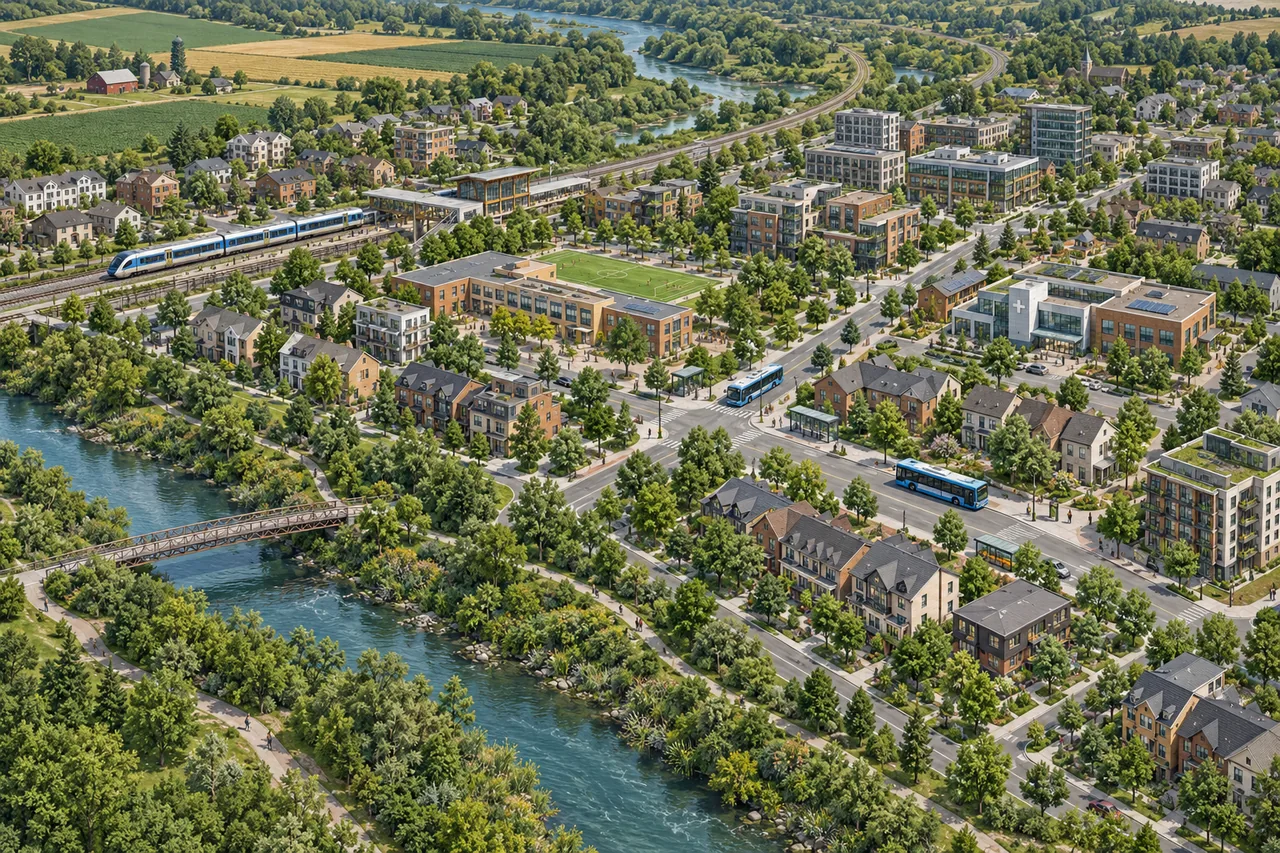
Image: illustration, not a documentary photograph. Original teaching model created for myAudience. · Original generated teaching illustration; no source textbook artwork reproduced.
A growing city can have a falling urban share
Urbanisation describes a rising share of a population living in places classified as urban. Urban population growth describes an increase in the number of urban residents. They often occur together, but they are not interchangeable: a city can grow while the rest of a country grows faster. Always ask whether a claim concerns a count, a percentage, a growth rate or a change in percentage points before explaining its causes.
Urban populations change through births and deaths, migration and changes to settlement boundaries or classifications. A household moving from a village to a city changes both populations without adding a person to the national total. Natural increase adds people where births exceed deaths. Reclassifying a previously rural settlement changes recorded urban totals even if nobody moves. The resulting statistical change is real within the classification, but its mechanism differs from migration.
The UN's World Urbanization Prospects 2025 introduces internationally harmonised Degree of Urbanization categories alongside national definitions. Cities, towns and semi-dense areas, and rural areas are not simply interchangeable with every country's urban/rural categories. A change of definition can interrupt an apparent trend. A reliable comparison records the edition, geographical coverage, settlement definition and reference year; it does not splice a national-definition percentage into a harmonised series without checking compatibility.
In the illustration, rail lines connect homes, jobs and services, while farmland remains at the fringe. This is an imaginary settlement network, not a survey from which to estimate population. Rural and urban places exchange workers, food, money and ideas. Employment and services can attract people, but housing costs, family ties, eligibility, danger and transport also shape migration. Push and pull factors describe influences, not a guarantee that everyone can move.
To explain a trend, connect a measured change to a plausible mechanism and identify the evidence still needed. Faster urban growth alone does not prove rural-to-urban migration caused it: births, deaths and reclassification may contribute. Compare migration records and vital statistics with the same boundaries and dates. Absolute growth informs demand for homes and services; the urban share describes national population distribution. Neither measure by itself tells us whether residents' living conditions improved.
Worked example: In a fictional country, urban population rises from 500,000 to 600,000 while total population rises from 1,000,000 to 1,500,000. Has urbanisation necessarily occurred?
Calculate the first urban share: 500,000 / 1,000,000 = 50%.
Calculate the later share: 600,000 / 1,500,000 = 40%. Urban count increased by 100,000, or 20%.
The urban share fell by 10 percentage points, a 20% relative fall from its starting share. Assume unchanged definitions and boundaries.
Answer: Urban population grew, but urbanisation, defined as an increasing urban share, did not occur in this interval.
Check your understanding: An annexed village adds 20,000 recorded city residents without anyone moving. Does that establish a migration surge?
Answer: No. Boundary change can increase the city count without migration.
Why: Compare like-for-like boundaries and classify the change separately. Movement records would be needed to quantify migration.