Compact places, transport and difficult trade-offs
By UK GCSE Geography · independent study · myAudience
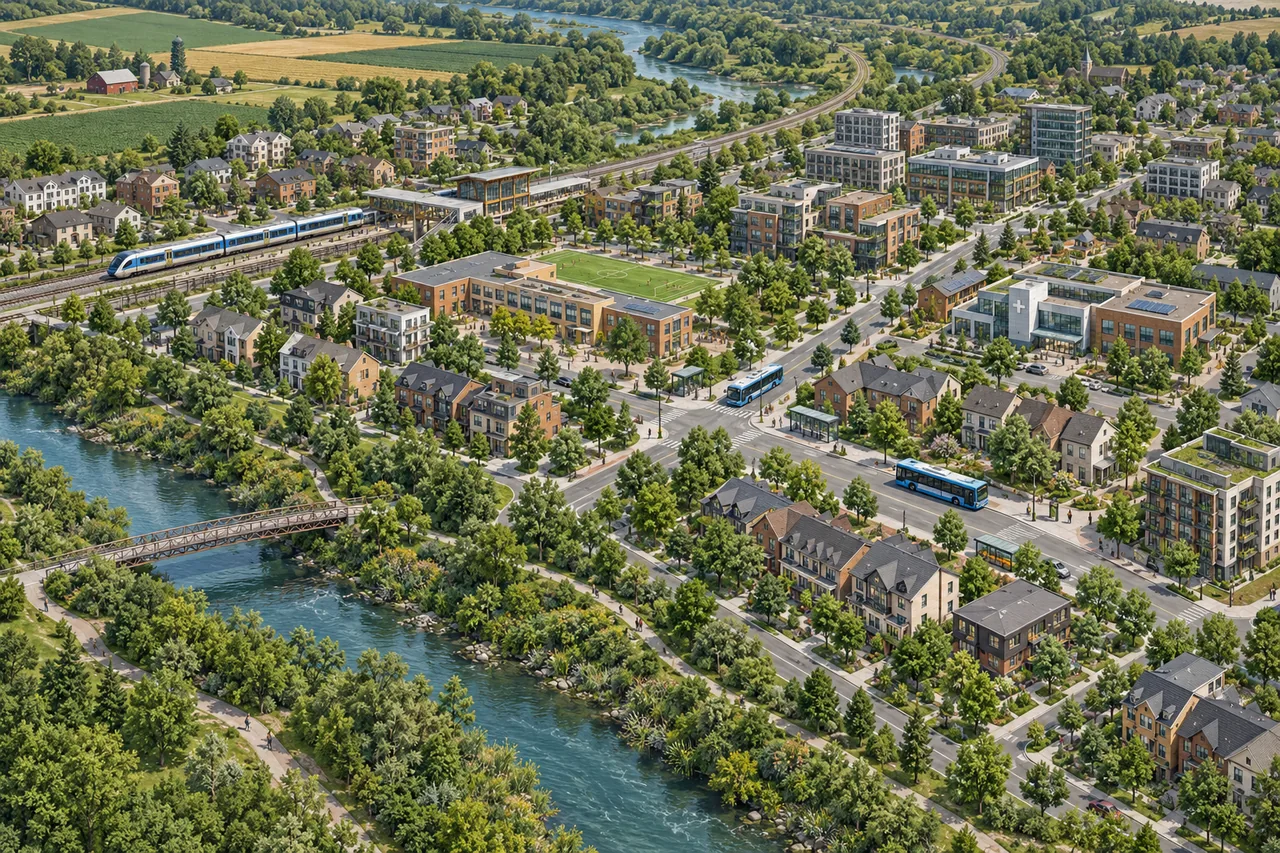
Image: illustration, not a documentary photograph. Original teaching model created for myAudience. · Original generated teaching illustration; no source textbook artwork reproduced.
Compact places, transport and difficult trade-offs
Urban sprawl extends development across a larger area, often increasing travel distances and converting undeveloped land. Compact development can put homes, jobs and services closer together, supporting walking, cycling and public transport. Density alone does not make a place sustainable: overcrowding, poor ventilation, insufficient green space and unaffordable housing can undermine its benefits. Evaluate the quality and distribution of provision as well as buildings per hectare.
Land choices involve competing effects. Reusing previously developed land can reduce pressure on countryside and make use of existing connections. However, contaminated sites may need remediation, and derelict land can contain valuable habitats. Building on undeveloped land can remove agricultural capacity or fragment ecosystems. Compare site conditions and the realistic alternative, rather than treating every brownfield site as harmless and every greenfield site as identical.
The imaginary city illustrates connected rail, buses, walking routes and a green river corridor. These are mechanisms worth investigating, not proof of a measured carbon reduction. Transport emissions per passenger depend on vehicle energy use, fuel source, occupancy and distance. Empty services can perform poorly on a simple per-passenger calculation, yet reliable services may also enable households to avoid car ownership. Consider accessibility and system effects alongside a single journey's emissions.
Conserving water and energy can reduce resource demand, but efficiency is not the same as total reduction. If cheaper heating encourages much more heating, some savings are lost. Compare total consumption before and after adjustment for weather, occupancy and service levels. Green space can support drainage, shade and recreation, yet expensive improvements can also raise rents. A sustainability argument should ask who benefits and who may be displaced.
A defensible plan sets criteria before choosing a project: environmental effects, access, affordability, reliability and long-term maintenance. A proposal can improve one criterion while worsening another. Explain the trade-off and identify evidence that would change the judgement. A named UK regeneration project needs its own verified case evidence; this conceptual comparison does not claim that such a project has been researched or that a generic design suits every city.
Worked example: For a fictional 10 km trip, a bus emits 12 kg of CO2 in operation and a car emits 2 kg. Compare the bus carrying 30 people with the car carrying one, then the bus carrying three.
At 30 passengers, bus emissions are 12 / 30 = 0.4 kg per passenger; the car is 2 kg per passenger.
At three passengers the bus figure is 4 kg per passenger, twice the car figure.
These invented figures exclude vehicle manufacture, routes to stops and wider network effects. They do not establish a universal ranking.
Answer: Occupancy changes the comparison. The bus performs better in the first operational comparison and worse in the second; an overall policy needs broader evidence.
Check your understanding: A building uses less energy per resident but total energy rises. Is that contradictory?
Answer: No. Resident numbers or demand may have increased.
Why: Efficiency is a ratio; total consumption depends on both the ratio and the scale of activity. Report both rather than calling every efficiency gain a total saving.