Food, water and energy share one connected system
By UK GCSE Geography · independent study · myAudience
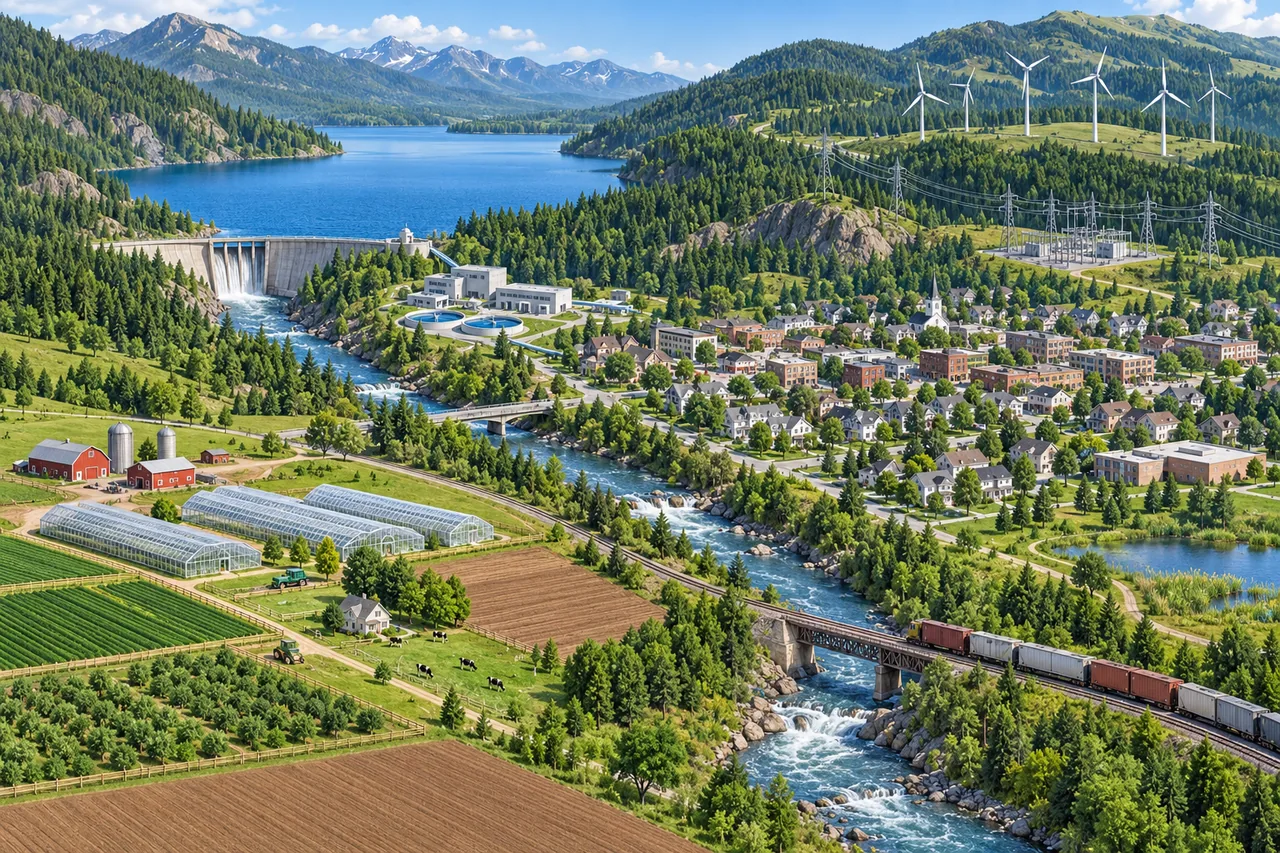
Image: illustration, not a documentary photograph. Original teaching model created for myAudience. · Original generated teaching illustration; no source textbook artwork reproduced.
Food, water and energy share one connected system
Food, water and energy support health and livelihoods, but their production and distribution depend on one another. Farming uses water and energy; pumping, treating and transporting water require energy; energy production can need water or land. A decision that improves one supply may put pressure on another. Thinking in connected systems helps reveal effects that a single-sector calculation overlooks.
The watershed illustration shows a reservoir, settlement, farms and energy infrastructure in an imaginary landscape. It is not an engineering plan or a measured water budget. Follow the physical connections: irrigation may increase crop output but reduce water available downstream; pumping can use electricity; protecting a catchment can support water quality. The size of each effect depends on local conditions, technology and timing, not simply on the presence of a pipe or turbine in the picture.
Supply is not the same as secure access. A region may produce abundant food or power while some households cannot afford it. Reliability, quality, distribution and competing demands all matter. Water withdrawal and water consumption are also different: some withdrawn water returns to the system, though its timing and quality may change. A comparison needs a clear system boundary and consistent units before totals can be added.
Resource choices have trade-offs across space and time. Storing wet-season water may help during dry months, but reservoirs alter river flows and ecosystems. More efficient irrigation can reduce water used per crop, yet expanding the irrigated area can offset savings. Food miles alone do not describe a product's total environmental impact; farming methods, storage, waste and transport mode also matter. Investigate the complete relevant chain rather than treating distance as a universal score.
A balanced decision protects essential needs and examines who bears shortages. Record available supply, demand, losses and any required environmental flow without double-counting the same water. Test dry conditions as well as an average year. This is the compulsory resource-management foundation: detailed optional food, water and energy branches remain distinct choices and are not all claimed as assessed coverage by one general lesson.
Worked example: A fictional catchment receives 80 million cubic metres in a dry year. Proposed human uses total 70 million, and 20 million must remain for an environmental flow. Is the proposal balanced?
With this simplified boundary, combined required allocation is 70 + 20 = 90 million cubic metres.
The shortfall is 90 − 80 = 10 million. Human allocation could be at most 60 million under these assumptions.
Real planning must distinguish withdrawals, return flows, storage changes and timing; these invented annual totals omit them.
Answer: The simplified budget is not balanced. At least 10 million of human demand must be reduced or an additional sustainable supply established; the environmental requirement cannot be silently counted as spare water.
Check your understanding: Efficiency rises while total abstraction rises. Must one measurement be wrong?
Answer: No; the scale of use may have expanded.
Why: Water per unit of output can fall while more units are produced. Compare both total use and efficiency, using the same boundary and period.