A good enquiry can explain what it cannot conclude
By UK GCSE Geography · independent study · myAudience
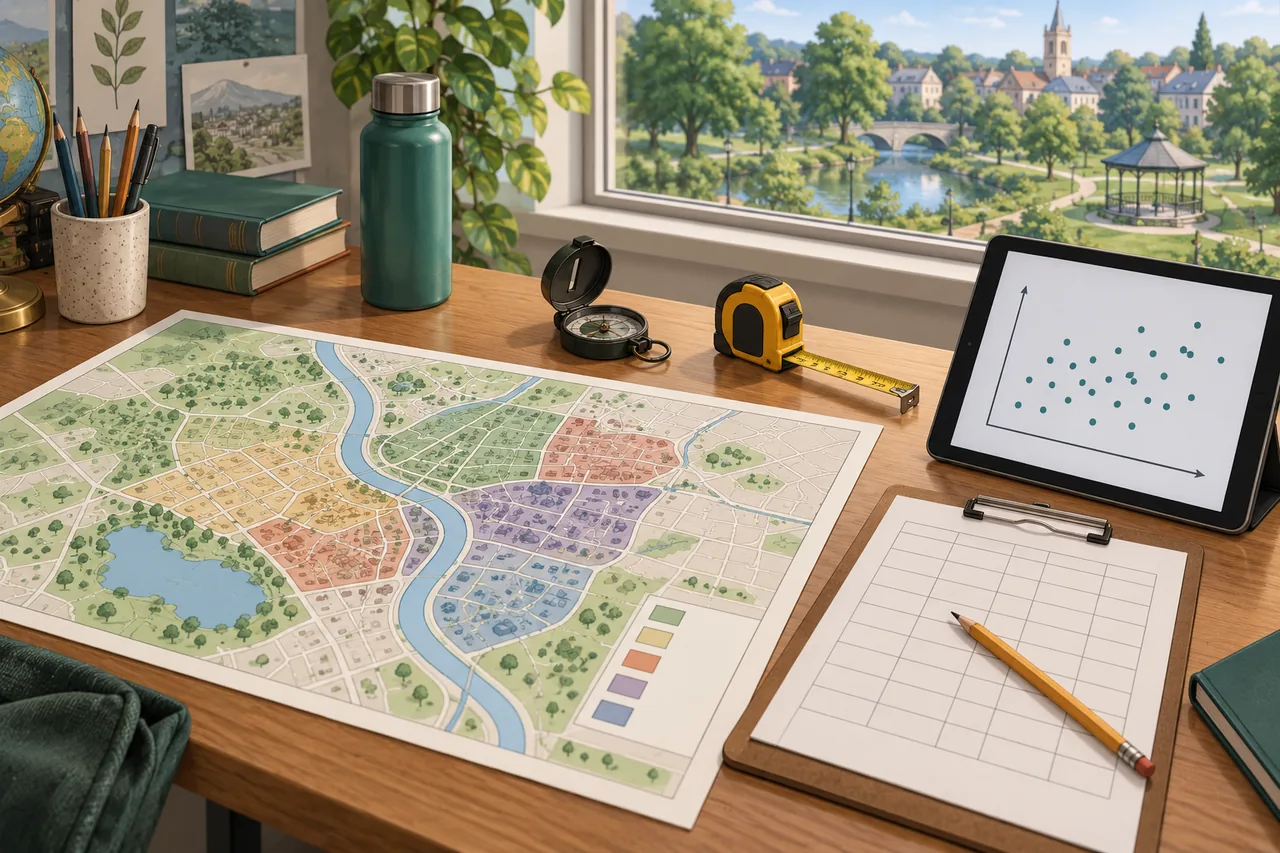
Image: illustration, not a documentary photograph. Original teaching model created for myAudience. · Original generated teaching illustration; no source textbook artwork reproduced.
A good enquiry can explain what it cannot conclude
Start an enquiry with a question that can be investigated and define its terms. "Does access improve near the station?" needs an operational measure: safe walking time to specified services, for example, rather than an undefined impression of access. A hypothesis predicts a relationship that evidence might challenge. Select methods that can test the question, and record why other factors could affect the observations.
A sampling frame defines the units from which observations can be chosen. Random selection gives a defined chance of inclusion; stratification divides the frame into relevant groups before selection within them; systematic sampling uses a fixed interval with an appropriate starting procedure. Convenience sampling is easier but can exclude important groups. More observations from the same biased frame do not necessarily make the result representative.
Reliability concerns consistency, while measurement accuracy concerns closeness to the relevant true value and precision concerns resolution or repeatability in context. Repeating a miscalibrated measurement can yield consistent wrong values. Standardise units and procedures, check instruments and record conditions. Time, weather and special events may affect comparisons. Repeated observations at the same site are not automatically independent evidence about many different places.
The illustration presents an imagined map, blank tally and schematic graph. No fieldwork has been conducted for this lesson. Real investigations need suitable safety arrangements, permission where required and respect for privacy; identifiable personal details are unnecessary for many geographical questions. Combine quantitative observations with carefully collected qualitative accounts when each contributes relevant evidence. Preserve disagreements and limitations instead of selecting only statements that support the hypothesis.
A justified conclusion links claims to the actual observations, evaluates alternative explanations and states the boundary of inference. An association across sites does not establish that one feature caused another. Discuss uncertainty from sampling, measurement and interpretation, then propose a specific improvement targeted at a limitation. Classroom scenarios develop enquiry reasoning but do not replace the examination board's real fieldwork requirements or claim that students have completed them.
Worked example: A hypothetical class counts pedestrians at five sites on four occasions. One pupil calls the 20 counts "20 independent locations proving the station caused more walking". Evaluate and improve the design.
There are five locations and 20 site-time observations, not 20 independent locations. Repeated counts may share site and time influences.
Station proximity could covary with shops, housing density or crossings; an association does not isolate a station effect.
Define comparable periods and units, sample additional matched sites, record relevant conditions and consider repeated before/after data with a defensible comparison.
Answer: The proposed claim overstates both independent spatial coverage and causation. A carefully qualified association may be supported; a causal claim needs stronger design and evidence.
Check your understanding: Would replacing a small convenience sample with a very large convenience sample necessarily remove selection bias?
Answer: No. The same excluded groups can remain excluded.
Why: Improve the frame and selection method, then assess response and measurement issues. Sample size helps some random uncertainty but cannot by itself repair systematic exclusion.