Counting particles without changing the element
By UK A Level Chemistry · independent study · myAudience
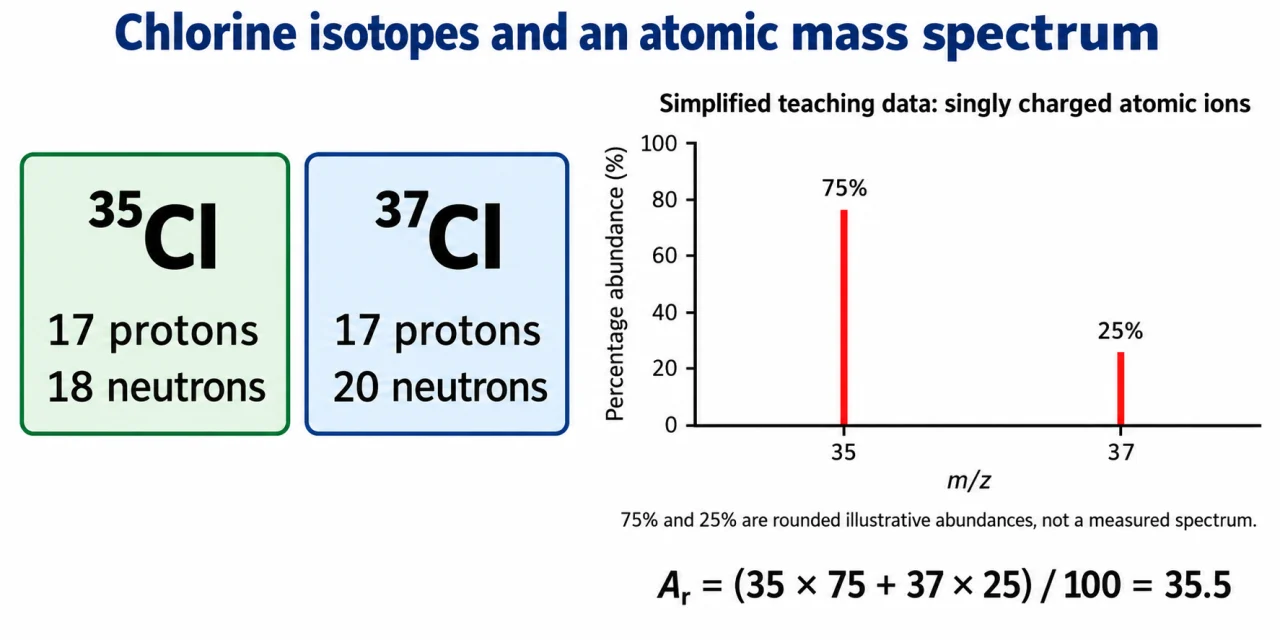
myAudience original teaching illustration. Image: illustration, not a documentary photograph. · Original generated illustration; not an or NIST source figure
Counting particles without changing the element
A chemical symbol identifies an element through its proton number, Z. The nucleus contains protons and neutrons, while electrons occupy the surrounding region. In the usual relative scale a proton has charge +1 and mass about 1, a neutron charge 0 and mass about 1, and an electron charge −1 and mass about 1/1836. Neglecting electron mass in a routine mass-number calculation is an approximation, not a claim that electrons have no mass. Particle counts are constrained by two independent observations: the nuclear identity fixes proton number Z, while the net charge fixes the difference between protons and electrons. For charge q expressed in elementary-charge units, electron count is Z−q; neutron count is A−Z. A negative q therefore adds electrons. Ionisation changes electron count without changing isotope identity. A mass number is a count of nucleons, not an accurate atomic mass in unified atomic mass units.
Mass number A counts protons plus neutrons in one nucleus. It is an integer attached to a particular isotope, unlike the often non-integer relative atomic mass printed on a periodic table. Subtracting Z from A gives the neutron count. Two atoms with the same Z but different A are isotopes: their nuclei differ, although their neutral atoms have the same electron count and broadly similar chemistry. A scattering observation must be matched to what it can actually distinguish. Most alpha particles passing through a foil supports a mostly empty volume on the classical model; a small number of large deflections supports concentrated positive charge and mass. It does not locate individual electrons in circular tracks or establish neutron numbers. An explanation earns more credit by rejecting an overclaim than by attaching every later discovery to one experiment.
An ion has unequal numbers of positive protons and negative electrons. If charge q is expressed in elementary-charge units, the electron count is Z − q. A positive q therefore means electrons have been removed. Ordinary chemical ion formation leaves the proton number unchanged; removing two electrons from magnesium produces magnesium ions, not a different element. A nuclear process would be needed to change the identity fixed by Z. Plate 01 separates the chlorine isotope identity cards from the atomic-ion spectrum. Both isotopes have 17 protons, but neutron numbers differ. There is no atom of mass 35.5 in that two-isotope model: the fractional number belongs to a population mean. The rounded 75:25 abundances are illustrative, whereas the separately sourced NIST composition is closer to 75.76:24.24. Neither is a photograph of an atom.
Atomic models have changed because new observations demanded new explanations. Electron discoveries made indivisible solid atoms inadequate; scattering evidence supported a small concentrated nucleus; quantised energies and quantum theory replaced literal planetary electron orbits. A shell drawing is a useful counting representation, but it does not establish that an electron follows a circular track. Distinguish evidence, explanatory model and convenient drawing when writing an account.
For a symbol carrying A = 34, Z = 16 and charge 2−, the nucleus contains 16 protons and 18 neutrons, with 18 electrons outside it. Check both conservation and meaning: the charge is 16 − 18 = −2. This reverse check prevents the common mistake of subtracting electrons for a negative ion. Describe which particle changes rather than writing the ambiguous phrase 'the atom loses charge'.
Further worked application: For 37Cl− and 35Cl+, calculate all particle counts and explain which quantities a mass spectrum can distinguish. Answer and reasoning: 37Cl− has 17 protons, 20 neutrons and 18 electrons. 35Cl+ has 17 protons, 18 neutrons and 16 electrons. Their isotope masses differ, but TOF records positive ions under the stated mode; it cannot directly compare an anion with a cation as if their acceleration were identical.
Further transfer practice: Question: Explain why large-angle scattering contradicts a diffuse positive-charge model but does not prove electron configurations. Answer and reasoning: A strongly concentrated repulsive field can produce large deflections; electron occupancies concern separate spectral and quantum evidence. Evidence for a nucleus is narrower than evidence for subshell filling. Prior check: Do sulfur-32 and sulfur-34 neutral atoms differ in proton number or neutron number? Answer: Neutron number: 16 and 18 respectively; both have 16 protons. A changes while Z remains 16. Changing Z would change the element.
Image: illustration, not a documentary photograph. The plate is a conceptual teaching representation; its stated nominal-mass, schematic-position or evaluated-data assumptions must be retained.
Worked example: For a synthetic particle-count exercise, find p, n and e for calcium-44 with Z = 20 and charge 2+.
Read Z: 20 protons.
Subtract 44 − 20: 24 neutrons.
Positive charge 2 means 20 − 2 = 18 electrons.
Answer: 20 protons, 24 neutrons, 18 electrons.
Check your understanding: A student says a peak at nominal m/z 37 proves 20 neutrons. Is the claim sufficient?
Answer: Only after identifying the ion as singly charged mononuclear chlorine: 37−17=20. A fragment, different element or different charge state breaks that inference.
Why: A mass-to-charge peak constrains an ion assignment. Neutron count additionally requires a known nuclear proton number, one nucleus and the correct charge state. Test those assumptions before subtracting Z from a nominal mass number.