From flight times to isotope evidence
By UK A Level Chemistry · independent study · myAudience
myAudience original teaching illustration. Image: illustration, not a documentary photograph. · Original generated illustration; not an or NIST source figure
From flight times to isotope evidence
A time-of-flight mass spectrometer separates ions by their travel times under controlled conditions. First a sample is converted into gas-phase ions. Electron impact removes an electron, while electrospray can produce protonated molecular ions; the ionisation method determines what species the signal represents. An electron-impact molecular ion and a protonated molecule do not have the same mass-to-charge value. Read the stated method before interpreting a peak. Treat spectral interpretation as an inverse problem: several species may give the same m/z. First identify the ionisation method, charge state and whether the sample has isolated atoms or molecules. Electron ionisation (often called electron impact in teaching) can be written M(g)+e− → M+•(g)+2e−; one electron is removed and the molecular ion is a radical cation. In the nominal-mass model its m/z for z=1 gives the nominal molecular mass for the specified isotopic composition. This is the usual exam Mr approximation; a monoisotopic peak is not the abundance-weighted relative molecular mass for isotope-rich compounds. Electrospray may instead give [M+H]+, whose nominal m/z is Mr+1. Neither method guarantees an intact parent peak; fragmentation, adducts and overlapping isotope patterns can obscure it.
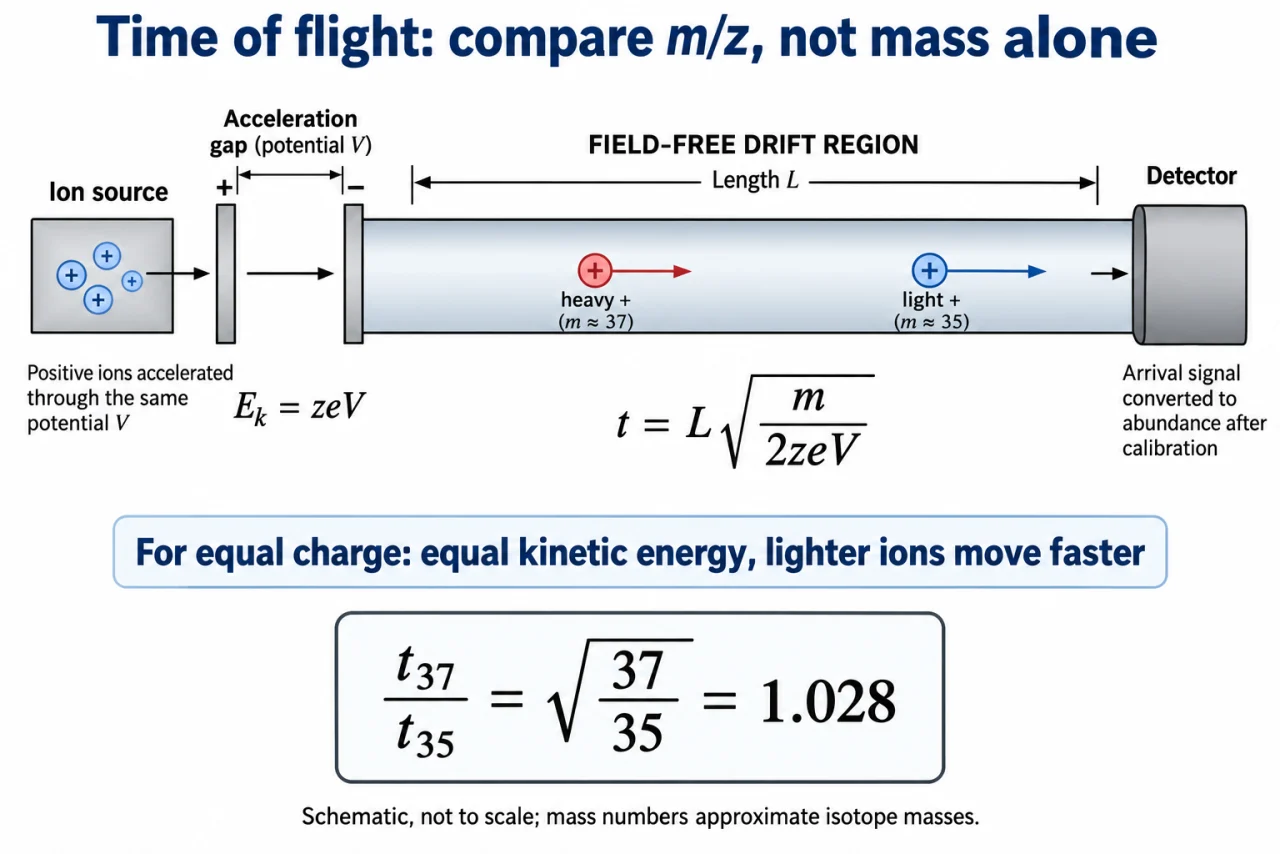
An electric field then accelerates the ions. In the simple model used here, ions of the same charge acquire the same kinetic energy E. Since E = mv²/2, heavier ions have lower speeds. They drift through a field-free region of fixed length L, so t = L/v and t² is proportional to m when E and charge are controlled. The drift region does not continue accelerating the ions. For an identified doubly protonated electrospray ion [M+2H]2+, nominal m/z=(Mr+2)/2, so Mr=2(m/z)−2. This is a stated-ion calculation, not permission to infer charge from a single unexplained peak. Isotope spacing of about 0.5 m/z units can support z=2 if the pattern is resolved. Accurate-mass work must use exact ion/adduct masses rather than substituting integer mass numbers.
At detection, ion arrivals produce an electrical signal. Peak positions indicate mass-to-charge ratio, m/z, and signal sizes provide relative abundance after suitable instrument treatment. For singly charged mononuclear ions, peak positions can be interpreted as relative isotopic masses. A molecular-ion peak can support a relative molecular mass, but a fragment peak is not automatically the parent mass. Charge state, calibration and sample composition are assumptions that deserve stating. Compare two real-element fingerprints using NIST reference compositions: chlorine has principal isotopes 35 and 37, with fractions 0.7576 and 0.2424; magnesium has 24, 25 and 26, with fractions 0.7899, 0.1000 and 0.1101. These are reference abundance patterns converted into teaching stick spectra, not freshly measured instrument records. Unknown atomic-ion data resembling 79:10:11 at 24:25:26 support magnesium within the stated candidate set, but an unrestricted unknown still needs mass calibration and charge confirmation.
Relative atomic mass is a weighted mean, not the average of the labels of two peaks. Multiply each relative isotopic mass by its abundance, add the products and divide by the total abundance. For invented isotope masses 62.0 and 64.0 with abundance 70.0% and 30.0%, the result is 62.6. These are deliberately synthetic data, not an asserted natural composition of an element. Plate 02 makes the TOF assumptions visible. Work zeV becomes kinetic energy, so v=√(2zeV/m), and field-free drift gives t=L√(m/(2zeV)). Here m is in kg, e in C, V in volts, L in m and t in seconds. Only equal charge states have equal energy at equal voltage. An 80 u doubly charged ion and a 40 u singly charged ion have equal m/z and equal ideal drift times; heavier alone does not imply slower.
A useful reasonableness test places the mean between the smallest and largest masses and nearer the more abundant isotope. Spectral axes also matter: if abundances are relative intensities rather than percentages, divide by their sum rather than assuming 100. Do not extend a mononuclear calculation to overlapping molecular patterns without more information. Accurate numerical processing cannot repair an incorrect interpretation of the detected species. Use peak areas or stated abundance measures consistently and normalise by their sum. A base peak of 100 is a reference intensity, not necessarily 100% of all ions. Natural isotope compositions vary, and NIST gives an atomic-weight interval for chlorine rather than an exact universal mean. A weighted mean from a supplied composition describes that modelled sample; apparent precision does not establish natural-sample universality.
Further worked application: Use NIST chlorine masses 34.968852682 and 36.965902602 with fractions 0.7576 and 0.2424. Then interpret synthetic nominal EI M+• at 88, ESI [M+H]+ at 89 and [M+2H]2+ at 45. Answer and reasoning: The chlorine weighted sum is 35.452937582608, reported about 35.453 for these inputs. Using integer mass numbers gives 35.4848, so mass number is not exact isotopic mass. Each stated molecular ion gives nominal Mr=88: 88; 89−1; 2×45−2. The agreement supports consistency of the assignments, not a unique molecular formula.
Further transfer practice: Question: Synthetic 35Cl+ flight time is 10.00 μs. Predict 37Cl+ time at equal energy and decide whether a 0.10 μs timing bound permits separation. Answer and reasoning: 10√(37/35)=10.2817 μs, about 10.28 μs. The central difference is 0.2817 μs; two conservative ±0.10 intervals do not overlap (10.10 versus 10.1817). That simple bound supports distinguishable times, but peak width, calibration and detector resolution are additional instrument limitations. Question: Would a peak at 44 establish Mr=44? Answer and reasoning: Only if identified as a singly charged intact molecular ion in the stated method. It could instead be a fragment, Mr=43 protonated molecule or a multiply charged species. Give the conditional conclusion and request the missing ion assignment. Prior check: Can isotope peaks of intensities 3 and 1 be averaged by dividing the weighted sum by 100? Answer: No; divide by 4. Intensities are relative weights, not already percentages.
Image: illustration, not a documentary photograph. The plate is a conceptual teaching representation; its stated nominal-mass, schematic-position or evaluated-data assumptions must be retained.
Worked example: Singly charged ions of masses 20 and 45 acquire equal kinetic energy and drift the same distance. The lighter ion takes 8.00 μs. Find the heavier flight time.
t is proportional to the square root of mass.
t₂/t₁ = √(45/20) = 1.5.
t₂ = 8.00 × 1.5 μs.
Answer: 12.0 μs.
Check your understanding: Synthetic atomic peaks at 24,25,26 have intensities 790,100,110. Identify the likely element from chlorine/magnesium and calculate a nominal weighted mean.
Answer: Magnesium is supported by the three-peak fingerprint. Normalise by 1000: (24×790+25×100+26×110)/1000=24.32. This uses rounded nominal masses and synthetic counts; a real reference calculation needs exact isotope masses and uncertainty.
Why: The ionisation method and isotope fingerprint support an assignment; normalising the supplied intensities then gives the mean for that stated model. Distinguish rounded counts and mass numbers from evaluated isotope masses.