Orbitals make electron configurations informative
By UK A Level Chemistry · independent study · myAudience
myAudience original teaching illustration. Image: illustration, not a documentary photograph. · Original generated illustration; not an or NIST source figure
Orbitals make electron configurations informative
A shell groups electron states by principal quantum number. Within it, subshells such as s, p and d contain different numbers of orbitals. An orbital is a quantum state represented by a probability distribution, not a track. Each orbital can accommodate at most two electrons with opposite spins. Thus an s subshell holds two electrons, a p subshell six and a d subshell ten. These capacities make a configuration checkable rather than decorative. Use the reference neutral-configuration bank below to practise every Z from 1 through 36. Cover the answer, build the occupancy, total electrons, then name the highest occupied principal shell. Square-bracket cores are abbreviations, not extra electrons. Writing 3d before 4s in the final expression is compatible with the elementary filling sequence; written order alone is not a fixed energy ordering.
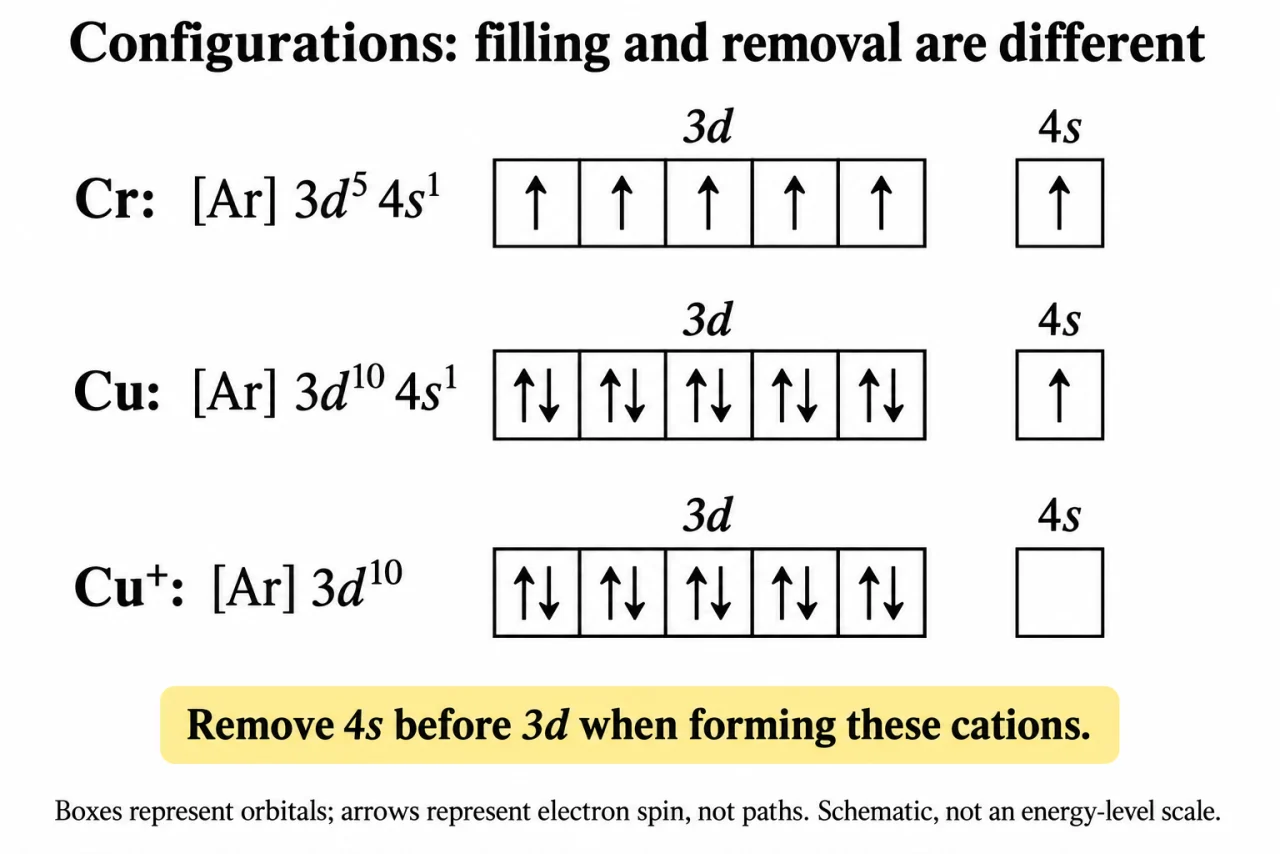
For ground-state neutral atoms through krypton, the usual building order is 1s, 2s, 2p, 3s, 3p, 4s, 3d, 4p. Write superscripts as electron counts, then add them to check Z. Argon is 1s² 2s² 2p⁶ 3s² 3p⁶; its symbol in square brackets can abbreviate that core. Bromine is [Ar] 3d¹⁰ 4s² 4p⁵, giving 18 + 10 + 2 + 5 = 35 electrons. Plate 03 shows the two observed neutral exceptions and Cu+. Chromium has five singly occupied d orbitals and one 4s electron; copper has ten d electrons and one 4s electron. The five boxes represent five orbitals, so ten arrows require opposite-spin pairs, not ten separate d orbitals. Exception explanations based solely on a magic stability slogan are incomplete: actual ground-state occupancies reflect the close subshell energies and electron interactions.
Equal-energy orbitals within a subshell are occupied singly before pairing in the simple ground-state description. Electron repulsion helps explain why pairing arrangements matter. The filling sequence is a useful pattern rather than a universal unchanging energy ladder: chromium is [Ar] 3d⁵ 4s¹ and copper [Ar] 3d¹⁰ 4s¹. Learn these observed exceptions within the specified Z ≤ 36 range instead of mechanically writing 4s² for every neutral atom. For common transition cations remove 4s before 3d. Do not claim this rule describes every highly excited ion or every possible charge state. Neutral-to-ion reasoning has two stages: select the actual neutral configuration, then remove the appropriate outer electrons. Cr3+ is [Ar]3d3, not [Ar]3d1 4s2; Cu2+ is [Ar]3d9, not [Ar]3d8 4s1. Electron totals are necessary checks, but they cannot distinguish every wrong arrangement with the same count.
An ion's configuration must contain the right total number of electrons. Main-group ions often gain or lose outer-shell electrons to reach a filled shell. Transition-metal cations lose 4s electrons before 3d electrons, despite 4s filling first in the elementary neutral-atom sequence. Iron therefore has [Ar] 3d⁶ 4s² as a neutral atom, [Ar] 3d⁶ as Fe²⁺ and [Ar] 3d⁵ as Fe³⁺. Confusing filling order with removal order produces the wrong ion. For p-block anions add electrons to the incomplete outer p subshell before opening a new shell. Se2− has 36 electrons and [Ar]3d10 4s2 4p6; Br− has the same occupancy but a different nucleus. Isoelectronic does not mean chemically identical. A configuration does not specify isotope mass, and it does not license replacing proton number with electron number when identifying the element.
Configuration connects particle counting to chemistry, but an isolated-atom configuration alone is not a complete description of a bond or a material. Treat each representation at its appropriate scale. When checking an answer, inspect capacity, total count and whether the species is neutral or charged. Those three checks are more reliable than memorising a long string without knowing what its symbols mean.
Further worked application: A mystery species has 24 electrons, Z=27 and charge +3. Determine its configuration; then compare with Cr and Fe2+. Answer and reasoning: It is Co3+: neutral Co [Ar]3d7 4s2 loses two 4s and one 3d electrons, giving [Ar]3d6. Fe2+ is also [Ar]3d6; neutral Cr instead is [Ar]3d5 4s1. All three contain 24 electrons, but electron count alone does not fix the occupied subshells.
Further transfer practice: Question: Diagnose [Ar]3d4 4s2 for Fe2+ and [Ar]3d9 4s2 for Cu. Answer and reasoning: The Fe2+ count is 24 but removal order is wrong; use 3d6. The Cu count is 29 but observed neutral occupancy is 3d10 4s1. A count check cannot replace a ground-state check. Prior check: Why is [Ar] 3d⁴ 4s² incorrect for Fe²⁺ even though it totals 24 electrons? Answer: The count is right but the occupied subshells are wrong. The cation loses 4s before 3d; Fe²⁺ is [Ar] 3d⁶.
Image: illustration, not a documentary photograph. The plate is a conceptual teaching representation; its stated nominal-mass, schematic-position or evaluated-data assumptions must be retained. Reference neutral ground states (Z = 1–36): 1 H: 1s^1; 2 He: 1s^2; 3 Li: 1s^2 2s^1; 4 Be: 1s^2 2s^2; 5 B: 1s^2 2s^2 2p^1; 6 C: 1s^2 2s^2 2p^2; 7 N: 1s^2 2s^2 2p^3; 8 O: 1s^2 2s^2 2p^4; 9 F: 1s^2 2s^2 2p^5; 10 Ne: 1s^2 2s^2 2p^6; 11 Na: 1s^2 2s^2 2p^6 3s^1; 12 Mg: 1s^2 2s^2 2p^6 3s^2; 13 Al: 1s^2 2s^2 2p^6 3s^2 3p^1; 14 Si: 1s^2 2s^2 2p^6 3s^2 3p^2; 15 P: 1s^2 2s^2 2p^6 3s^2 3p^3; 16 S: 1s^2 2s^2 2p^6 3s^2 3p^4; 17 Cl: 1s^2 2s^2 2p^6 3s^2 3p^5; 18 Ar: 1s^2 2s^2 2p^6 3s^2 3p^6; 19 K: 1s^2 2s^2 2p^6 3s^2 3p^6 4s^1; 20 Ca: 1s^2 2s^2 2p^6 3s^2 3p^6 4s^2; 21 Sc: 1s^2 2s^2 2p^6 3s^2 3p^6 4s^2 3d^1; 22 Ti: 1s^2 2s^2 2p^6 3s^2 3p^6 4s^2 3d^2; 23 V: 1s^2 2s^2 2p^6 3s^2 3p^6 4s^2 3d^3; 24 Cr: 1s^2 2s^2 2p^6 3s^2 3p^6 4s^1 3d^5; 25 Mn: 1s^2 2s^2 2p^6 3s^2 3p^6 4s^2 3d^5; 26 Fe: 1s^2 2s^2 2p^6 3s^2 3p^6 4s^2 3d^6; 27 Co: 1s^2 2s^2 2p^6 3s^2 3p^6 4s^2 3d^7; 28 Ni: 1s^2 2s^2 2p^6 3s^2 3p^6 4s^2 3d^8; 29 Cu: 1s^2 2s^2 2p^6 3s^2 3p^6 4s^1 3d^10; 30 Zn: 1s^2 2s^2 2p^6 3s^2 3p^6 4s^2 3d^10; 31 Ga: 1s^2 2s^2 2p^6 3s^2 3p^6 4s^2 3d^10 4p^1; 32 Ge: 1s^2 2s^2 2p^6 3s^2 3p^6 4s^2 3d^10 4p^2; 33 As: 1s^2 2s^2 2p^6 3s^2 3p^6 4s^2 3d^10 4p^3; 34 Se: 1s^2 2s^2 2p^6 3s^2 3p^6 4s^2 3d^10 4p^4; 35 Br: 1s^2 2s^2 2p^6 3s^2 3p^6 4s^2 3d^10 4p^5; 36 Kr: 1s^2 2s^2 2p^6 3s^2 3p^6 4s^2 3d^10 4p^6.
Worked example: Write the ground-state configuration of Zn²⁺, given Z = 30.
Neutral Zn is [Ar] 3d¹⁰ 4s².
Remove the two 4s electrons.
18 + 10 = 28 electrons, matching 30 − 2.
Answer: [Ar] 3d¹⁰.
Check your understanding: Write and justify Sc3+, V2+, Mn2+, Ni2+, Cu+, Cu2+, Zn2+, As3− and Kr.
Answer: Answers are [Ar]; [Ar]3d3; [Ar]3d5; [Ar]3d8; [Ar]3d10; [Ar]3d9; [Ar]3d10; [Ar]3d10 4s2 4p6; and the same krypton occupancy. Check Z−q for each, remove 4s first for the listed transition cations, and fill 4p for As3−.
Why: Electron total and ground-state occupancy are separate constraints. Reconstruct each neutral species, apply its charge, check subshell capacities and compare removal or filling order rather than counting electrons alone.