Ionisation energies reveal shells and subshells
By UK A Level Chemistry · independent study · myAudience
myAudience original teaching illustration. Image: illustration, not a documentary photograph. · Original generated illustration; not an or NIST source figure
Ionisation energies reveal shells and subshells
First ionisation energy is the energy required to remove one mole of electrons from one mole of gaseous atoms to make one mole of gaseous singly positive ions. The equation X(g) → X⁺(g) + e⁻ describes one representative event; the measured molar energy scales this up. Gas-state symbols ensure that the quantity concerns separated particles rather than melting, vaporising or breaking bonds in a solid. Its usual unit is kJ mol⁻¹ and the change is endothermic. The reference ionisation dataset below keeps evaluated NIST ASD v5.12 energies in eV per particle and selected source uncertainty/qualification marks. Conversion to kJ mol−1 multiplies by eNA/1000=96.4853321233 approximately. An eV is energy, not a potential difference by itself. These are evaluated atomic data, not synthetic observations or a learner experiment. NIST square brackets flag semi-empirical estimates based on experimental information; parentheses flag calculated values or values not derived from evaluated experimental data. Those marks must not be silently relabelled direct measurements.
A second ionisation removes an electron from X⁺(g), so the equation is X⁺(g) → X²⁺(g) + e⁻. It does not begin with another neutral atom. Successive ionisation generally requires more energy as positive charge rises. A very large jump marks removal from an inner shell after the outer electrons have been removed. A jump after the second removal supports two outer electrons in a main-group atom; it does not by itself uniquely name the element. Compare the first Period 3 energies before explaining them. Na→Mg rises from 5.13907696 to 7.646236 eV, but Al falls to 5.985769. Mg loses 3s while Al loses 3p; the latter is higher in energy and less penetrating in the same shell. P at 10.486686 exceeds S at 10.3600167 despite S having greater nuclear charge. Pairing in a 3p orbital increases repulsion in S. Similar core shielding, increasing nuclear charge and shrinking radius explain the broad rise; the two local decreases test subshell and pairing explanations.
Across Period 3, first ionisation energy generally rises as nuclear charge increases while electrons enter the same principal shell. Similar inner-shell shielding and decreasing size strengthen attraction. The aluminium value is below magnesium's because the removed electron occupies the higher-energy 3p subshell rather than 3s. This local fall is evidence that a shell contains subshells; a statement that nuclear charge decreases would be false. Now examine successive energies across all Na–Ar, stopping just after their n=3 electrons are removed. The major shell boundary is after removal 1 in Na, 2 in Mg, 3 in Al, through 8 in Ar. Earlier increases within a shell do not all represent new shells: Si rises from 16.34585 to 33.49300 eV when 3p removal gives way to 3s removal, before the larger jump from 45.14179 to 166.767 eV at the n=3/n=2 boundary. Infer structure using the whole sequence and configurations, rather than an arbitrary universal jump threshold.
Sulfur has a lower first ionisation energy than phosphorus. In the simple configuration picture, sulfur has a paired 3p electron whose repulsion makes removal easier, whereas phosphorus has three singly occupied 3p orbitals. State the subshell and pairing mechanism. Merely saying 'sulfur is less stable' leaves the explanatory work undone. A broad trend and local exceptions can both be correct because several influences act together. For Be, Mg, Ca, Sr and Ba, first/second/third energies in the bank all show a major change after two removals. Their first energies decrease from 9.322699 to 5.2116646 eV down the group. Added occupied shells increase separation and shielding; these effects outweigh the increased proton number. The third energies also decrease across these examples, but they start from different closed-shell cores. They are not all removal of a 2p electron.
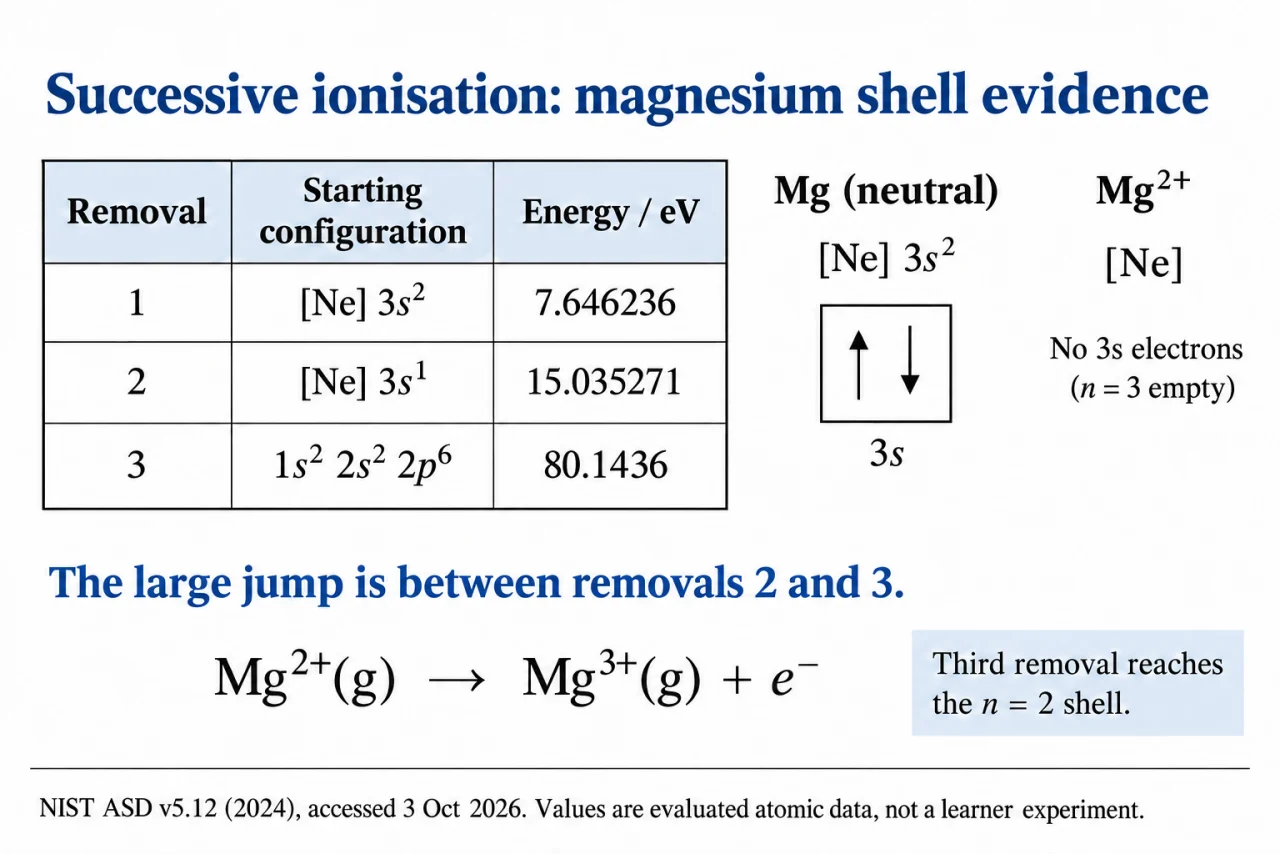
Down Group 2 from beryllium to barium, increased shell size and shielding generally outweigh increased nuclear charge, lowering first ionisation energy. Successive-energy patterns retain evidence for two outer electrons. In an explanation, link the evidence to distance, shielding and attraction before stating the consequence for removal energy. Quantitative values and unusual deviations need data; the qualitative model should not be presented as a calculation of actual energies. Plate 04 separates the starting species for each magnesium removal. After two electrons are removed, Mg2+ has a neon-like core; the third step starts at Mg2+, not Mg or Mg3+. Its 80.1436 eV compared with the second 15.035271 eV is shell evidence. NIST uncertainties are far smaller than that difference. This supports the interpretation strongly, without claiming that a simple shielding sketch numerically predicts exact energies.
Further worked application: Compute magnesium second and third energies in kJ mol−1 and their ratio. Compare the location of the Al and Si shell jumps. Answer and reasoning: Mg gives about 1450.7 and 7732.7 kJ mol−1; ratio 80.1436/15.035271=5.3304. Al has its shell jump between IE3=28.447642 and IE4=119.9924 eV, whereas Si has it between IE4=45.14179 and IE5=166.767 eV. The inferred outer counts are three and four; write Al3+(g)→Al4+(g)+e− and Si4+(g)→Si5+(g)+e−.
Further transfer practice: Question: A first-energy plot hides the Mg/Al dip because its y-axis begins at 1000 kJ mol−1. Evaluate the plot. Answer and reasoning: The truncation excludes both relevant values rather than providing full evidence. Use all points, label units and explain any truncation. Precision or a visually rising line cannot rescue missing points; replot and test both exceptions. Question: Can a large jump after the second removal uniquely identify magnesium? Answer and reasoning: No. It supports two outer electrons in a main-group interpretation; all the Group 2 examples have that pattern. Element identification needs additional quantitative values or nuclear/isotope evidence. Prior check: Write the third ionisation equation for Mg. Answer: Mg²⁺(g) → Mg³⁺(g) + e⁻. Successive removal begins with the ion formed in the previous step, retaining gas-state symbols.
Image: illustration, not a documentary photograph. The plate is a conceptual teaching representation; its stated nominal-mass, schematic-position or evaluated-data assumptions must be retained. NIST reference successive energies in eV per particle, each followed by its source uncertainty: Na: 5.13907696 ± 2.5e-07, 47.28636 ± 0.00025; Mg: 7.646236 ± 4e-06, 15.035271 ± 6e-06, 80.1436 ± 0.0006; Al: 5.985769 ± 3e-06, 18.82855 ± 5e-05, 28.447642 ± 2.5e-05, 119.9924 ± 0.0019; Si: 8.15168 ± 3e-05, 16.34585 ± 4e-05, 33.493 ± 9e-05, 45.14179 ± 7e-05, 166.767 ± 0.003; P: 10.486686 ± 1.5e-05, [19.76949] ± 4e-05, 30.20264 ± 9e-05, 51.44387 ± 0.00012, 65.02511 ± 0.00012, [220.43] ± 0.005; S: 10.3600167 ± 1.4e-06, 23.33788 ± 0.00025, [34.86] ± 0.04, [47.222] ± 0.012, 72.5945 ± 0.0004, 88.0529 ± 0.0004, 280.954 ± 0.007; Cl: 12.967633 ± 1.6e-05, 23.81364 ± 0.00012, [39.8] ± 0.11, [53.24] ± 0.12, [67.68] ± 0.1, [96.94] ± 0.04, 114.2013 ± 0.0006, 348.306 ± 0.007; Ar: 15.7596119 ± 5e-07, 27.62967 ± 0.00012, [40.735] ± 0.012, [59.58] ± 0.18, [74.84] ± 0.17, 91.29 ± 0.01, [124.41] ± 0.06, [143.4567] ± 0.0012, [422.6] ± 0.06; Be: 9.322699 ± 7e-06, 18.21115 ± 4e-05, (153.896205) ± 4e-06; Ca: 6.113154921 ± 5e-10, 11.871719 ± 4e-06, 50.91316 ± 0.00025; Sr: 5.69486745 ± 1.2e-07, 11.0302765 ± 2.5e-06, 42.88353 ± 0.00019; Ba: 5.2116646 ± 1.2e-06, 10.003826 ± 1.2e-05, 35.8438 ± 0.0025. Square brackets and parentheses retain the qualifications explained above, not statistical confidence intervals.
Worked example: Synthetic successive ionisation energies are 600, 1200, 7800 and 10500 kJ mol⁻¹. What outer-electron inference is justified?
Compare neighbouring changes rather than just the largest value.
The major jump occurs between the second and third removals.
Removal three reaches a more tightly bound inner shell.
Answer: A main-group interpretation suggests two outer-shell electrons; the element is not uniquely identified.
Check your understanding: Use all five Group 2 triplets to reject the statement that the third ionisation always removes 2p.
Answer: The major jump after two supports ns2 valence occupancy in each. Be2+ begins 1s2, Mg2+ begins [Ne], Ca2+ [Ar], Sr2+ [Kr], Ba2+ [Xe]. The third removal is from n=1,2,3,4,5 respectively, so only Mg fits 2p.
Why: Ionisation number identifies which electron is removed from the preceding gaseous ion. The core configuration changes down Group2, so a shared two-electron valence pattern cannot identify the same inner subshell in every element.