Lisbon at Belém: a riverfront that changed
By Places and their stories · myAudience
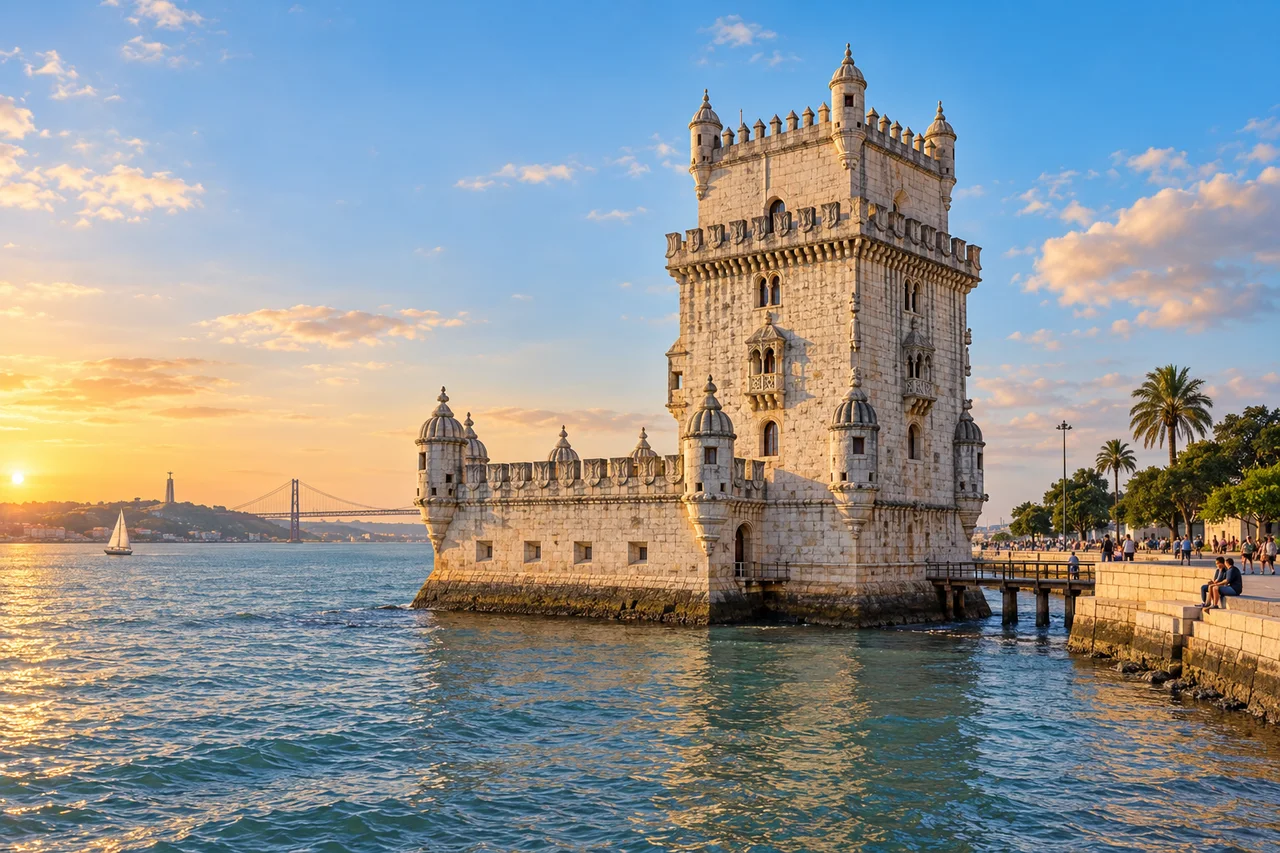
myAudience · original generated illustration · Original generated illustration; interpreted setting, not documentary evidence, current conditions or an authenticated viewpoint.
At Belém, the Tagus links a pair of monuments to Lisbon's maritime history. The UNESCO property includes the Jerónimos monastery and the Tower of Belém, rather than every part of the city. The monastery is a royal foundation associated with Manuel I; its richly worked stone belongs to the Manueline tradition. A place can be understood through building detail and through the larger networks that helped finance and use it.
The tower combined commemorative and defensive meanings. Looking at its form, distinguish the raised tower from the low bastion facing the river. The site also illustrates why a monument's setting should not be assumed constant: UNESCO records surrounding change from landfill and sediment accumulation in the Tagus. A modern shore view cannot simply be relabelled as the tower's original sixteenth-century position.
Lisbon's museum education programme includes a walk concerned with the city's less visible places of slavery. That invites a useful companion question to celebratory accounts of maritime expansion: whose experience is missing from the monument? Admiring skilled stonework does not oblige a reader to assume that trade and overseas power benefited everyone equally. Specific claims about a person, voyage or institution still require specific historical evidence.
In the illustration, notice how a low water-facing platform and a tall lookout create two different relationships with the river. What can you infer about visibility and approach, and what remains uncertain? The geometry suggests a way to ask questions, but it cannot tell you where guns stood, measure defensive ranges or authenticate carved motifs. Our modern riverfront scene is interpreted, with no reconstructed ancient island or navigational route.
Belém is one opening into Lisbon, not a complete account of its neighbourhoods. Follow monument staff and current official visitor guidance, give riverfront paths room for everyday users and do not treat quiet entrances as permission to enter. Source notes explain the reading's basis; the illustration provides neither current opening times nor an access or safety assessment.
Image: illustration, not a documentary photograph.
Further reading
At Belém, start with two different questions: what survives, and what did it mean to the people who commissioned or used it? The monastery and tower belong to the same designated property, but they were not interchangeable buildings. Royal patronage, religious service and the defence of a harbour connected them to a wider maritime world. A monument is evidence of decisions about resources and authority; its impressive appearance does not establish that those decisions benefited everyone equally.
The monastery's carved stone asks us to look at skilled work as well as royal ambition. Someone had to design, cut, assemble and maintain that fabric. Decoration communicates importance, while rooms and circulation also serve particular activities. These are complementary ways of reading a building. Nevertheless, an ornate surface cannot identify the wages or circumstances of its makers. For those questions, an account needs records of work and patronage, rather than a confident story invented from the carving.
The tower and its low bastion illustrate how one complex can address different relationships with water. Height provides a wider outlook; a low platform has a different position relative to approaching vessels. That is a qualitative comparison, not a calculation of defensive effectiveness. The illustration cannot reveal original armaments, their ranges or where an attacker would have sailed. Those claims would require dated plans and evidence about the site's actual equipment and river conditions.
Even a building that remains in place can acquire a different setting. UNESCO records alteration around the tower through silting and landfill. Sediment accumulation and deliberately added ground are different processes, though both may change a shoreline. Comparing a historic plan with a modern one would therefore require matching dates, scale and reference points. Finding water in both images would not prove an unchanged position relative to the shore; a small visual similarity can hide a large spatial change.
A fuller maritime history must also make room for experiences that celebratory monuments leave difficult to see. The Museu de Lisboa's dated 2025 programme included walks about places associated with slavery and African histories. This supports a precise claim about that educational programme, not a claim that any particular carving depicts an enslaved person. The productive question is which additional records and accounts illuminate coercion, work and life beyond royal commemoration. Learning those histories enriches interpretation without treating beauty as moral proof.
Read the existing image as a contemporary interpreted riverfront scene. The square tower rises above a low water-facing platform, while an accessible-looking promenade lies beside it. Those pictured relationships help frame questions about outlook, movement and the separation of visitors from the water. Exact decorative details and the distant bridge are not authenticated by the rendering. In particular, its shore connection is no warrant for reconstructing the tower's original setting or treating the invented figures as documentary evidence.
Consider a fictional proposal to add a large visitor shelter beside the monument. Its supporters point to comfort and accessible waiting space; opponents worry about obscuring river-facing views. A reasoned evaluation would ask for sightline drawings, accessibility evidence, reversible design options and accounts from everyday users. It would distinguish damage to original fabric from effects on the wider setting. Neither 'more facilities are always better' nor 'all change is destruction' adequately examines the actual design and its alternatives.
Try this transfer: a caption claims that the picture proves the tower has always stood beside today's promenade and that maritime wealth was shared fairly. Explain what is wrong and propose a stronger caption. Answer: the scene supports a qualitative comparison of tower, platform and present-day public space, but it establishes neither historical shoreline continuity nor distribution of wealth. A stronger caption identifies the illustration as interpreted, uses dated mapping to investigate the shoreline and directs the social question toward historical records and the museum's documented educational work. Good reasoning separates an observation, an inference and a claim requiring further evidence.
Author source references
- UNESCO: Monastery of the Hieronymites and Tower of Belém — foundation, form and changed river setting
- Lisbon municipal DESCOLA: Museu de Lisboa educational programme — includes slavery-history walk
- UNESCO: Monastery of the Hieronymites and Tower of Belém — foundation, form and changed river setting
- Further reading reference