Marrakesh: heritage also needs a voice
By Places and their stories · myAudience
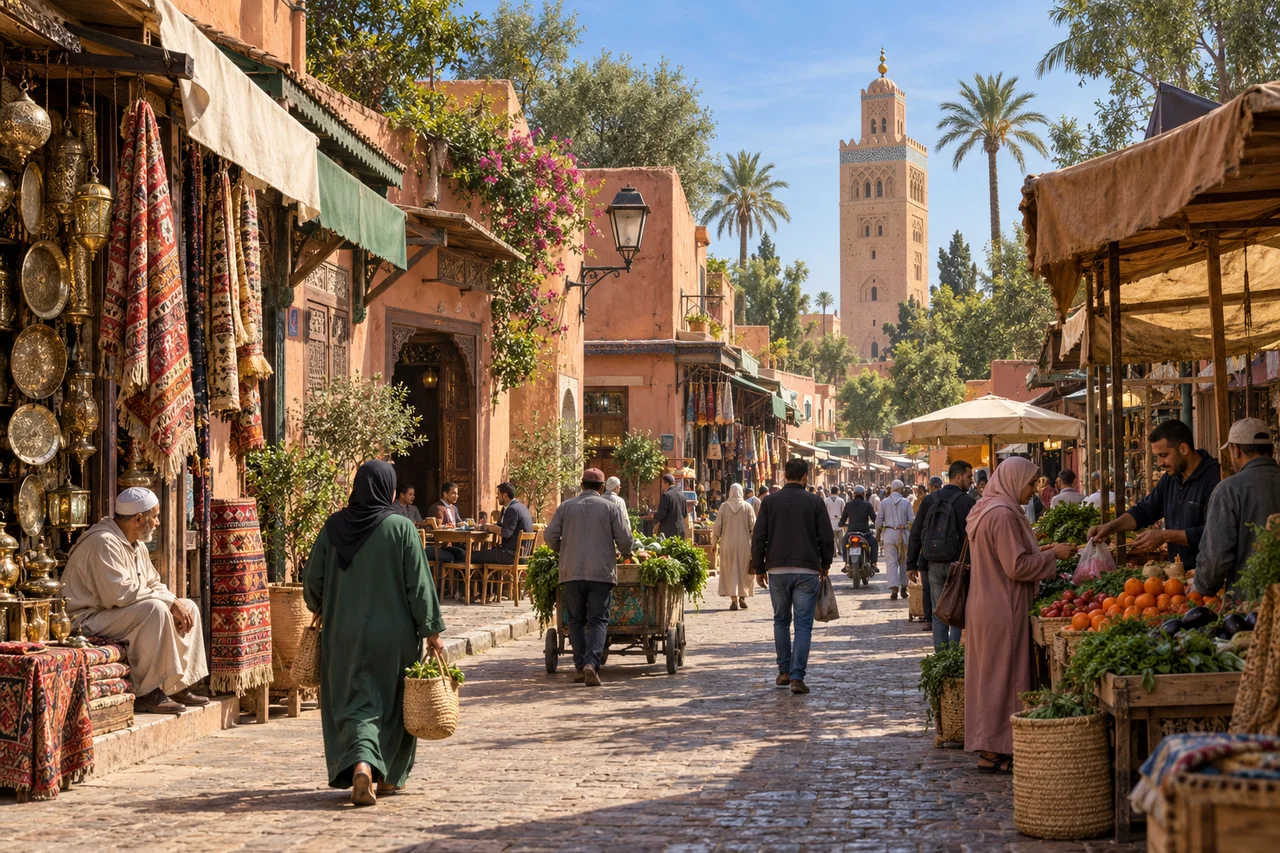
myAudience · original generated illustration · Original generated illustration; interpreted setting, not documentary evidence, current conditions or an authenticated viewpoint.
Marrakesh's medina combines monuments with the tightly woven spaces of everyday work. Founded under the Almoravids in the eleventh century and later an Almohad capital, the city developed through several periods. The Koutoubia minaret, walls, gardens, homes and places of commerce belong in the same account. A surviving historic district is more than a collection of palace interiors.
A market lane reveals a different scale of organisation: small frontages, movement between shops and houses, covered or shaded spaces, and the work of craft and trade. UNESCO's heritage description includes these living urban qualities. A tower can help orient a skyline, but it cannot by itself explain the many ordinary connections that make a neighbourhood function.
Jemaa el-Fna is also recognised through UNESCO's intangible cultural heritage framework. Its significance includes oral and musical traditions, exchange and performance, not only the paving and surrounding buildings. Those practices depend on people learning, adapting and participating. A conservation project that retained the shape of a square but displaced all its social uses would raise a very different question from one that supported its cultural life.
Compare tangible and intangible heritage in the illustration. Stone, plaster and a minaret can be pictured; a storyteller's timing, language or relationship with listeners cannot be recovered from an invented still image. What further evidence would help? A respectful account from practitioners is more useful than guessing a tradition from clothing. This market composition is not a record of a particular day's performers or a measured Jemaa el-Fna layout.
Treat shops as workplaces and religious buildings as places with their own expectations. Ask before photographing people, and agree openly before paying for a service rather than assuming a scene exists for a visitor's camera. Current access and local rules require official information. No medical, fortune-telling or animal-performance claim is endorsed by this reading.
Image: illustration, not a documentary photograph.
Further reading
A medina is not simply a museum whose exhibits happen to be buildings. Its lanes connect homes, shops, workshops and public spaces; those relationships help explain why a historic district can remain meaningful through everyday use. Marrakesh also contains buildings from different periods. Reading the whole district as the achievement of a single dynasty erases the changes through which it developed. A strong account keeps the scale of a monument, a neighbourhood and a city's longer history distinct.
Begin with the difference between retaining a structure and sustaining a practice. A gate can remain standing while the activities around it change; a craft can continue while its tools or location adapt. UNESCO's account of the medina considers both built fabric and living urban qualities. This does not mean that any alteration is harmless. It means a conservation question should identify what is being protected and how people depend on it, instead of assuming a tidy exterior tells the whole story.
Oral performance adds another dimension. In a UNESCO Courier essay, Juan Goytisolo describes a storyteller and listeners sharing a setting, with voice, rhythm and gesture contributing to meaning. Read that as an attributed historical reflection, published on the website in 2017 and linked to its December 2000 issue, rather than a census of today's performers. It explains why a transcript or a still picture leaves things out: a performance involves relationships and responses that its words alone do not exhaust.
Imagine an original short story told once to a group who knows a local reference and once to people who do not. The second telling may need an explanation, a different pause or a changed example. Adaptation can help communication rather than automatically invalidate a tradition. The important distinction is between practitioners making choices within their practice and an outsider imposing a supposedly authentic script. Our fictional example illustrates that distinction; it makes no claim to reproduce a named Marrakesh tale or performance.
Materials and skilled maintenance matter alongside social life. A repair that looks convincing from a distance may differ in how it behaves, or in whether it preserves earlier workmanship. Equally, treating every trace of use as damage can misunderstand a living place. To evaluate a real intervention, ask what original fabric remains, what was replaced, how the decision was documented and whose expertise informed it. The historical heritage description is a starting point; it is not a present-day engineering specification or permission to undertake repairs.
In the composite market illustration, awnings, small frontages and people moving through a lane invite questions about shade, access and work. The minaret provides a skyline reference, but it cannot identify the lane as a particular square. None of the fictional figures certifies a person's occupation, religious belief or cultural practice. The main image and smaller versions preserve these broad visual relationships; the small thumbnail is for recognition, not close inspection of invented decorative details.
Consider a fictional plan that preserves a square's paving while removing all informal gatherings to create an unobstructed visitor photograph. It could improve one kind of circulation yet undermine the social uses that make the place significant. A better evaluation would involve users and practitioners, test accessible movement at different times and consider a less disruptive layout. Counting clean paving stones is not a sufficient measure of conservation success. Nor should popularity alone decide whether everyone's access and livelihood have been respected.
Transfer question: what evidence would help judge the claim 'the square is fully preserved because every surrounding façade is repaired'? Answer: records of fabric and repairs could support the architectural part, but observation over time and accounts from practitioners would be needed for living use and transmission. A photograph cannot establish whether a performance is understood, learned or freely maintained. The conclusion should therefore be conditional and specific: the repair may conserve façades, while the broader cultural claim remains unproven. This distinction protects both careful material conservation and the people whose practices cannot be reduced to a picture.