Prague: a bridge connects more than two banks
By Places and their stories · myAudience
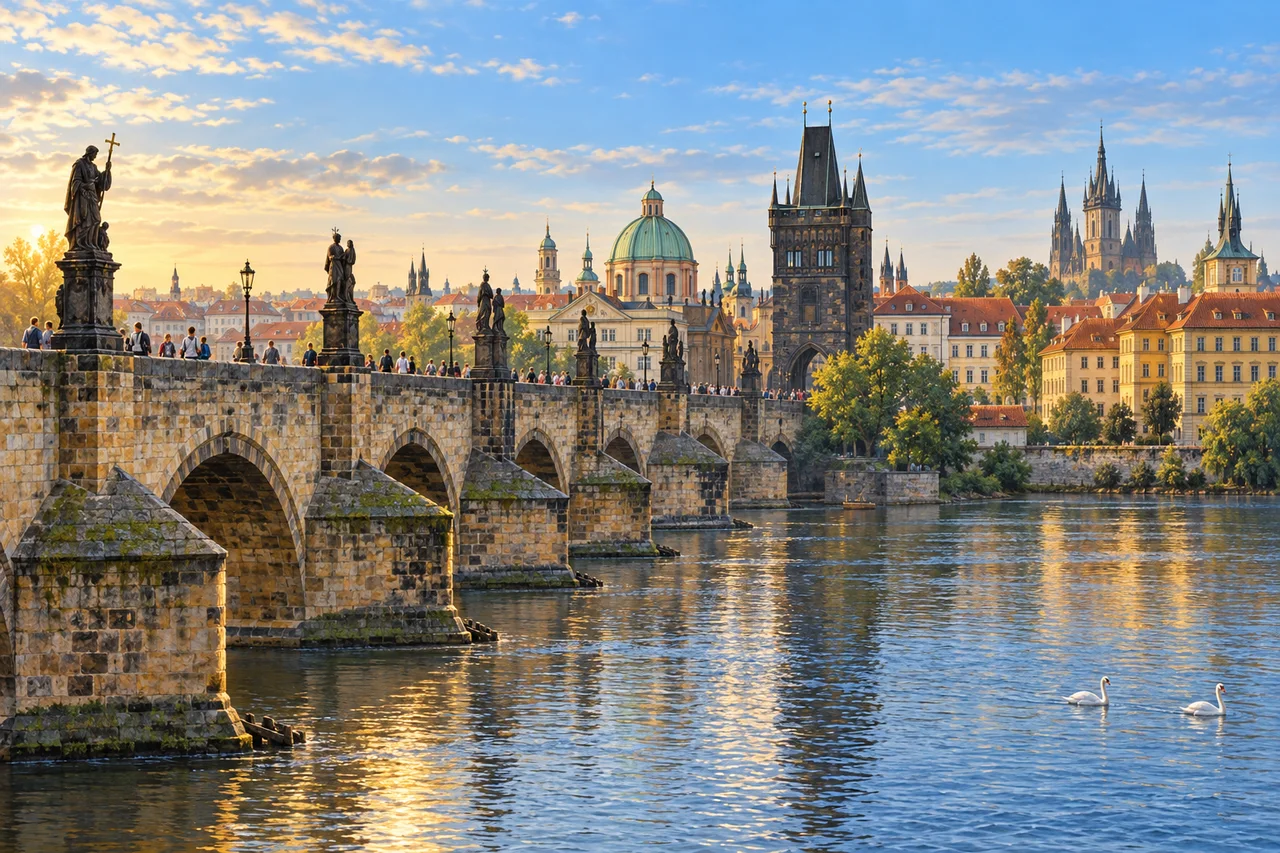
myAudience · original generated illustration · Original generated illustration; interpreted setting, not documentary evidence, current conditions or an authenticated viewpoint.
Prague's historic centre preserves the meeting of river crossings, neighbourhoods and successive architectural periods. The Vltava gives the city a strong organising line, but the old streets are not a single uniform medieval design. Gothic, Baroque and later buildings contribute different layers. Looking at their relationships is often more revealing than collecting a list of famous facades.
Charles Bridge connects the Old Town and Lesser Town. Prague's municipal account distinguishes its medieval stone structure from sculptures added in later centuries. A bridge can therefore carry several kinds of history at once: the engineering of the crossing, changes in decoration and the ordinary journeys it makes possible. A modern silhouette is not proof that every visible feature was present when work began.
The World Heritage property also includes Průhonice Park outside the historic centre. That matters when interpreting a designation: a named property can have separate components, and its boundary does not cover everything in the city or region. The park's designed landscape raises another question about heritage: how do living plants, changing seasons and continuing care differ from the maintenance of a stone facade?
In the illustration, compare the broad stone arches with the vertical tower silhouettes and repeated statues. The bridge directs movement across water; the towers make distant places recognisable. Imagine removing the statues while retaining the crossing. Which function remains, and which layer of meaning changes? The image is a composite interpretation, not a reliable count of arches, an authenticated statue inventory or a survey of the city's skyline.
A bridge is public space as well as a landmark. Leave room for other people to cross and do not treat a parapet or statue base as a viewing platform. Respect places of worship and residents' entrances beyond the principal visitor routes. The city cannot be understood from this one image: source notes provide historical context, while current official information is needed for access, repair work and visiting arrangements.
Image: illustration, not a documentary photograph.
Further reading
Prague's historic centre rewards a different kind of attention from a search for one perfectly preserved medieval scene. Buildings, streets and plots record developments across periods. The designated property also includes Průhonice Park, so its meaning cannot be reduced to the bridge in our illustration. Begin by distinguishing the scope of a heritage designation from the portion visible in a picture. A well-known landmark can open a story without defining its entire subject.
The city can preserve aspects of spatial organisation while individual structures change. A street line or plot boundary may endure through alterations to the buildings beside it. Conversely, an old-looking façade does not prove an unchanged plan behind it. This distinction helps explain how architectural layers can coexist in a functioning city. It also prevents the false choice between 'entirely original' and 'worthless reconstruction': historical value depends on which qualities survive and how the changes are understood.
The municipal bridge account connects Charles Bridge with the Old Town and Lesser Town and distinguishes it from its predecessor. It also separates the bridge's history from the later periods of its sculptural decoration. Those distinctions matter more here than repeating picturesque foundation legends. A bridge can connect everyday journeys, political centres and ceremonial movement, but determining their relative importance at a given time requires evidence. An attractive crossing alone cannot tell us how many people used it or why.
Conservation involves the larger view as well as individual stonework. UNESCO's account discusses pressure on the roofscape and the scale of new development. This provides a useful question about cumulative effects: one change that seems minor in isolation may alter the relationship between buildings when repeated. The historical management text is not a current planning permission or a statement about a specific proposed project. Any actual intervention requires current records and the responsible authorities' assessment.
Work through a fictional evidence table. A dated plan shows a lane in the same position as today; a repair record identifies replaced roof material; an undated sketch shows a window that cannot be located confidently. The first supports continuity of that mapped alignment, not every building; the second supports a material change, not necessarily a change in overall form; the third remains uncertain. Keeping those conclusions separate is stronger than combining all three into the sweeping claim that the district never changed.
The reused illustration offers stone arches, projecting pier shapes, sculptural figures and a layered skyline. These support qualitative questions about repetition, crossing and framing a view. They do not authenticate every statue or reproduce a measured set of spans. The small images preserve the crossing's relationship to water, while only the larger image supports closer observation of pictured surfaces. Even there, an invented surface must not be substituted for a condition survey or a record of original material.
Imagine a fictional rooftop extension that provides much-needed usable space but changes the visible silhouette of a street. A balanced account would compare its design, reversibility and practical benefit with effects on established views and neighbouring buildings. Alternatives might reduce the visual effect without eliminating the space entirely. The argument should not assume that residents' needs and heritage are inherently enemies. A useful judgement explains which evidence matters and how competing values would be weighed.
Transfer task: evaluate 'all the visible bridge statues must be medieval because the bridge is medieval'. Answer: the age of a structure does not establish the age of every addition, and the municipal account explicitly distinguishes later sculpture. A defensible reading identifies the bridge's layered history and asks for dates or records for particular figures. It also rejects authentication by generated appearance. Apply the same reasoning elsewhere: an old district can contain later repairs, additions and uses without losing every connection to its past. The quality of the account lies in making those connections specific.