Luang Prabang: a town shaped by rivers and daily life
By Places and their stories · myAudience
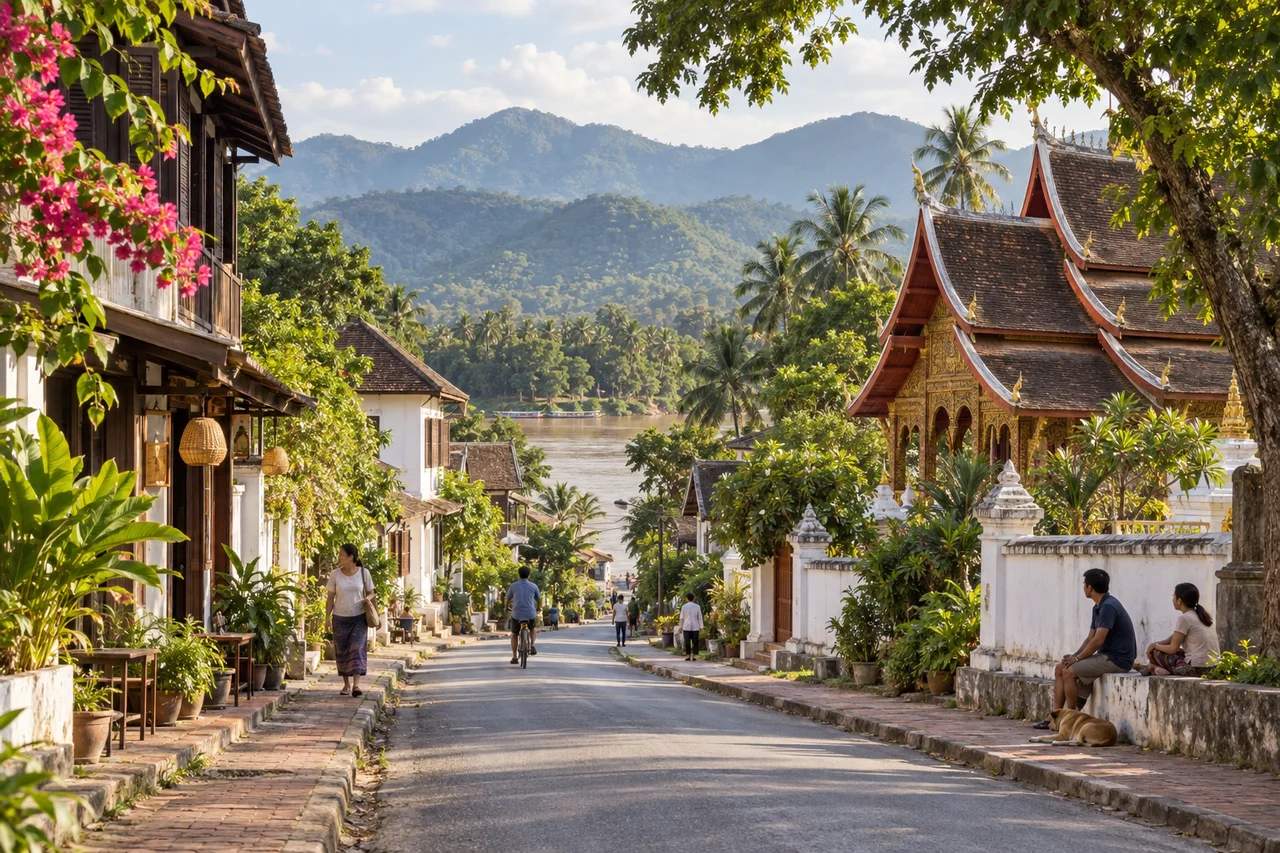
myAudience · original generated illustration · Original generated illustration; interpreted setting, not documentary evidence, current conditions or an authenticated viewpoint.
Luang Prabang occupies a peninsula between the Mekong and Nam Khan in northern Laos. Its setting brings water, mountain slopes and an inhabited town into one view. UNESCO describes an architectural ensemble combining Lao traditions with buildings and street arrangements from the colonial period. Calling the whole place a timeless ancient town would conceal that layered history and the people who continue to live there.
Look at buildings at different scales. Low houses, temple compounds and streets organise daily movement in ways that a distant skyline cannot explain. Roof form, shade, materials and the relationship between an entrance and public space offer useful questions for close observation. They do not by themselves establish a building's age or purpose: a careful account needs records, local knowledge and attention to alterations.
The official Lao tourism account identifies morning alms giving as a sacred religious practice and asks visitors not to disrupt it. That is a different framing from treating it as entertainment arranged for a camera. Watching an unfamiliar practice is not the same as understanding its significance. Ask how people describe their own traditions, and distinguish those accounts from a visitor's guesses about clothing, gestures or belief.
Our illustration shows a composite neighbourhood, with timber and masonry homes, a Lao-temple-inspired roof and a glimpse of river beyond. The roof's sweeping lines provide a visual contrast with domestic balconies, but the scene does not reproduce a named temple or locate a real street. What additional evidence would help you interpret the place? A local explanation of use and upkeep would tell you more than counting decorative details in an invented image.
Living heritage includes the right to ordinary routines and privacy. Give worship, entrances and residents' activities room; ask before photographing people and follow the expectations of each site. This reading offers background rather than a ceremonial script or a promise of access. Consult current official visitor guidance for arrangements, and remember that an attractive view is only one small part of a community's account of its town.
Image: illustration, not a documentary photograph.
Further reading
The rivers frame Luang Prabang, but the town is not only a pleasing arrangement beside water. The peninsula between the Mekong and Nam Khan provides a setting for buildings, movement and inhabited neighbourhoods. Reading the setting and the built form together is more useful than treating hills as scenery unrelated to the town. It also leaves room for the fact that an illustrated glimpse of water is not a map of the peninsula or a complete account of local livelihoods.
Lao traditions and colonial-era changes form part of the documented architectural history. This is a layered account, rather than a claim that every house has remained unchanged since an unspecified ancient time. The phrase 'timeless town' can sound admiring while concealing decisions and transformations. A fuller reading asks which forms, materials and spatial relationships are inherited, which were introduced later and how people have continued to adapt them.
Different building types offer different questions. Timber houses, temple compounds and masonry buildings can be compared through entrances, roof forms, enclosure and relationships with streets. These observations do not establish a building's date or use by themselves. A familiar-looking balcony may have been repaired, and a building may have acquired a new purpose. Written records, local accounts and documented alterations provide information that visual resemblance cannot supply, particularly when the image itself is invented.
UNESCO's historical description also identifies religious practices as part of the town's significance. That supports recognising a lived religious context, rather than interpreting all activity as spectacle for visitors. It does not supply a current ceremonial timetable or instructions for participation. Our new reading makes no such claims: the official Lao tourism page was unavailable during this source check. Respectful inquiry begins with distinguishing what has been verified from what would require a current local account.
The natural setting includes more than a distant mountain outline. Riverbanks and wetland spaces appear in the heritage account alongside the urban ensemble. This encourages a relational question: how do inhabited places, open spaces and water features belong together? It does not justify assigning one flood-control or agricultural function to every pictured pool or green patch. Detailed functional claims would need mapped features, dated evidence and information about their actual use.
The reused composite scene shows domestic balconies, a temple-inspired sweeping roof, vegetation and a glimpse of river. Their different scales make a useful comparison between home, compound and wider setting. The fictional residents are not evidence of a particular ceremony, and the roof is not authenticated as a named temple. In the smaller versions, the contrast between domestic frontage and temple-like form remains readable; fine decorative detail should not carry a historical claim at any size.
Imagine a fictional house whose owners need more usable interior space. One proposal changes the street-facing roof; another preserves that view but replaces almost all older material behind it. Comparing them requires more than asking which looks older. A reasoned judgement would consider surviving fabric, documented form, residents' needs, repair skills, reversibility and costs. Consultation matters because a living home cannot be treated simply as an exhibit whose occupants should disappear for the convenience of a view.
Transfer task: distinguish two observations and two unsupported claims about the illustration. Answer: the scene depicts a balcony and a sweeping temple-inspired roof; those are observations about its composition. 'This is an unchanged historic house' and 'these people are performing a named ritual' require evidence the generated image does not provide. A better account would seek building records and local explanations while protecting privacy. It would use the image to encourage careful looking, then explain how knowledge about a lived place depends on more than looking alone.