Rapa Nui: monuments belong to a living landscape
By Places and their stories · myAudience
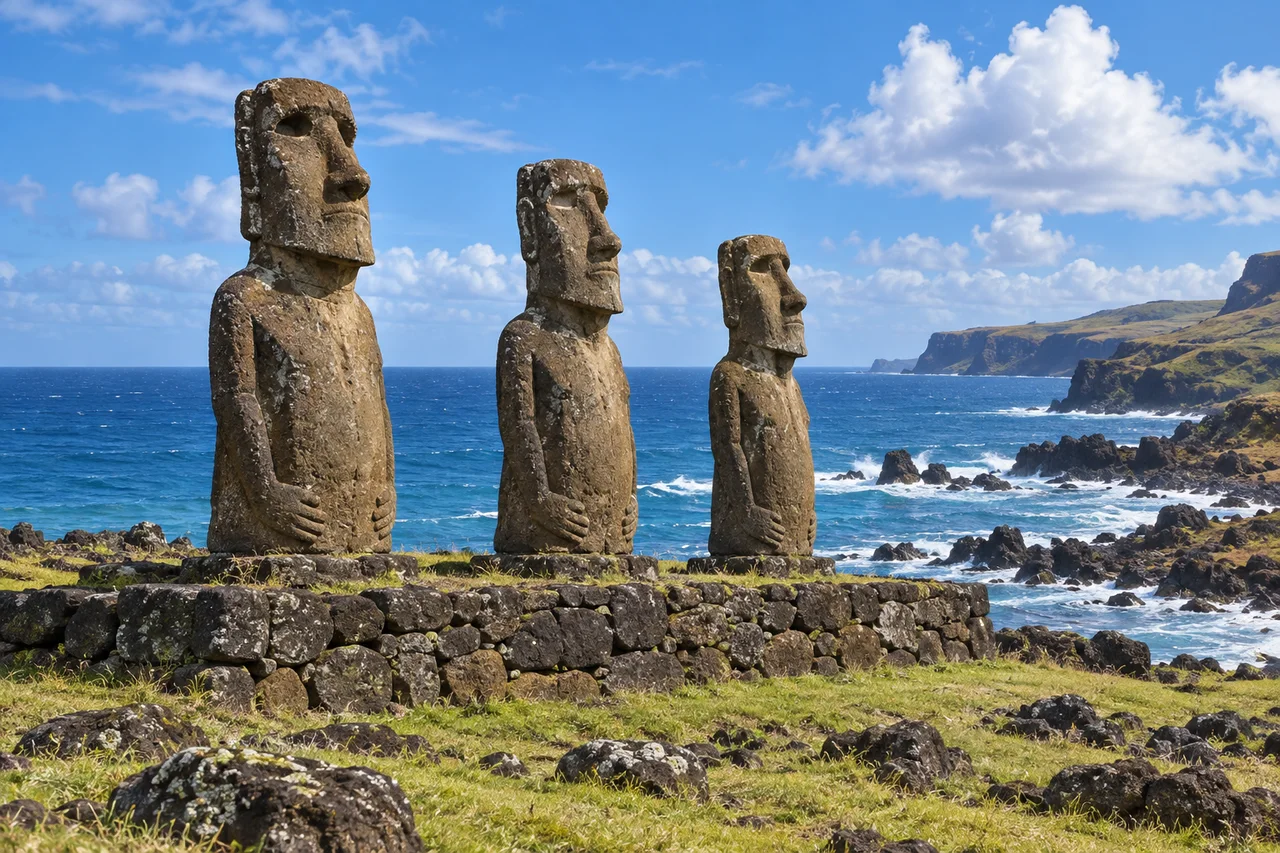
myAudience · original generated illustration · Original generated illustration; interpreted setting, not documentary evidence, current conditions or an authenticated viewpoint.
Rapa Nui's monumental sculpture comes from a Polynesian cultural tradition. Moai are not mysterious objects without makers: they are worked stone figures associated with ancestors and ceremonial places. Their surviving forms invite questions about skill, organisation and meaning. An account that replaces people with fantasies of outsiders fails to explain the material evidence and dismisses the community whose heritage is being discussed.
The archaeological landscape includes more than standing statues. Ahu platforms, quarries, housing remains, rock art and other structures help connect sculpture to production, settlement and ritual. UNESCO's account describes statues in different stages of carving, movement and later history. Studying only a finished silhouette hides the many tasks between selecting stone and placing a monument within a wider landscape.
Ma'u Henua presents the national park as living, ceremonial and protected territory. Its visitor regulations prohibit touching, climbing, walking on or removing protected elements. These are not merely rules for obtaining a tidy photograph. They recognise fragile material remains and a community's responsibility for places with cultural meaning. A visitor's wish to get closer does not outweigh either of those interests.
In the illustration, notice that the figures have shoulders and torsos, not just heads. The low worked-stone platform also changes how a statue relates to surrounding ground. What could an archaeological plan tell you that this image cannot? It could distinguish a quarry, a restored platform and an original setting. Our three-figure coastal scene is interpreted, with no claim to reproduce a named ahu, an exact carving sequence or an authenticated historic arrangement.
Avoid turning complex history into one simple story of an inevitable collapse. Archaeological interpretations require evidence, and the island's living people deserve more than a dramatic ending imposed on their past. Follow current park guidance, stay in permitted spaces and do not touch the monuments. Learning about a place can begin with a striking image, but it should continue through the accounts of its custodians and the evidence beyond the frame.
Image: illustration, not a documentary photograph.
Further reading
Begin with makers, rather than with a supposed mystery requiring outsiders. Rapa Nui's sculpture belongs to a Polynesian cultural landscape with living custodians. A powerful monument can prompt questions about skill, organisation and meaning without erasing the people who made it. Our account deliberately avoids a precise settlement chronology: different passages of the heritage page do not present that issue consistently, so a confident date would require additional, specifically reviewed evidence.
The landscape includes platforms, quarries and other archaeological remains alongside statues. Those relationships help turn a finished form into questions about production and use. A quarry can preserve evidence of work in progress, while a platform provides a different setting for a monument. It would nevertheless be a mistake to assume that every statue followed one identical sequence or that a pictured finished figure reveals the route by which it arrived.
Material traces can constrain an explanation without resolving every stage. An unfinished carving, a tool mark and a displaced object answer different questions, and their context matters. To compare proposed movement techniques, investigators would need relevant archaeological evidence and clear boundaries on what a demonstration establishes. Showing that a method could work under one set of conditions would not prove that it was used for every monument. Possibility, evidence of use and universality are distinct claims.
Restoration complicates another common assumption: a standing monument is not automatically a record of an unchanged arrangement. Records of excavation, intervention and re-erection can help distinguish present appearance from earlier states. This does not remove the cultural importance of the place. It makes documentation part of understanding it. A reader should not assign a named platform or restoration history to our invented scene simply because its figures appear convincingly weathered.
The current Ma’u Henua page describes the park as living, ceremonial and protected territory, and identifies protected elements including ahu, moai and rock art. Its stated restrictions on touching, climbing and removing material reinforce a basic principle: curiosity does not confer permission to alter evidence or intrude on a place's cultural use. The page is the appropriate source for its stated rules; our illustration is not an access plan or a promise that any depicted position is permitted.
The reused scene depicts three figures with torsos and arms above an ahu-inspired worked-stone platform. Noticing those full forms helps counter the habit of reducing the sculpture to disembodied heads. The landscape and arrangement are interpreted, not a named archaeological site. Smaller images retain that relationship between figures and platform, while no version authenticates the particular carving details. The image can support an observation exercise without becoming a substitute for a site record.
Avoid compressing the island's history into a single inevitable-collapse story. The heritage synthesis itself attributes an ecological interpretation to some studies, rather than resolving every cause and sequence. Our reading does not make that disputed account a settled explanation or turn present descendants into an epilogue. A more responsible approach asks what evidence supports a particular claim, what alternatives remain and which historical experiences disappear when one dramatic explanation takes over the whole narrative.
Transfer question: evaluate 'the picture proves outsiders must have moved the statues, and touching them would help us discover how'. Answer: neither claim follows. The rendered scene contains no evidence about transport, and the documented protected status rules out treating physical contact as an investigative entitlement. A justified inquiry would compare archaeological context, relevant research and custodians' accounts without damaging remains. It should also distinguish a proposed mechanism from proof of actual use. Respect for living people and respect for material evidence are connected parts of learning, not obstacles to it.