Tongariro: a landscape can have more than one meaning
By Places and their stories · myAudience
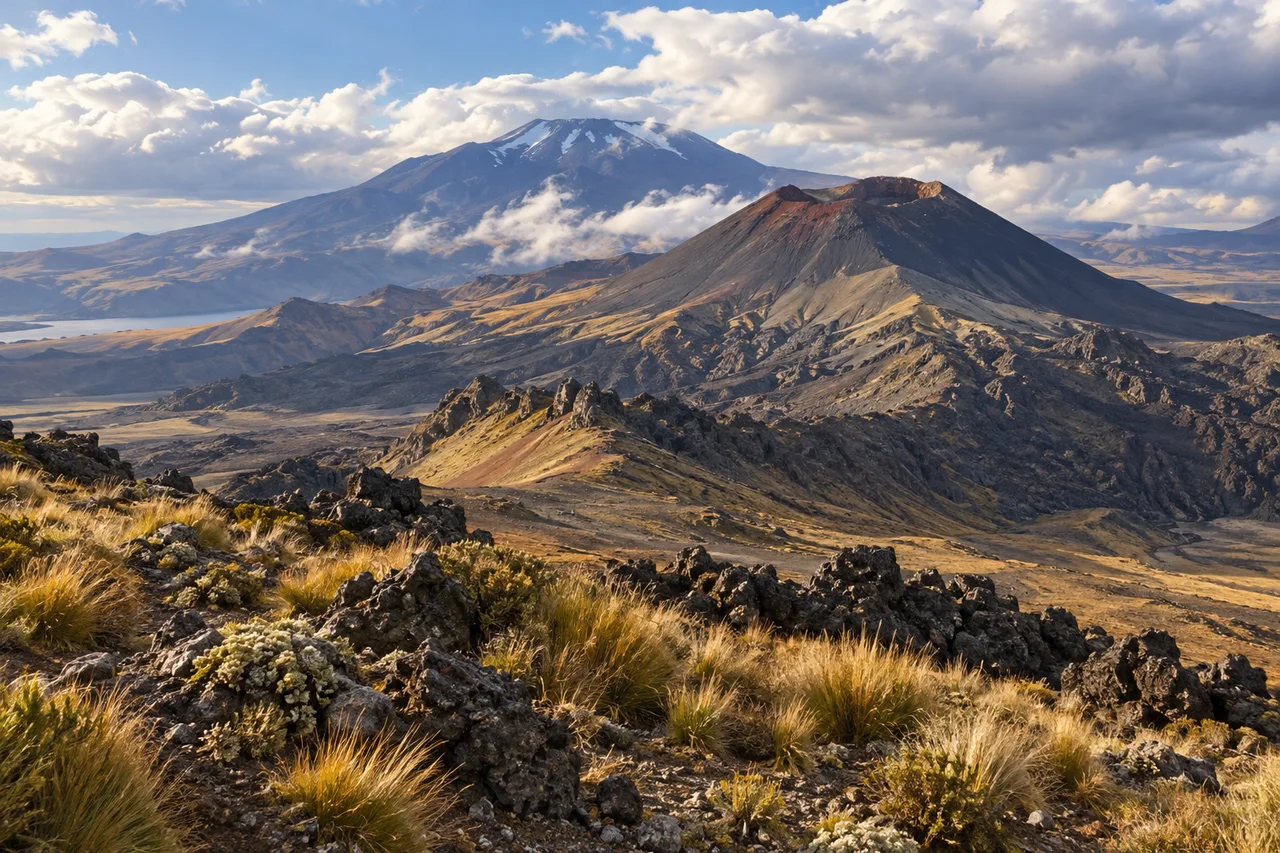
myAudience · original generated illustration · Original generated illustration; interpreted setting, not documentary evidence, current conditions or an authenticated viewpoint.
Tongariro National Park combines volcanic landscapes with cultural and spiritual significance for Māori. Its dual World Heritage recognition is not simply a reward for an impressive mountain view. The mountains express relationships between people and place as well as processes studied by geology. These accounts can be considered together without treating a spiritual tradition as a scientific claim about how rocks formed.
Volcanic cones, older lava surfaces and glacially shaped features offer different kinds of evidence. A dark ridge might invite a question about material and erosion; it cannot establish a precise eruption date or current volcanic activity by appearance alone. Understanding a landscape requires records, field evidence and scientific interpretation. A sunny illustration is particularly poor evidence for deciding whether a mountain environment is safe to enter.
The Department of Conservation identifies Ngāti Hikairo ki Tongariro's role as guardians and records requests to respect sacred mountains and waterways. Their account also describes a restorative rāhui following fires in late 2025. Read with its date, this is a reminder that care is active and conditions change. The illustration does not document the fires or the recovery of a particular site, and the reading should not substitute for current park information.
In the image, compare the cone-like profile, rough ridges and small plants in the foreground. What can a distant view reveal, and what would require closer evidence? It can introduce contrasts of form and cover, but cannot identify every plant or map a lava flow boundary. This is a broad interpreted landscape, not an exact viewpoint, a summit route or a claim that all pictured ground lies open to visitors.
Admiring a place does not require entering every part of it. Follow current official instructions, stay in permitted spaces and respect requests not to enter or touch sacred waterways. Park notices and conditions must be checked afresh before any visit. This reading offers geological questions and cultural context, not hiking preparation, a weather forecast or a guarantee of access; the mountains deserve care beyond the moment when they look most inviting.
Image: illustration, not a documentary photograph.
Further reading
Tongariro's significance includes volcanic landscapes and living Māori cultural relationships. These accounts address different questions: geological evidence investigates the formation of landforms, while custodial perspectives explain relationships, obligations and meaning. Neither should be made to replace the other. UNESCO recognised natural values in 1990 and cultural values in 1993. The later recognition is not merely an additional scenic prize; it acknowledges that a landscape's importance cannot be fully described by its appearance or rock formations alone.
Volcanic ridges and deposits invite questions about processes and sequence, but a skyline alone cannot determine an eruption date or the origin of every visible surface. Mapped deposits, dated observations and geological records would support those claims. Glacial modification introduces another kind of evidence, making a single “volcano built all this at once” account inadequate. Separating landform description from causal reconstruction helps a learner ask better questions. It also prevents a generated scenic image from being mistaken for a survey or a current observation.
Cultural significance involves relationships transmitted and practised by people, rather than only a set of symbols attached to a mountain. UNESCO identifies Māori cultural and spiritual associations as part of the property's importance. Explain these as attributed cultural perspectives instead of presenting them as scientific claims about rock genesis. A scientific account of a deposit does not disprove a community's obligations to a place, just as cultural meaning does not supply a measured eruption chronology. Respectful interpretation makes the kind and scope of each claim clear.
Ngāti Hikairo ki Tongariro's guardianship adds a living custodial dimension to conservation. Decisions about care may concern damaged vegetation, obligations and relationships over time, not just whether a visitor can obtain an attractive view. This complicates a purely visitor-centred measure of success. A restoration decision can be meaningful even where part of a wider landscape looks undamaged. Understanding who speaks for a particular custodial account and what that account addresses is essential; this lesson does not presume to describe every Māori perspective as identical.
The DOC page read on 5 October 2026 describes two fires in late 2025 and a ten-year restorative rāhui over the affected area declared by Ngāti Hikairo ki Tongariro. This is a dated institutional account, not a promise about current access on every route or a universal statement about all park areas. It illustrates that conservation information changes and that restrictions can relate to recovery over time. A future reader should distinguish the historical claim made here from the separate question of what current authorities advise for a particular visit.
The illustration's broad ridges and patches of vegetation support a discussion of landscape scale. They do not depict a verified walking route, current fire recovery or present eruption conditions. A green patch in a generated scene is especially weak evidence about a real damaged area. The picture can encourage questions about how processes and cultural care intersect, but it cannot answer a practical access or hazard question. Its role is interpretive: the factual claims come from the identified institutional accounts, with their dates and scope.
Suppose a fictional visitor photographs a healthy-looking patch on a sunny day and concludes that a wider recovery restriction is unnecessary. The observation is local and momentary, whereas recovery may concern a larger area and processes extending through time. It supplies no direct evidence about damage outside the frame, restoration goals or authority to change the restriction. Additional observations could inform an ecological inquiry, but a visitor's visual assessment does not replace custodial decision-making or a current official access statement.
Transfer question: does new green growth in that one photograph prove that fire damage has ended, the rāhui no longer applies and volcanic travel is safe? Answer: these are three separate claims and none follows. Wider damage and recovery need evidence across the relevant area and period; the restriction's status requires current authoritative information; hazards require their own current assessment. Healthy local growth is compatible with ongoing recovery elsewhere. The strongest conclusion describes the observation narrowly and refuses to convert it into unrestricted permission.