Singapore: a garden is also a scientific institution
By Places and their stories · myAudience
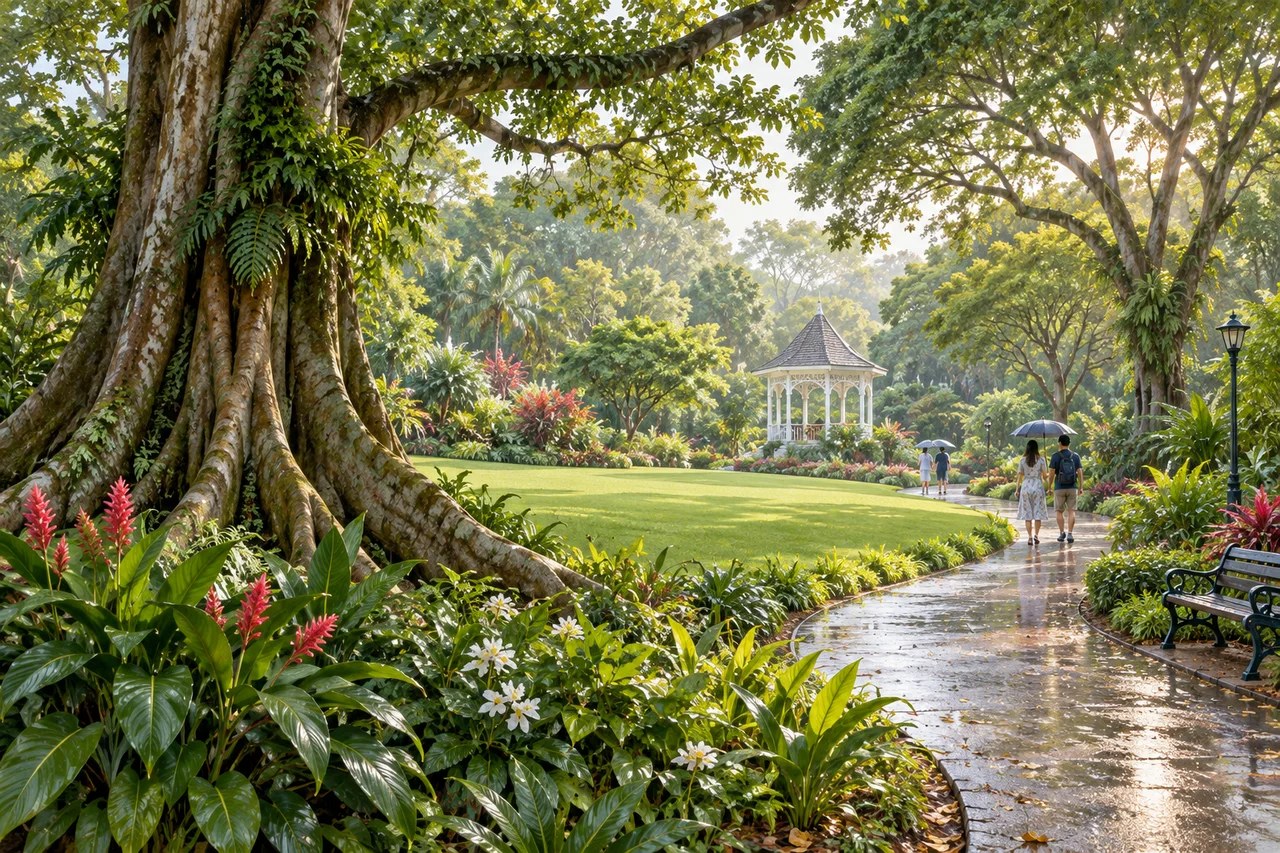
myAudience · original generated illustration · Original generated illustration; interpreted setting, not documentary evidence, current conditions or an authenticated viewpoint.
Singapore Botanic Gardens offers a different view of the city from a skyline alone. Established in 1859, it developed from a colonial tropical garden into a place for botanical research, conservation, education and recreation. UNESCO recognises this continuing landscape and institutional history. It should not be confused with Gardens by the Bay: a city can contain several distinctive garden places with different origins and purposes.
A botanic garden is more than attractive planting. Studying plants depends on identifying specimens, preserving records and relating observations to a wider body of knowledge. A beautiful flower photograph without an identification or collection record cannot do all of that work. The designed landscape also provides a setting in which people can encounter questions about plants, cultivation and conservation that might otherwise remain hidden inside specialist research.
UNESCO's account links the garden with the development and spread of plantation rubber in Southeast Asia. That connects botanical expertise with economic history and land use beyond the garden boundary. Scientific advances do not take place apart from institutions, labour and the ways crops are adopted. A full account would need evidence about those wider relationships, rather than assume that every consequence of a successful cultivated plant was the same for everyone.
In the illustration, notice the contrast between a mature tree, a planted border, a lawn and a public path. Each suggests different kinds of care and use. What would you need to identify the pictured tree reliably? Several botanical features and a trustworthy record would help; an invented image is not a specimen. Our garden composition does not reproduce an exact heritage tree, planting plan or named gazebo, and it does not establish current flowering conditions.
Living collections change through growth, replacement and continuing care. That makes their preservation different from keeping an object behind glass. Keep to permitted areas, leave plants intact and let labels and official interpretation support closer learning during a visit. This reading introduces the relationship between pleasure, research and cultivation; current access and individual plant claims should come from the institution rather than guesses from an attractive scene.
Image: illustration, not a documentary photograph.
Further reading
The Botanic Gardens' history begins with a distinction between an earlier experiment and the institution at its present site. NParks dates a botanical and experimental garden on Government Hill to 1822, while the Tanglin garden began in 1859. Those are different sites and stages of development. The later garden initially combined leisure and ornamental landscape design with the interests of an agricultural and horticultural society. Scientific work subsequently became more central as the institution developed. This sequence helps explain why a botanic garden can look like a park while doing work that a park does not necessarily do. The spaces open to a visitor are connected to collections, research and records extending beyond what is visible along a path.
Plant identification is one of those less visible tasks. The Singapore Herbarium describes taxonomy as naming, describing and classifying organisms. Its preserved specimens allow researchers to compare material rather than rely only on a remembered image or a familiar common name. A specimen and its collection record form a reference that can be revisited. That matters when two plants look alike but differ in diagnostic features, or when the application of a name changes through further study. Taxonomy is therefore more than attaching a label to a tree. It provides a shared way to test which organisms people are discussing. Conservation and research depend on that clarity, because a claim about a species has little value if the identity behind the claim is uncertain.
The historical work on rubber illustrates a different use of botanical knowledge. The Gardens' institutional account describes experiments and promotion involving Para rubber under Henry Ridley, including research into obtaining and preparing latex. It links that work with the expansion of rubber cultivation in the region. A plant's economic importance did not arise solely from its presence in a collection: cultivation, knowledge of its behaviour and methods of handling its product mattered too. This is also a colonial economic history, not simply a celebratory story about one scientist. Decisions about profitable crops changed landscapes and labour. The garden can introduce that larger connection between biological material, experiment and commercial demand without pretending that the view of one tree tells the entire story.
Orchid breeding demonstrates another relationship between a collection and a result. The Gardens' current programme account dates its initiation under R. E. Holttum to 1928 and the flowering of its first hybrid to 1931. It describes selecting parent plants and a multi-year journey involving both horticultural and laboratory teams. Crossing plants begins a process rather than instantly delivering the finished bloom that appears in a display. The offspring must grow, and their characteristics must be observed. A desired combination is therefore explored through living material over time. This helps explain why a striking hybrid is evidence of sustained work as well as a decorative object. The colour visible to a visitor is only one part of that developmental history.
Botanical collections also connect local and international work. The Herbarium records loans and exchanges with recognised institutions, while the historical account describes the growth of publications, a library and systematic research. A plant collected in one place can become part of a comparison made elsewhere; an identification can then be checked against other material and descriptions. The value of the collection grows through these relationships, not just through its size. Keeping records allows later questions to be asked of earlier material. A garden is thus a place where living displays and long-lived references coexist. The distinction is useful when admiring an old tree: the tree is alive and changing, while associated records can preserve observations made at particular times.
The illustration brings that work into a visitor's setting, with a broad tree, layered planting, an open lawn and a pavilion-inspired structure. It is a composite rather than an authenticated portrait of a named specimen or building. Its relationships still provide a useful way into the subject. Large plants create one scale of space, paths bring the scene back to the movement of people, and smaller beds invite attention to individual forms. The garden's deeper interest lies in connecting those experiences with identification, cultivation, experiment and memory. It offers a way to enjoy living beauty while also asking how people have learned about plants, changed them and preserved the evidence needed for others to learn more.