Borobudur: a monument gives movement a shape
By Places and their stories · myAudience
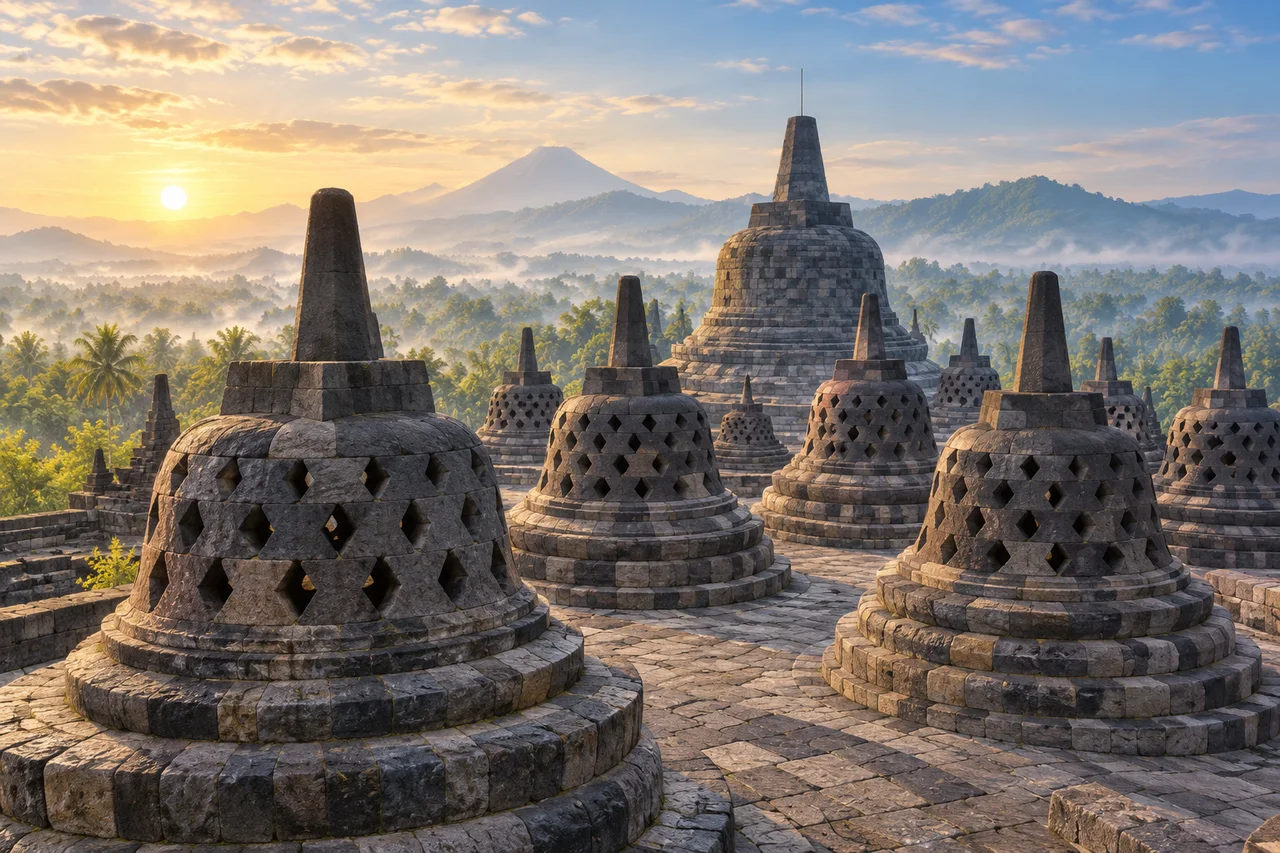
myAudience · original generated illustration · Original generated illustration; interpreted setting, not documentary evidence, current conditions or an authenticated viewpoint.
Borobudur is a Buddhist monument in Central Java, associated with the eighth and ninth centuries. Its stepped form combines square terraces, circular upper platforms and a large central stupa. The wider World Heritage property also includes Mendut and Pawon. A close view of the upper terraces is therefore one part of a larger architectural and cultural relationship, not a complete account of the compound.
The shift from square to circular forms gives the monument a strong spatial progression. UNESCO explains this organisation in relation to Buddhist cosmology and the journey toward liberation. That is an interpretation within a religious tradition, not a physical claim that the universe consists of the pictured platforms. Keeping the distinction clear lets a reader appreciate how architecture can express ideas without confusing symbolic meaning with scientific description.
The monument also carries an important conservation history. Twentieth-century restoration retained substantial original material while incorporating work to consolidate the structure and improve drainage. A surviving monument can therefore include both inherited stone and later care. Asking which parts are original, restored or added helps explain preservation more usefully than simply calling everything ancient or dismissing a cared-for site as no longer authentic.
Our illustration concentrates on repeated openwork stupas and the larger central form. What changes when you compare one stupa with the pattern across a platform? Repetition introduces a relationship between individual objects and the whole, but exact counts and positions need a verified plan. The image is not a complete reconstruction, an authenticated sculpture catalogue or a record of every relief. No invented marks here can be used as a primary source for a particular narrative.
A place can be an archaeological monument and retain religious significance. Give both material care and cultural practice room, following current site instructions instead of treating every surface as a place to touch or climb. The wider landscape deserves attention beyond the best-known silhouette. Source notes provide the reading's basis; current arrangements and specific interpretations should be checked through official information and identified evidence rather than assumed from a generated scene.
Image: illustration, not a documentary photograph.
Further reading
Borobudur forms part of a World Heritage property with Mendut and Pawon, distinct components rather than identical versions of one monument. UNESCO locates the complex in Central Java and attributes its eighth- to ninth-century construction to the Syailendra period. Beginning with that setting and qualified chronology helps distinguish historical explanation from a striking silhouette. A reader should ask which component a statement concerns: details about Borobudur's terraces cannot silently become the architecture or chronology of every building in the compound.
The movement from square terraces toward circular upper platforms organises an experience of progression. UNESCO connects that form with Buddhist cosmological interpretation. Explain the meaning as an attributed religious framework, not a scientific model of the physical universe. Spatial sequence and cultural interpretation are related but distinct claims: one can be investigated through the monument's form, the other through appropriate historical and religious evidence. This distinction preserves the importance of the symbolism without pretending that a generated image proves its entire interpretation.
Individual stupas participate in a patterned whole, so the scale of observation matters. Looking at one enclosure may reveal openings and a contained figure, while a plan addresses arrangement across a terrace. A partial view cannot validate a complete inventory. The lesson should connect details to the larger sequence without deriving exact counts from the illustration. When counts matter, use documented surveys and state what is being counted; a decorative repetition in generated art is not a substitute for that evidential step.
Reliefs also require context and interpretation. Their placement and narrative relationships can matter as much as the appearance of an isolated carved figure. Located documentation and reliable readings are needed to identify what a scene depicts and how it participates in a sequence. Our image contains interpreted forms, not an authenticated relief panel to translate. Recognising this limit is productive: it directs attention toward the evidence required for a real historical reading instead of supplying a plausible story unsupported by the pictured markings.
Twentieth-century restoration involved more than displaying surviving stone. UNESCO discusses retained material together with consolidation and drainage measures, illustrating how unseen infrastructure can affect a visible monument. Water movement and structural care are questions that a façade photograph may not answer. The source's dated management references should also remain dated rather than become current completion claims. A sound account separates what the restoration sought to achieve, what material it retained, and what evidence would be needed to evaluate continuing performance.
The illustration depicts an interpreted upper-terrace scene with openwork stupas and a central form. It does not show every tier, authenticate the complete inventory or reproduce a measured viewpoint. Its repeated enclosures help the reader think about detail and pattern, but their number and placement are not survey data. Nor can visible weather and visitors establish present access rules. Use the art to introduce the spatial question, then use documented plans and source descriptions to investigate the actual monument.
Compare two fictional restoration records retaining equal amounts of original stone. One includes documented drainage observations and maintenance; the other offers only a pleasing photograph. Their material totals may be similar while their evidence for water management differs. That does not prove the first system always works: observation periods, locations and omitted flows still matter. It does show why an evaluation needs separate criteria for retained fabric, structural measures and drainage, rather than making one visible number decide every aspect of conservation.
Transfer question: a photograph shows no drain, and both records retain equal stone totals. Can we conclude drainage is absent and the restorations are equally effective? Answer: no. Hidden routes or components may lie outside the view, and material retention does not measure water movement. Seek located plans, monitoring and maintenance records, then compare their scope and uncertainty. A documented drainage account is stronger evidence for that particular claim than a photograph alone. This conclusion remains conditional and does not certify a restoration or infer exact terrace and stupa counts from the artwork.