Near Yogyakarta: Prambanan is not one generic temple
By Places and their stories · myAudience
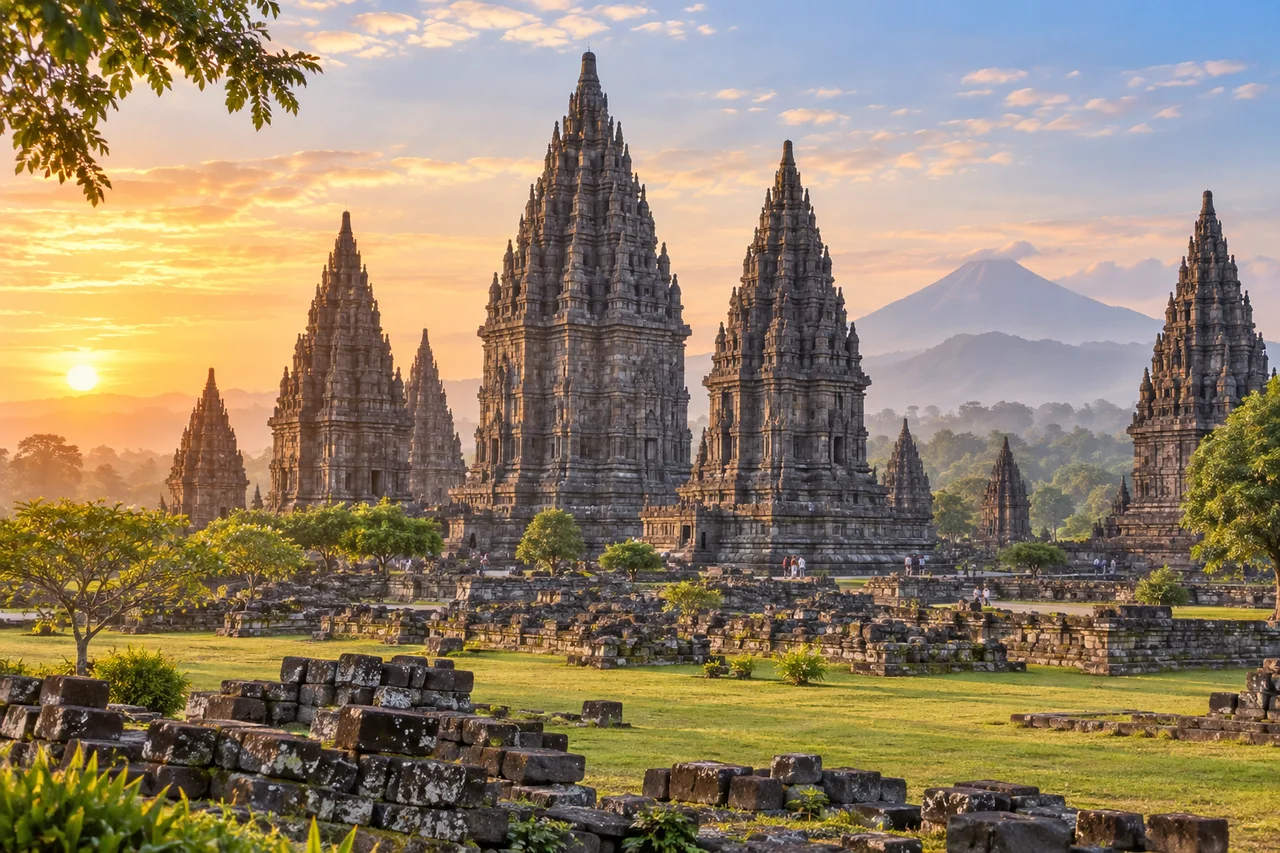
myAudience · original generated illustration · Original generated illustration; interpreted setting, not documentary evidence, current conditions or an authenticated viewpoint.
Prambanan introduces a major temple landscape near Yogyakarta and Central Java. Its Hindu towers form a different architectural image from the Buddhist stupas of Borobudur. The wider UNESCO property includes several compounds, with Hindu and Buddhist components that need to be distinguished. A regional map can reveal relationships between places, but it should not collapse their buildings, histories and traditions into one interchangeable ancient site.
At Prambanan, tall stone towers rise above stepped bases and surrounding structures. UNESCO describes major Hindu temples associated with Shiva, Vishnu and Brahma and reliefs illustrating the Indonesian Ramayana tradition. Those associations need identified evidence, not guesses from a tower's outline. An invented illustration can introduce scale and form; it cannot authenticate a specific carved scene or establish the meaning of every architectural detail.
The compounds also include the Buddhist complex at Sewu. Their presence in the wider property makes religious variety an important part of the account, while leaving room for differences between particular sites and periods. Simply declaring that all ancient people lived in perfect harmony would go further than the evidence established here. Architectural proximity invites historical questions; it is not by itself a complete measure of every social relationship.
Compare the tall towers with the low foundations in our interpreted view. A visitor may see both standing structures and remains that no longer have their original height. What would a reconstruction need beyond the picture? Evidence about blocks, structural connections, dates and previous work would help. The scene is not a measured temple arrangement, an exact tower count or an inventory of all Hindu and Buddhist components in the archaeological park.
UNESCO records a long restoration history, including care after earthquake damage. That highlights the work required to preserve masonry architecture in a changing environment. Respect restricted structures, follow current site guidance and do not read a sunny illustration as a statement about present conditions. Yogyakarta and its surroundings have living cultural histories beyond monuments; this reading offers one introduction, without claiming that archaeological remains represent every resident's beliefs or the whole region's story.
Image: illustration, not a documentary photograph.
Further reading
Near Yogyakarta and Central Java, Prambanan presents a religious landscape made of several compounds, rather than one interchangeable ancient temple. UNESCO distinguishes Hindu Loro Jonggrang, associated with the ninth century, from neighbouring Buddhist complexes including Sewu. Names and locations matter here: the broader property contains different architectural and religious traditions. A map can connect them geographically without turning their histories or beliefs into a single simplified narrative.
The Hindu temples' Ramayana reliefs connect stone architecture with a narrative tradition. A relief is more than surface decoration: its placement can bring stories into a person's encounter with a building. Interpreting a particular scene requires an identified carving and evidence about the narrative, not a guess from a tower silhouette. Asking how architecture, movement and imagery work together gives a richer introduction than merely listing which monument is tallest.
Standing towers and low remains also pose a construction question. The original interlocking stonework and later restoration are different kinds of evidence within the same complex. UNESCO records restoration since 1918 and the use of both traditional methods and modern reinforcement. A restored building can preserve valuable original material while incorporating later interventions. Recognising those layers avoids the false choice between calling everything untouched antiquity and dismissing every repaired structure as meaningless.
Earthquake damage made that distinction especially important in 2006. UNESCO's notice for a March 2007 expert meeting describes a move from emergency response to longer-term rehabilitation planning. It identifies damage to Prambanan and to the different Islamic-era Taman Sari site. Shared exposure to a disaster does not make these buildings identical. Repair proposals need evidence about their particular materials, connections, damage and histories, not a standard reconstruction copied from a neighbouring monument.
Restoration is a sequence of questions as well as a sequence of building work. Which blocks can be identified? Which connections survive? Where would an intervention change the evidence future researchers can examine? Survey records and documentation help make those choices accountable. A newly upright tower is not, by itself, a complete measure of conservation success. Preserving knowledge about original and replacement material matters alongside presenting a recognisable form.
The wider setting includes people whose livelihoods and cultural practices continue around the monuments. The 2007 meeting linked rehabilitation with the recovery of affected communities. That historical notice supports a connection between heritage work and recovery; it is not a report of current visitor arrangements or economic conditions. Good interpretation keeps residents within the story and separates a dated recovery programme from promises about what a traveller will find today.
The existing illustration contrasts steep towers with low foundations and open ground. It introduces scale, but it is not an exact inventory of the compounds or an authenticated Ramayana scene. Its completed-looking forms cannot establish which stones are ancient, replaced or reinforced. Reading the standing and missing structures together is more useful than imagining the image records one pristine moment before all later change.
Consider a fictional restoration proposal: reuse identified original stones where evidence permits, but fill undocumented gaps to create a perfectly symmetrical skyline. Its supporter says symmetry proves historical accuracy. Answer: reject symmetry as proof. A plausible overall shape does not establish an undocumented block's original position or detail. Compare labelled material records, earlier documentation and connection evidence; explain uncertainty where it remains. A visually complete proposal may lose evidence if it silently presents conjecture as original fabric. This evaluates interpretation, not the engineering safety of an actual temple.