Abu Simbel: preserving a monument also changes its story
By Places and their stories · myAudience
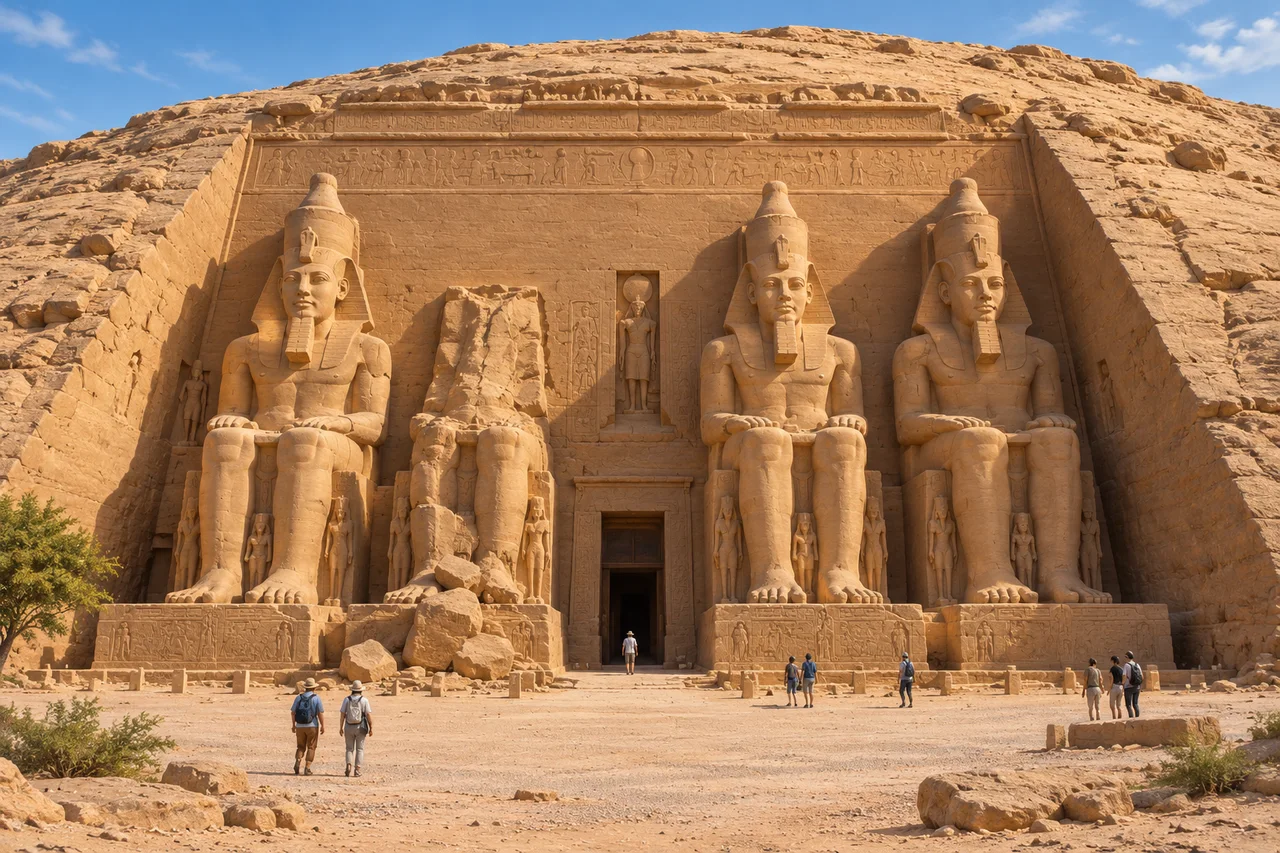
myAudience · original generated illustration · Original generated illustration; interpreted setting, not documentary evidence, current conditions or an authenticated viewpoint.
Abu Simbel is striking for the scale of its rock-cut royal architecture. The great temple associated with Ramses II presents monumental seated figures at its entrance, making the facade an assertion of authority as well as a crafted surface. Studying the site invites questions about patronage, labour, religious meaning and the relationship between a monument and the landscape surrounding it.
The temples belong to a wider UNESCO serial property of Nubian monuments, whose components have different dates and settings. Abu Simbel should not be confused with the sanctuary of Isis at Philae, nor made to stand for every chapter of Nubian history. The region's connections with Egyptian power included trade and domination. An impressive facade does not settle the experiences of all people who lived within those relationships.
A major modern chapter concerns preservation. During the international rescue campaign of 1960–1980, threatened temples were dismantled and reconstructed away from the rising waters associated with the Aswan High Dam. Abu Simbel's present setting is therefore part of a conservation history, not simply an untouched original position. The work raises an enduring question: what can relocation preserve, and which relationships with an original landscape necessarily change?
Compare the repeated seated figures, smaller details and doorway in our interpreted illustration. How is scale used to direct attention toward royal power? That is a visual interpretation, while identification of a particular smaller figure requires evidence. The picture does not authenticate every carving, reconstruct an ancient ceremony or establish a date for sunlight reaching an inner chamber. A complete architectural and conservation account needs records beyond the facade.
Nubia is more than a collection of monuments. A responsible reading leaves room for the region's people and the consequences of changing landscapes, rather than presenting an engineering rescue as the whole story. Respect protective barriers and current site guidance. The illustration can make the monument approachable for learning, while its label keeps the distinction between an interpreted scene and documentary evidence clear. Historical appreciation grows through questions about both what was saved and what changed.
Image: illustration, not a documentary photograph.
Further reading
Abu Simbel brings together two very different kinds of building achievement: temples cut into rock in the thirteenth century BCE, and a modern project that moved them. The great facade is an assertion of Ramses II's authority as well as a work of carving. UNESCO places the temples within a wider Nubian landscape of cultural encounters and Egyptian activity to the south. Learning the site means attending to that regional history, not only recognising colossal royal figures.
Carving into an escarpment creates spaces by removing material rather than assembling every wall from separate blocks. The original relationship between cliff, chambers and approach therefore mattered to the monument's form. Stone was both the material and part of the setting. Understanding that relationship explains why relocation posed more than a transport problem: conserving a rock-cut structure required a new way to support and present a complex that had belonged within a particular rock face.
The Aswan High Dam created a conflict between a modern reservoir project and monuments in the area to be flooded. UNESCO's November 2022 retrospective records Egypt and Sudan's request for assistance in 1959, followed by an international campaign launched in 1960. These are stages in a decision process, not proof that every consequence of the dam was resolved. A monument-rescue account evaluates one part of a wider development decision; effects on people and environments require their own evidence.
For Abu Simbel, the rescue involved cutting the temples into blocks, identifying them and reconstructing them at a higher site within an artificial cliff. UNESCO's retrospective records inauguration at the new location on 22 September 1968. Identification is central to the mechanism: moving stone without retaining its relationships would not preserve the same arrangement. Survey, labelling and documentation linked the dismantled material to a planned reconstruction rather than treating blocks as interchangeable cargo.
The wider campaign ran from 1960 to 1980 and involved other monuments, including Philae. Abu Simbel's 1968 inauguration should not be used as the completion date of every project. Different locations required different interventions. The World Heritage property is also a serial property, comprising separate components rather than one continuous temple. Those distinctions let an account recognise international coordination while remaining precise about which site and operation it describes.
Relocation protects material while altering location. That is a real conservation trade-off, not a logical contradiction. We can distinguish authenticity of retained fabric, reconstruction of spatial relationships and continuity of the original setting. Each asks for different evidence. A successful explanation records the intervention instead of hiding it behind a timeless-looking view, and it does not assume that protecting a monument by itself proves equitable treatment of every community connected with the region.
The existing illustration places a monumental rock-cut facade in a dry cliff setting. It fits a discussion of rock, representation and changed context, but it is not a measured record of either the original or relocated site. Do not read its figures or cliff shape as an inventory of the rescue. Its strongest teaching role is to prompt the question of how original material can be retained while its surroundings and support are deliberately changed.
Transfer task: a fictional relocation ledger lists 1,000 numbered blocks; 998 are installed, while two remain in labelled storage. A report calls the reconstruction both complete and unchanged in every respect. Answer: the inventory accounts for all 1,000, but only 998 are installed, so installation is not complete under the stated target. Even installing the final two would not prove an unchanged location or setting. Compare documented block positions, retained fabric and the new support system separately. These chosen figures teach record reconciliation and are not Abu Simbel's actual block count.