New Orleans: listen for the communities behind the music
By Places and their stories · myAudience
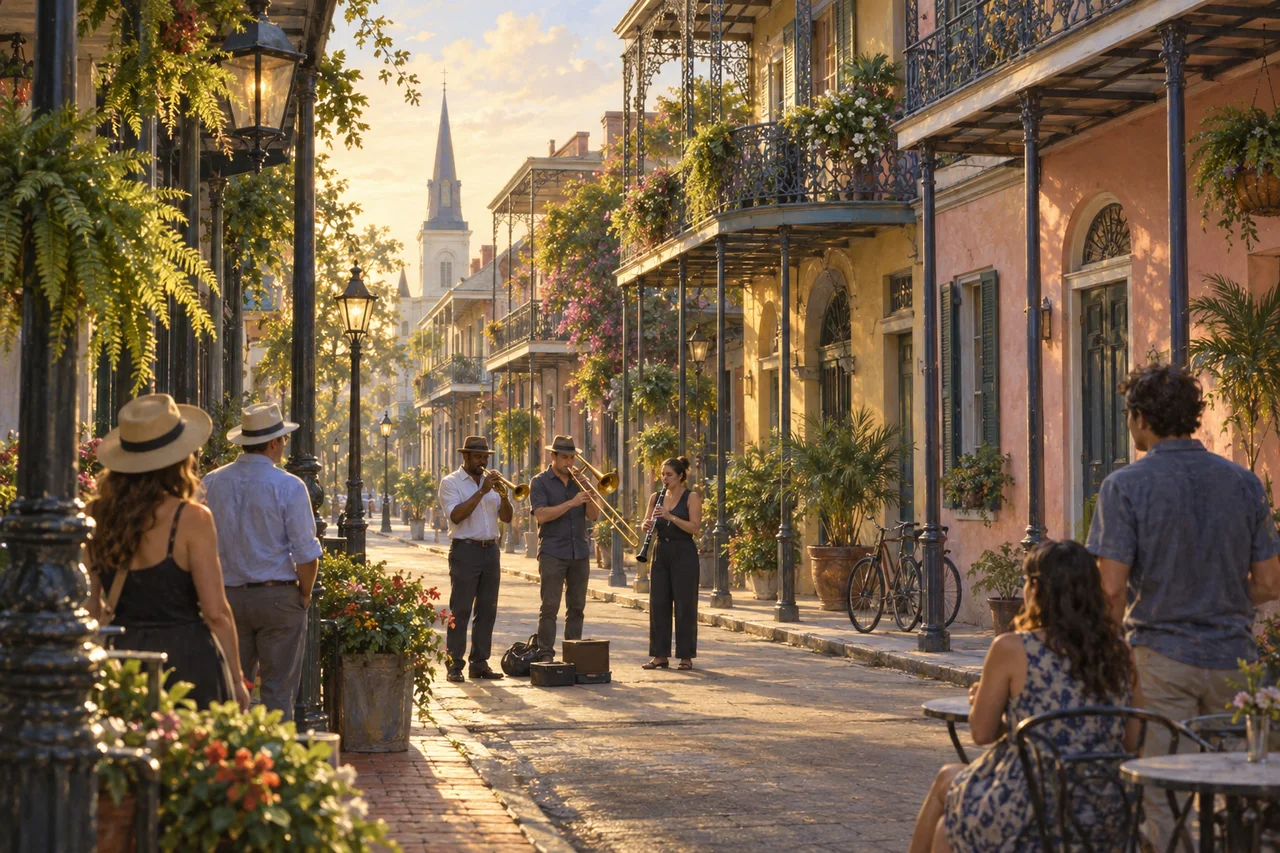
myAudience · original generated illustration · Original generated illustration; interpreted setting, not documentary evidence, current conditions or an authenticated viewpoint.
New Orleans introduces a city through music that belongs to communities as well as stages. Learning about jazz means paying attention to the places where people worked, danced, gathered and supported one another. A brass instrument in a street scene is an inviting visual hook, but the deeper history concerns musicians, listeners and the circumstances in which musical ideas were shared and changed.
The National Park Service emphasises roots in African American communities alongside wider cultural exchanges. Its account connects African traditions associated with Congo Square, brass bands, blues, ragtime and other musical forms with the developing sound. Those relationships resist a simple claim that jazz appeared fully formed through one inventor. A history of exchange also needs to recognise slavery, discrimination and unequal opportunities rather than imagining uncomplicated social harmony.
The account also links brass bands with mutual-aid and benevolent societies and describes community participation in processions. Music could accompany support, remembrance and celebration, not only commercial entertainment. Early New Orleans ensembles developed collective improvisation, with musical lines interacting. Listening to that interaction can be more revealing than reducing the style to one instrument, one famous name or a decorative costume.
Imagine several musicians responding to one another while keeping a shared pulse. How could a listener distinguish an individual line from the group's combined texture? Try describing what you hear in your own words without needing a technical label for every moment. Our interpreted street illustration cannot reproduce sound or authenticate a historic ensemble. Its instruments and people are invented examples, not portraits of identified performers or evidence of a particular procession.
Contemporary musicians and neighbourhoods deserve attention in their own right. Give performers space, respect local guidance and seek permission where appropriate rather than treating a community event as a staged attraction. The city's history extends beyond its best-known visitor streets. A thoughtful introduction can enjoy the music while asking whose work and support made it possible, using fresh local information for actual events instead of assuming that an illustrated scene promises a performance.
Image: illustration, not a documentary photograph.
Further reading
New Orleans' jazz history begins with communities and musical practices, not with a single moment when an inventor unveiled a finished style. The National Park Service describes African American contributions within a wider exchange among musical traditions. That account should not be flattened into an image of uncomplicated harmony. Slavery and racial discrimination shaped opportunities as well as the circumstances in which people heard and worked with one another.
Congo Square is one important connection in this longer history. The NPS account describes African dance and drumming traditions in gatherings associated with the place. Such evidence helps establish a cultural environment, but it does not turn every later jazz phrase into a direct transcription of one documented performance. Transmission can involve adaptation, combination and change. Asking which practice a source actually records is more productive than making a smooth origin story that erases those distinctions.
Brass bands and mutual-aid or benevolent organisations supplied another connection between music and community life. Performances accompanied occasions such as processions, dances and remembrance. These organisations supported people and created work for musicians; the band was part of a social relationship, not simply a soundtrack available for spectators. The participation known as the second line also reminds us to distinguish the contracted group from people joining the procession.
Musical interaction provides a mechanism to listen for. In the New Orleans approach described by NPS, cornet, clarinet and trombone could contribute interacting improvised lines. Several parts can be active at once while relating to a common pulse and musical framework. Collective improvisation does not mean that nobody prepared or that every note was chosen without constraint. The interaction becomes interesting precisely because individual choices must fit or respond to what other players are doing.
The NPS history describes musicians rehearsing, adapting material and developing ensembles, alongside changes toward prominent solo performance. Improvisation and composition are therefore not mutually exclusive labels for whole careers. A performance can combine learned patterns, arranged relationships and newly chosen details. Listening for a foregrounded solo differs from listening for several simultaneous lines, but neither observation alone measures artistic value or proves that one approach entirely replaced the other everywhere.
Recording and touring changed how the music reached audiences beyond local venues. The NPS history describes the commercial success of the Original Dixieland Jazz Band's 1917 recording. A surviving commercial release is evidence about recording and distribution; it is not a birth certificate for the whole musical tradition. Musicians' earlier work and different opportunities to enter the record market matter when evaluating who becomes most visible in a collection of surviving recordings.
The existing illustration depicts a small fictional contemporary street ensemble beneath street balconies. It supplies a useful visual invitation to investigate musicians, audiences and their setting, but it produces no sound and identifies no historical performer. Instrument shapes cannot authenticate a particular style of improvisation or a procession. The teaching account should remain attached to documented musical practices and community institutions rather than treating the invented scene as an archival photograph.
Transfer task: a fictional archive's earliest surviving recording is dated 1917, so a caption claims its band invented all jazz that year. Another listener says three visible instruments prove collective improvisation. Answer: reject both inferences. Survival and market access do not establish the earliest practice or a sole inventor; compare earlier accounts and the recording's circumstances. Instrument count alone does not establish musical interaction: listen for overlapping lines, responses and the shared framework. A carefully bounded caption can identify the recording and explain what it documents without turning an archival gap or an illustration into proof of origin.