Kathmandu Valley: craftsmanship across a living landscape
By Places and their stories · myAudience
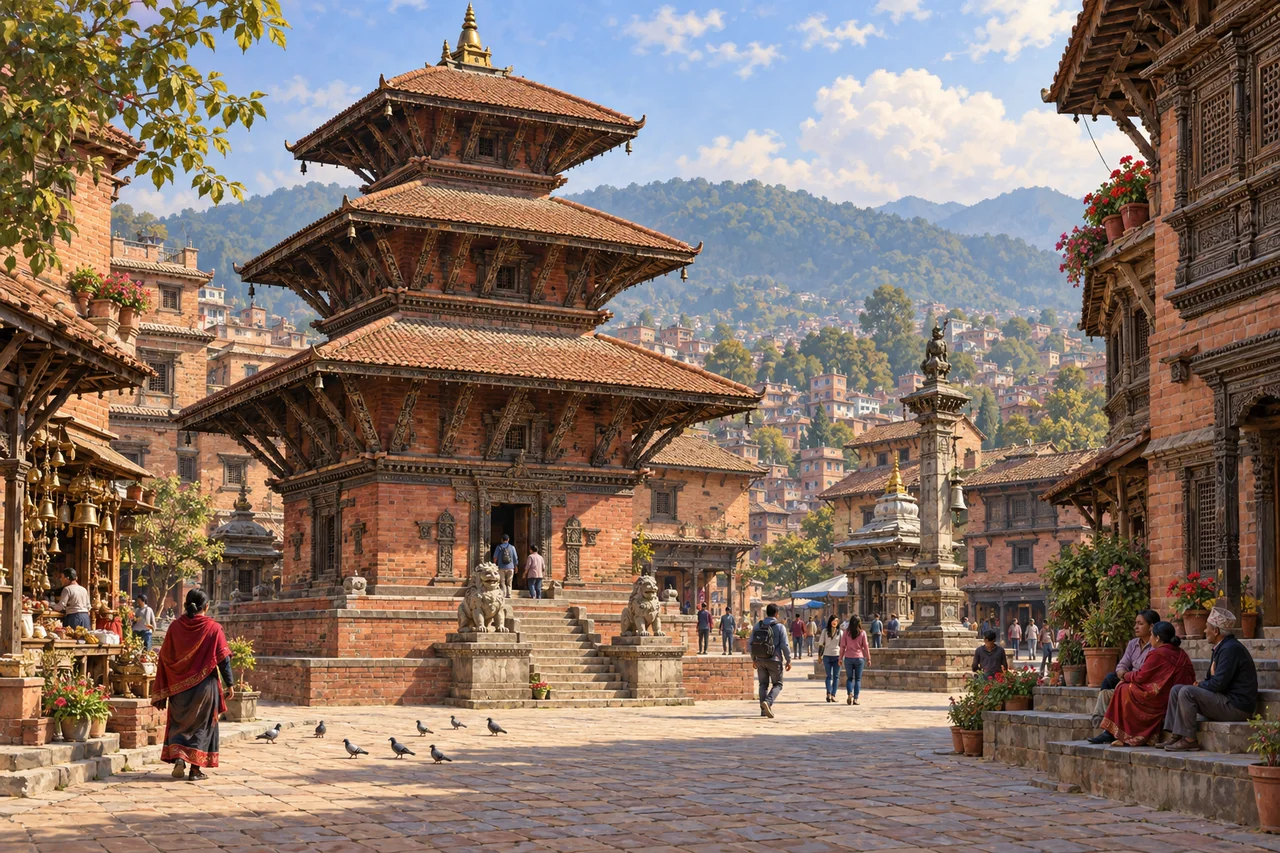
myAudience · original generated illustration · Original generated illustration; interpreted setting, not documentary evidence, current conditions or an authenticated viewpoint.
Kathmandu Valley's heritage is not concentrated in one landmark. Its UNESCO designation brings together seven monument zones, including the palace squares of Kathmandu, Patan and Bhaktapur and distinct Hindu and Buddhist religious ensembles. The distributed arrangement matters: learning about the valley means comparing places and communities rather than finding one building that supposedly represents them all.
UNESCO describes fired-brick walls, timber structures and overlapping roof tiles among the characteristic materials of its tiered temples. Carved windows, doors and roof supports introduce the skill of Newar craftspeople. A building's silhouette can draw attention first, but construction becomes more interesting when you ask how different materials work together. Ornament and structure deserve separate examination even when they share the same surface.
The stupas and temples have different forms and religious associations. A stupa's rounded body is not simply a version of a tiered temple, and architectural exchange does not make Hinduism and Buddhism identical. The valley's cultural relationships developed over centuries. Particular practices, images and histories should be explained through identified sources and community perspectives, rather than assigned meanings from a visitor's impression alone.
Our interpreted square uses brickwork, carved timber and layered roofs to encourage close looking. Follow a roof edge toward its supporting members, then compare the building with the open space around it. Which features might a distant photograph miss? The image cannot establish the age of a carved beam, the identity of a ritual or the history of rebuilding. Those questions need records and the knowledge of people connected with the place.
A heritage square remains part of everyday life as well as a setting for worship and remembrance. Respect private thresholds, ceremonies and current local rules, including photography arrangements. Ask how conservation can preserve skills and support residents, rather than protecting only a familiar skyline. This reading introduces architectural relationships without promising an unchanged historic scene or current access. The wider valley has more stories than one illustration can contain.
Image: illustration, not a documentary photograph.
Further reading
A useful starting point for Kathmandu Valley is a group of places rather than a single skyline. Its World Heritage property comprises seven monument zones: three palace-centred urban ensembles and four religious ensembles. The Durbar squares connect buildings with public space, while the religious sites have their own histories and practices. Comparing them makes the valley's heritage a relationship between settlements, institutions and skilled work, rather than an isolated collection of impressive roofs.
Newar craftsmanship connects materials that behave differently. UNESCO identifies brick and mud mortar alongside structural timber, tiled roofs and metal ornament in characteristic tiered temples. A wall encloses space, a frame supports parts of a building, and projecting roofs shelter edges; carving may decorate a member that also carries load. These are distinctions for reading construction, not a design calculation. The actual connections and condition must be established before a visible pattern can support a structural conclusion.
The broad historical period in which an architectural tradition flourished is not the manufacturing date of every part. UNESCO describes a particularly important development between 1500 and 1800, within a much longer cultural history. A replaced roof tile and an earlier carved strut might occupy the same building. Ask whether a date refers to a foundation, a construction campaign, an inscription or a later repair. This separates the age of an institution from the history of its surviving fabric.
Hindu and Buddhist ensembles are distinct even where traditions have interacted. A rounded stupa and a tiered temple organise space differently; their religious meanings need identified evidence and custodians' explanations. Exchange does not mean that every practice is interchangeable. Urban heritage also includes houses, courtyards and routes through which people reach these places. Concentrating only on a monumental silhouette can obscure how worship, craft and everyday life belong within the same settlement.
A documented reconstruction offers a closer construction story. UNESCO's October 2020 account of the Radha Krishna Temple describes assessment after the 2015 earthquakes, including damaged timber and cracks in brickwork. Archaeological investigation and records of earlier interventions informed the restoration. This example is a shikhara-style temple at Teku, not proof that every tiered temple shown in our cover underwent the same work. Its value is the sequence from observed damage to documented decisions.
That project numbered and measured exterior brick layers before reinstating them and consulted local experts about materials and joints. Such recording preserves information that dismantling would otherwise destroy. Training and traditional workmanship were part of the process, rather than an optional decorative finish. A faithful outline alone would not show which materials were retained, replaced or tested. This dated completion report concerns one project; it does not certify the condition of every monument or offer current visiting instructions.
Our illustration shows a brick temple with layered tiled roofs, carved timber and a busy paved square. It supports comparison of enclosure, projection and adjoining public space. It is not an authenticated identification of the Radha Krishna Temple, a load test or a record of a particular ceremony. Follow the visible roof edges and supports, then use documentary evidence to ask about connections and repairs. The people and surrounding buildings are an interpreted setting, not a historical census.
Check: A fictional repair team recreates a temple's previous silhouette but replaces all timber without recording the old joints. It claims to have preserved every kind of historical evidence because the roof looks unchanged. Is the claim justified, and what would improve the record? Answer: The silhouette preserves one aspect of form, not the discarded fabric or construction evidence. Measured drawings, component identifiers, photographs and an explicit retained/replaced register could document what was lost and why. Consultation with custodians also matters to use and meaning. None of these records alone establishes structural safety.