Gorée: a place of memory, and how to read it
By Places and their stories · myAudience
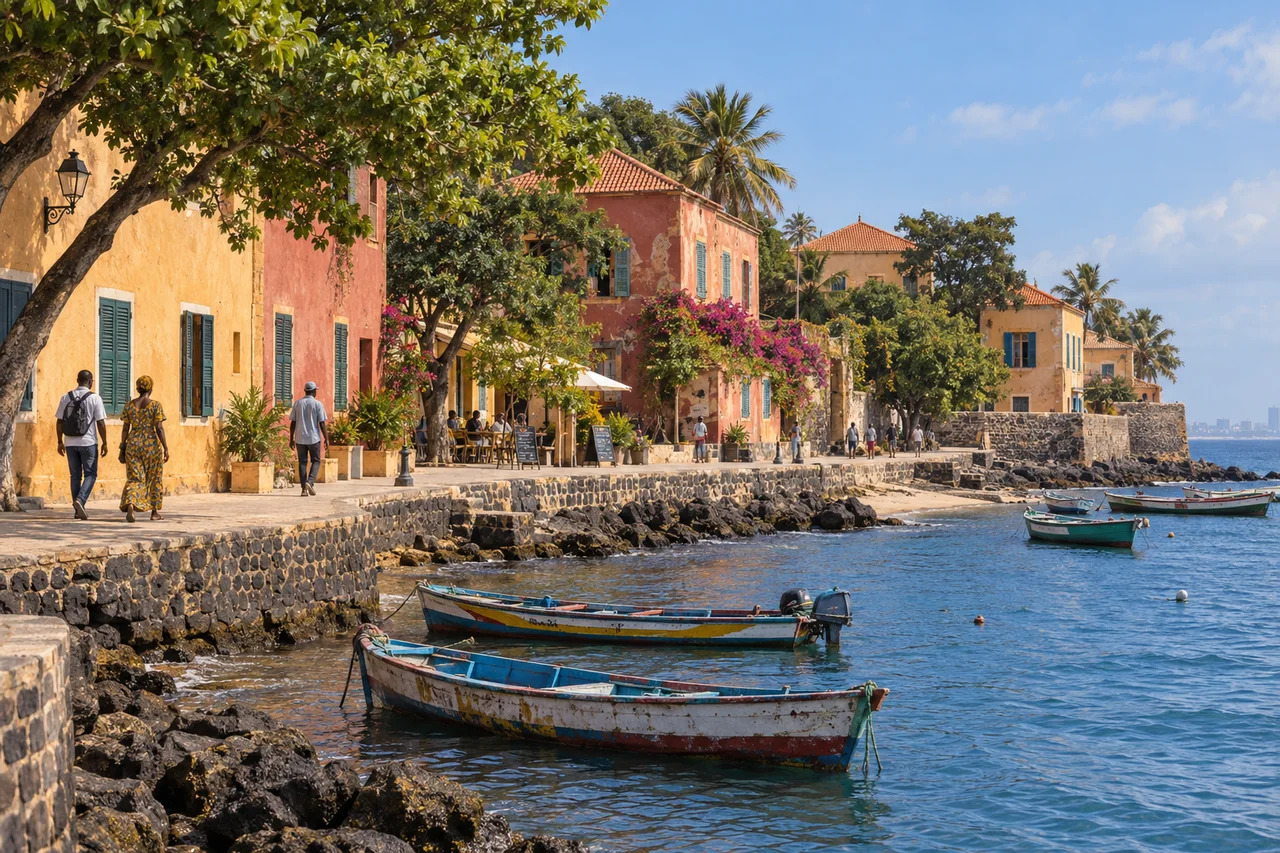
myAudience · original generated illustration · Original generated illustration; interpreted setting, not documentary evidence, current conditions or an authenticated viewpoint.
Gorée lies off Dakar, but its significance reaches across the Atlantic. The island is a place of memory associated with enslavement and the slave trade, whose consequences connect African, European and American histories. A quiet waterfront image must not make those relationships disappear. Looking carefully means holding the beauty of a present setting alongside questions about exploitation, loss and remembrance.
UNESCO identifies buildings, streets, fortifications and former residences as elements of that memorial landscape. European powers successively controlled the island, leaving material evidence of unequal authority. A historic house can be examined through its spaces, recorded uses and later interpretation. Its attractive facade does not reveal the experience of every person connected with it, or establish the scale of trafficking through that particular building.
Distinguishing evidence from commemorative meaning is essential. A place can carry powerful symbolic importance without a visitor repeating an unverified transport total or ranking it against every other port. Records, archaeological work and personal histories answer different kinds of question. An account should identify what each source can support rather than treating a familiar memorial story as a complete statistical history of Atlantic slavery.
Our interpreted waterfront shows masonry, shaded edges and everyday movement rather than reenacting suffering. Ask what a view includes and what it leaves outside the frame. The image cannot identify a particular prison room, authenticate a historical departure or reproduce the testimony of an enslaved person. It can encourage attention to setting while written and spoken evidence provides the harder history that appearance alone cannot disclose.
Give memorial spaces and people living on the island the respect due to both. Listening to interpretation is different from demanding a performance or using a place of mourning as a decorative background. Reconciliation should not be presented as something every person has achieved or owes to others. Use current official guidance for an actual visit. This introduction supports learning and remembrance without reducing Gorée either to a picturesque escape or to one simplified account of a much wider tragedy.
Image: illustration, not a documentary photograph.
Further reading
Gorée can be approached as a place of remembrance without reducing it to a picturesque waterfront. Its buildings, streets and fortifications belong to histories of European competition, commerce and the enslavement of African people. The harm involved is not an architectural style: people were deprived of freedom and subjected to violence. A responsible reading asks what surviving spaces and documentary records reveal about those relationships, alongside the later work of commemorating them.
The island's position near Dakar and its anchorage help explain interest in controlling it. A port connects local routes with wider maritime networks, but a favourable position does not establish how much traffic passed through a particular building. Shipping records, dates, destinations and the boundaries of a count would all matter. Never infer a population total from a doorway's size, or assume that one island represents every region's experience of the Atlantic slave trade.
The House of Slaves has become an important memorial site. UNESCO's 2024 Courier account discusses the role of curator Boubacar Joseph Ndiaye in developing recognition and remembrance. It also explicitly notes debate about the island's centrality within the trade. The older World Heritage description uses a sweeping ranking that should not be repeated here as a measured conclusion. Symbolic importance and a disputed quantitative claim must be kept separate, without treating uncertainty about the latter as denial of slavery's documented violence.
Memorial interpretation is an activity with a history of its own. A museum route, an explanation and a commemorative doorway can focus attention on loss and separation. Ask which parts of an account derive from specific records and which communicate remembrance more broadly. This need not diminish the place's meaning. It allows learners to understand both the past being remembered and how later curators, visitors and communities have made that history publicly legible.
Surviving buildings can raise questions about unequal power. Who occupied an upper room, who was confined elsewhere, and which evidence supports that identification? A layout can direct an investigation but does not answer those questions by itself. Documentary provenance, changes of use and alterations need to accompany interpretation. Avoid inventing the identity or route of an individual person from a fictional image. Naming the limits of the evidence helps prevent a moving narrative from becoming an unsupported biography.
The Courier's dated reporting also describes Gorée as an inhabited island and a place of diaspora remembrance. These roles coexist: learning about harm need not erase present residents, and contemporary daily life does not erase the history. Conservation concerns may include coastlines and buildings as well as interpretation. A report about a revitalisation programme is evidence of the programme described then, not a promise about current completion, boat services or a visitor's emotional response.
Our illustration depicts colourful waterfront buildings, a stone shore edge, small boats and fictional people. It is not an authenticated image of the House of Slaves, an embarkation record or a reconstruction of captive conditions. Its pleasant light cannot establish a benign historical relationship. Use the visible shore-and-street arrangement to ask how an island connects with maritime movement, while keeping the learning anchored in historical evidence and remembrance rather than treating the cover as testimony.
Check: A fictional curator estimates total departures by multiplying the capacity of one room by the number of years a building existed. Another suggests explaining memorial meaning without presenting that estimate as an archival count. Which approach is better supported? Answer: Capacity multiplied by years lacks occupancy, duration, turnover, dates of use and records connecting people to departures. It cannot establish a total. The second approach can explain the site's documented commemorative role while identifying the separate evidence needed for a quantitative history. Rejecting the calculation does not minimise the violence being remembered.