Seville: a tower, a palace and an archive
By Places and their stories · myAudience
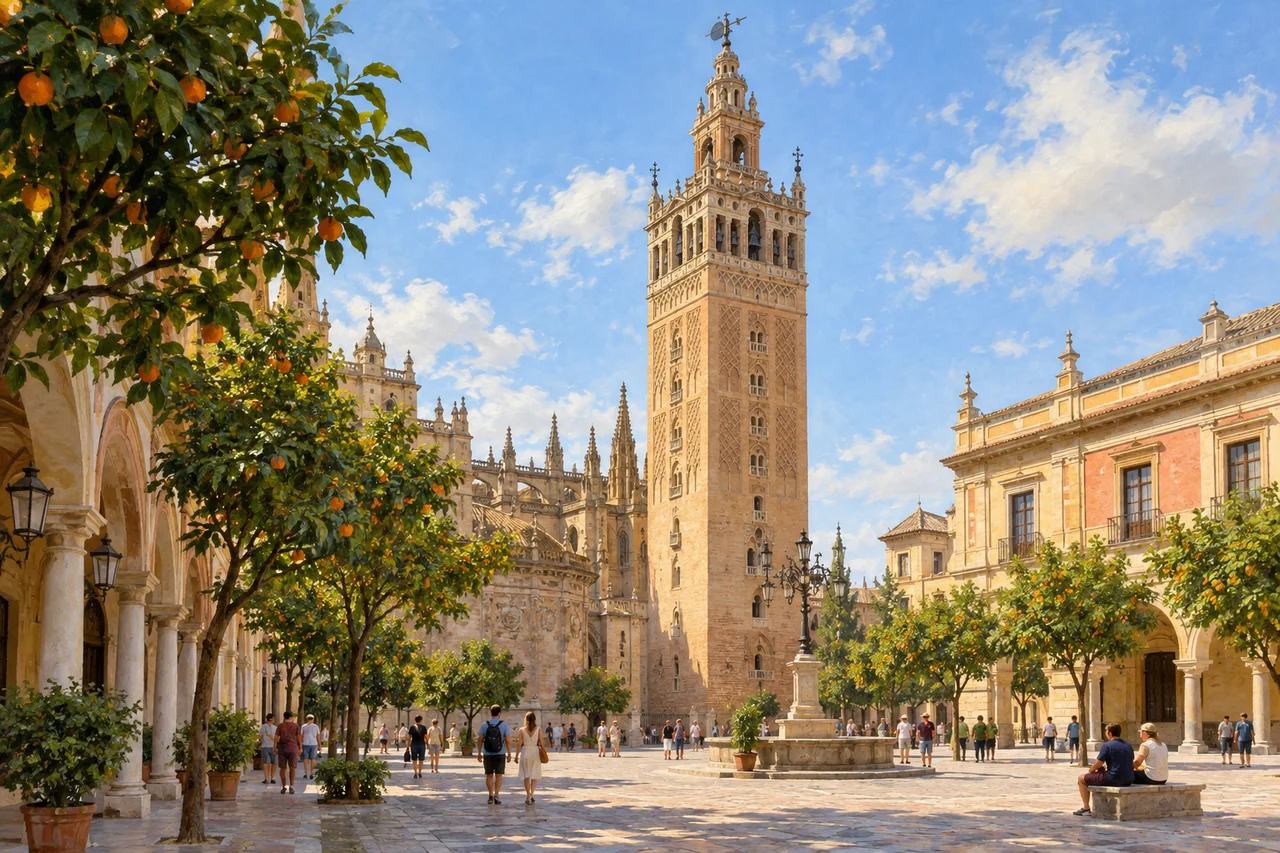
myAudience · original generated illustration · Original generated illustration; interpreted setting, not documentary evidence, current conditions or an authenticated viewpoint.
Seville's designated monumental ensemble joins the cathedral and Giralda, the Alcázar and the Archivo de Indias. Their proximity makes a useful introduction to different kinds of power: religious institutions, royal authority and colonial administration. They do not all tell the same story or come from one period. Learning how their uses and architecture differ gives the group more meaning than a list of impressive buildings.
The Giralda began as the minaret of an Almohad mosque and later became a cathedral bell tower, with a Renaissance upper section. The cathedral replaced the mosque while retaining elements of the earlier complex. A tower's present form therefore combines changes of function and additions over time. Recognising those layers prevents its silhouette from being treated as a single unchanged example of one architectural tradition.
UNESCO describes the Alcázar as a group of palatial buildings and gardens shaped across successive periods, including Mudéjar craftsmanship. The archive building, originally a merchants' exchange, later housed records connected with Spanish administration in the Americas. Those documents provide evidence of colonial relationships; an institutional collection is not a neutral account of every person's experience. Its records invite questions about whose actions were documented and whose voices need other sources.
Our interpreted scene pairs a Giralda-inspired tower with warm masonry, planted edges and public space. Compare the tower's lower body with its more elaborate upper portion. What could that difference suggest for further investigation? It does not prove a date by itself. The image cannot authenticate a specific courtyard or inscription, reconstruct the former mosque or show the archive's contents. Architectural observation should lead toward evidence rather than replace it.
A responsible introduction can appreciate skilled work while acknowledging conquest and colonial power. It need not use the language of discovery to imply that the Americas lacked people or histories before European arrival. Respect living worship spaces, working entrances and current visitor arrangements. The wider city includes communities and everyday places beyond its monumental ensemble. Learning about Seville is richer when a beautiful skyline opens questions about change, institutions and the limits of the records they leave.
Image: illustration, not a documentary photograph.
Further reading
Standing near a tower, a palace and an archive opens three different questions about power. Buildings can express religious authority, royal government or the organisation of trade, while their uses and forms change. Seville's designated ensemble is a useful place to practise that comparison. Proximity does not make the buildings one institution, and an impressive skyline cannot tell us whose actions appear in surviving records. Read the differences between the objects as carefully as their shared setting.
The UNESCO account identifies the Giralda as an earlier minaret later incorporated into the cathedral's bell tower, with a Renaissance upper section. This combines continuity of material with changes in form and function. Observing a contrast between lower and upper portions can prompt further investigation; it is not, alone, proof of a construction date. The source relationship and appropriate dated evidence supply the historical argument. A silhouette may remain recognisable while the purposes associated with it alter substantially.
The Alcázar's named spaces make its successive phases easier to understand. UNESCO identifies the Patio del Yeso and Jardines del Crucero with surviving Almohad work, alongside the Palacio de Pedro I as an example of Mudéjar architecture. Later Renaissance and Neoclassical elements extend the sequence. These are specific relationships within a palace complex, rather than one style applied to every room. They show how a later royal project could draw upon forms and craftsmanship associated with earlier Islamic building traditions. The gardens and palatial spaces also explain why the ensemble has to be read in plan and movement, not only as a collection of decorated facades.
The Archivo de Indias demonstrates a particularly clear change of institutional use. UNESCO dates the building's construction as a merchants' exchange to 1585 and its conversion to the archive to 1785. The interval is two hundred years, but the subtraction does not describe every activity within it. The dates support a contrast between documented roles. They do not establish an unchanged audience, collection or purpose throughout the building's life, nor tell us that its present contents represent every perspective equally.
The Ministry of Culture's history of the Lonja shows that becoming an archive did not instantly give it one exclusive tenant. From 1785 the Archivo General de Indias occupied part of the upper floor, while commercial institutions continued using lower spaces; the archive subsequently expanded. The institution now identifies records produced by the Consejo de Indias, the Casa de la Contratación and the consulates of Seville and Cádiz among its holdings. Conservation, arrangement and description make those records usable to readers. Their institutional origins also explain their perspective: correspondence and administrative documents can reveal how imperial government worked, while requiring other evidence to recover experiences less visible in its paperwork.
Discussing the ensemble can appreciate craftsmanship while examining conquest and colonial administration. Architectural achievement does not erase the unequal relations documented by institutions, and institutional records should not be treated as the sole voice of every community. Compare what a source was produced to do, what it records and what remains uncertain. This does not make the source useless. It makes its contribution clearer and avoids replacing careful historical interpretation with either uncritical celebration or a claim that no evidence can be trusted.
The illustration contrasts a tall lower tower body with an elaborate upper section, warm masonry, planting and public space. Those visible differences invite a layered reading of form. The scene is Giralda-inspired, not a reconstruction of the former mosque or a survey of the archive. No documents are pictured, and the surrounding activity is not a historical census. Use the image to begin architectural comparison, then let the relevant sources carry claims about institutions, dates and changing functions.
Check: An exhibition retains a tower silhouette and displays official colonial records. It claims unchanged architectural function and a complete account of every community. Assess the claims separately. Answer: Neither follows. A surviving silhouette does not establish unchanged function or construction phase; official records preserve particular institutional perspectives, not all voices. Compare dated fabric and use evidence with complementary sources. Retain what the records do establish without treating their omissions as proof that other experiences did not exist.