Reykjavík: the city beyond the dramatic landscape
By Places and their stories · myAudience
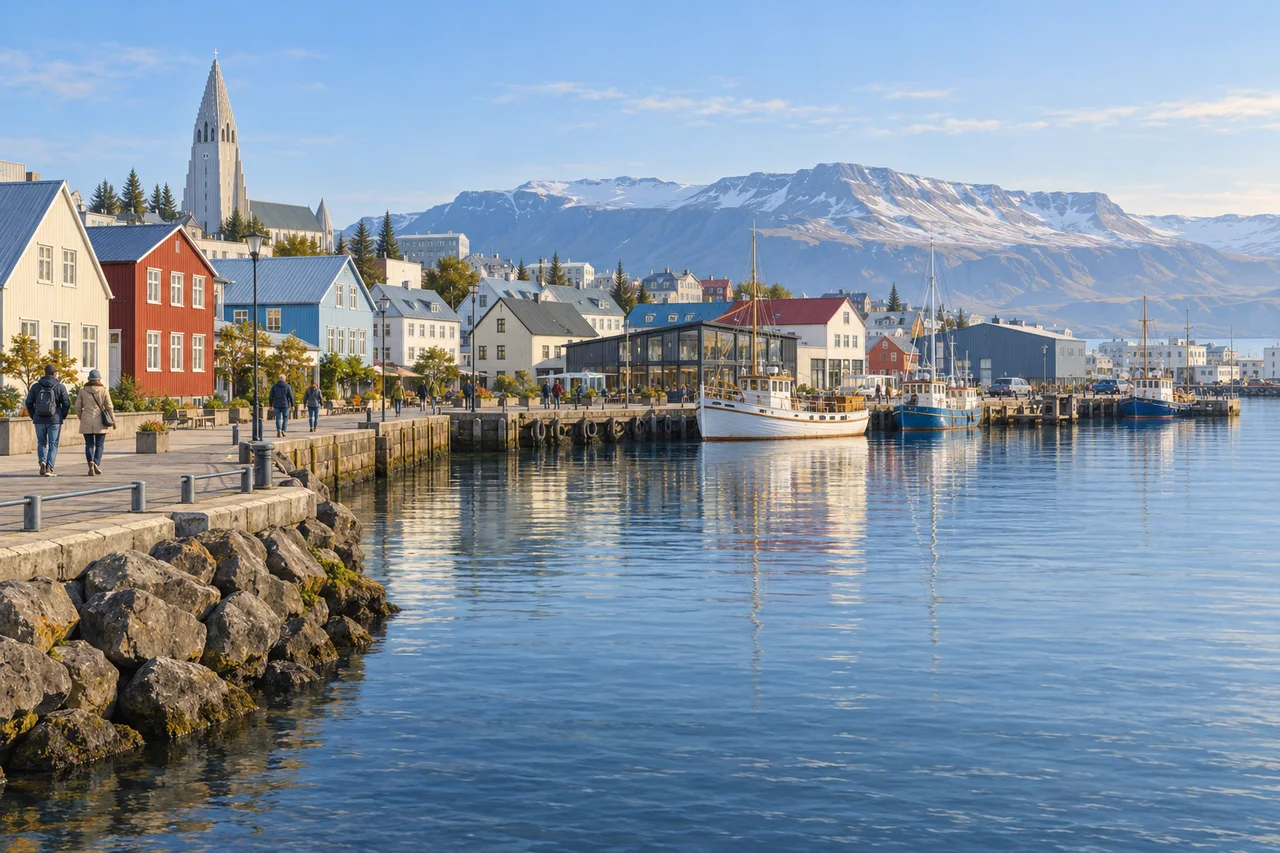
myAudience · original generated illustration · Original generated illustration; interpreted setting, not documentary evidence, current conditions or an authenticated viewpoint.
Reykjavík is often used as a starting point for journeys into Iceland's landscapes, but the city has a history worth exploring in its own right. Modest buildings, public institutions and harbour spaces reveal how a settlement became an urban centre. Looking beyond a dramatic national backdrop makes ordinary streets more interesting: they hold stories about work, education, infrastructure and decisions that shaped daily life.
The city's official visitor history describes scattered farms before urban development gathered pace in the eighteenth century. Efforts to establish a wool industry helped that change, and town rights followed in 1786. These are different milestones from the much earlier history of settlement in the area. A founding tradition, an archaeological remain and a legal charter should not be collapsed into one moment when a complete city supposedly appeared.
The same account connects later growth with institutions including the re-established Alþingi in 1845 and the University of Iceland in 1911. It also discusses harbour construction and early water, electricity and heating infrastructure. These developments suggest a useful way to investigate urban change: follow a service or institution and ask how it affected places beyond one prominent building. Historical dates do not establish today's capacity or service arrangements.
Our interpreted harbour scene places modest colourful buildings beside water and a restrained contemporary waterfront. Compare the low roofs with the broad northern sky. What could a historic map reveal about changing shoreline use and the relationship between homes and work? The illustration does not reproduce a particular harbour phase, authenticate a named house or show the underground heating system. Its calm composition introduces the city without substituting for those records.
A good city visit can make room for museums, ordinary neighbourhoods and everyday cultural life as well as landmark photographs. Respect homes and working routes, and consult current local information for arrangements and weather. This reading makes no promise of aurora, clear conditions or access to a distant landscape. Reykjavík's story becomes richer when its urban development is treated as something to learn about, rather than as a waiting room for the rest of Iceland.
Image: illustration, not a documentary photograph.
Further reading
Reykjavík's harbour brings together a working waterfront, streets of small buildings and a mountain horizon. That attractive surface conceals an unusual urban question: how does a northern city keep buildings warm without putting a furnace in every home? The answer connects geological heat to pumps, storage and maintenance. A harbour view also opens a different history of fishing, trade and settlement. Following those two networks, water beneath the ground and movement across the sea, gives the city more depth than a collection of scenic stops.
Veitur identifies two sources for the capital region's heating supply: local geothermal wells and the cogeneration plants at Hellisheiði and Nesjavellir. Wells feed pumping stations; water from the plants passes through storage tanks on Reynisvatnsheiði before distribution. These named places matter because geothermal heat is not simply available at every building's doorstep. A utility connects distant supply to uneven demand. The city's warmth depends on an organised system of pipes, tanks and stations, with geology supplying an opportunity that engineering must turn into a reliable service.
Consider the purpose of a storage tank. Homes do not all demand the same amount of heat at the same moment, and equipment cannot respond without limits. Stored hot water can help separate the timing of production from the timing of use. Pumps establish movement through a network; insulation reduces unwanted heat transfer along the route. These are general engineering principles, rather than a claim about a particular tank's capacity. A diagram with a source, a pump, a reservoir and several consumers explains more than drawing a single arrow from a volcano to a house.
Some used heating water returns to the pumping stations. Veitur describes mixing this cooler return with very hot supply water to bring the distributed water to around eighty degrees Celsius. That is a description of part of the utility's system, not an instruction for home plumbing. Mixing illustrates an energy balance: hot and cooler streams produce an intermediate temperature when losses and heat capacities are accounted for. Geothermal heat therefore does not remove the need for temperature control, safe equipment or careful operation. Renewable supply and dependable distribution are different achievements.
Reykjavík's earlier settlement can be explored through evidence preserved beneath present streets. The Settlement Exhibition centres on a tenth-century longhouse discovered during construction in 2001 and retained at its original location. A foundation is valuable because its relationship to the surrounding ground survives; moving stones into a display would lose some of that context. Domestic remains can tell a different story from a written account of famous settlers. They invite questions about room arrangement, shelter and ordinary work, while interpretation must distinguish observed remains from a reconstructed interior.
The municipal museum places the Maritime Museum, the Settlement Exhibition, Árbær, the photographic collection and Viðey within one network. This offers several scales for understanding urban change: a household, a waterfront industry, a preserved building and a photographed street. A former fish factory housing the Maritime Museum is itself part of the fishing story. Sources and objects can be compared rather than expected to tell identical histories. An image may show a vessel's form, a tool its use and an account the experiences of people who worked aboard it.
In the illustration, follow the quay's edge towards the boats, then look back at the compact roofs and distant ridgeline. This is an introductory harbour composition, not a survey of Reykjavík's actual skyline or a historical photograph. The church-like tower and mountain arrangement should not be used to infer a precise viewpoint or walking route. The heating pipes discussed here are mostly absent from the scene. That absence is useful: a city's most important systems can shape everyday comfort without becoming its most visible landmarks.
Check: In a fictional, loss-free mixing model, one kilogram of water at ninety degrees Celsius joins one kilogram at fifty degrees. Assume equal specific heat capacities. What is the resulting temperature, and does that describe every part of Reykjavík's network? Answer: Equal masses give equal thermal weighting, so the mixture is seventy degrees Celsius. The hot stream cools by twenty degrees while the other warms by twenty. Unequal masses, losses and real equipment would alter the result. This model explains mixing; Veitur's description of approximately eighty-degree supply concerns its actual system, not these invented quantities.