Varanasi: a riverfront with different meanings
By Places and their stories · myAudience
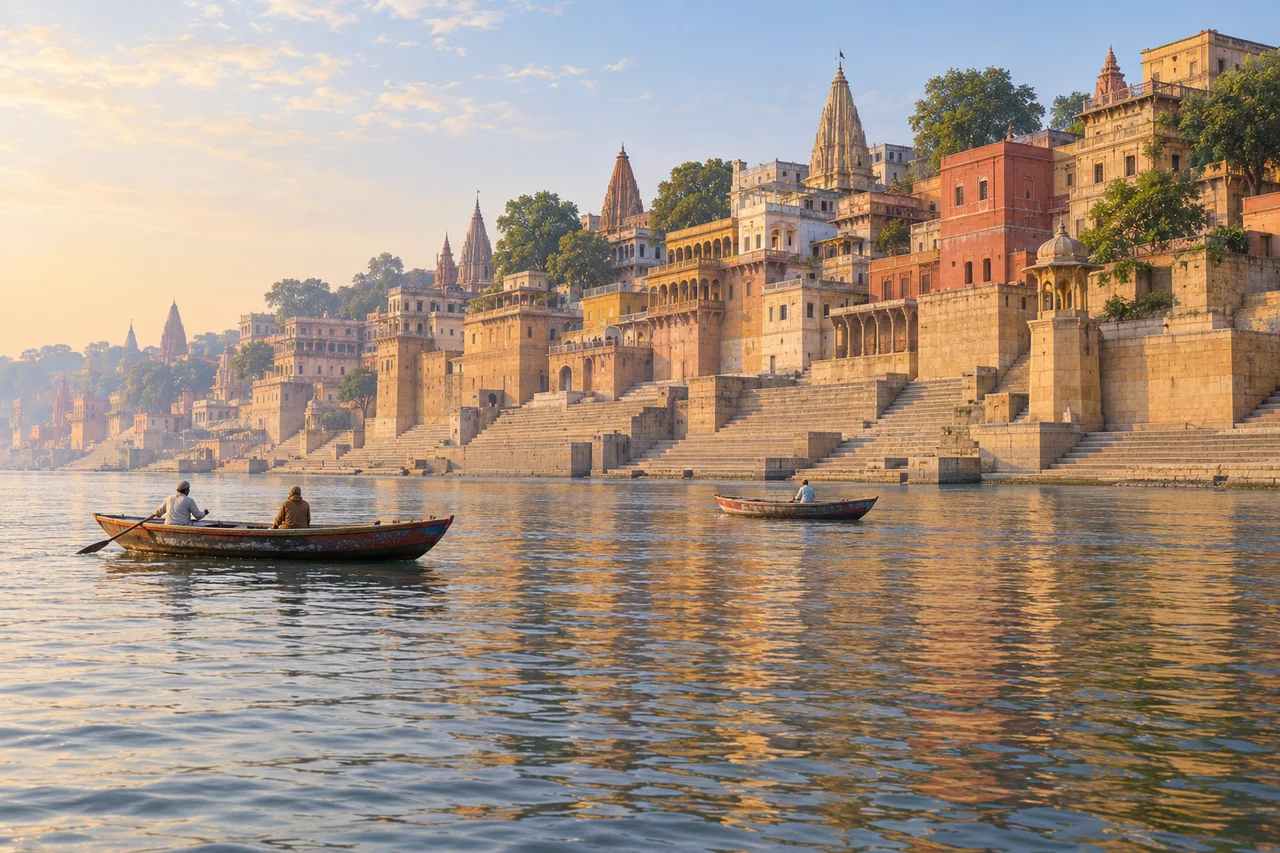
myAudience · original generated illustration · Original generated illustration; interpreted setting, not documentary evidence, current conditions or an authenticated viewpoint.
Varanasi's riverfront is often introduced through the broad steps descending to the Ganges. Those ghats connect the city to water, but their purposes and meanings are not interchangeable. A distant view can suggest an architectural rhythm while concealing distinctions between daily movement, worship and funerary practice. Learning to notice those differences is part of approaching a living place with care rather than treating it as a single spectacle.
The district administration describes ghats as riverfront steps and distinguishes bathing and puja settings from cremation sites. It also notes the association of many ghats with legends and religious traditions. Such accounts explain significance to participants; they should not be presented as scientific evidence for supernatural effects or water safety. Historical evidence, religious interpretation and practical visitor information answer different kinds of questions.
A staircase is a useful point of architectural inquiry. Compare the repeated landings with the height of neighbouring buildings, then ask how a street above might connect to the water below. A measured plan and observations at different river levels would be needed to investigate that relationship properly. A beautiful view cannot establish how a particular ghat was constructed, how it has changed or whether a route is appropriate today.
Our interpreted image shows ordinary steps, masonry buildings and a few small boats, without depicting a cremation, identifying worshippers or staging a ritual. The broad river and compact frontage create a contrast between horizontal space and repeated vertical edges. Notice how that contrast guides the composition. It is an invitation to look more carefully, not evidence of a precise bank profile, season, water quality or named viewpoint.
People's religious observance and grief deserve privacy, especially where visitors may misunderstand what is happening. Ask before photographing identifiable people, follow local restrictions and avoid intruding into ceremonies or funerary spaces. Consult current official advice for any actual visit or river activity. This introduction does not prescribe bathing, make cleanliness claims or certify boat access. A respectful reading can appreciate the riverfront while recognising that its meaning belongs to communities and practices beyond the visitor's frame.
Image: illustration, not a documentary photograph.
Further reading
Varanasi's riverfront presents a city through its thresholds. Broad flights of steps descend from dense buildings towards boats and water; narrow lanes connect the upper town to the edge. This relationship makes the ghats both physical structures and places of activity. A distant view reveals levels and movement, but it cannot explain every practice occurring there. The deeper account joins urban space with worship, music, craft and learning, recognising residents and practitioners rather than treating the riverbank as a stage assembled for a visitor's camera.
India's tourism ministry distinguishes the functions and histories of named ghats. Its Varanasi account connects Dashashwamedh with evening worship, Assi with a sunrise gathering and Manikarnika with cremation. These places should not be collapsed into one generic riverside attraction or assigned an identical meaning. The city also contains universities, markets and artisan work. A useful map might record different kinds of activity and their relationships, while leaving an actual visit's access and conduct to current local guidance. A picturesque riverfront does not erase the need to respect private grief or religious practice.
Steps make a connection across changing levels. In a general waterfront design, an extended flight can provide several possible landing heights as the water surface changes. That geometry does not guarantee that every step is usable at every river stage; currents, submerged surfaces and access management matter. Draw a cross-section and move a water line through it to see how the available dry area changes. This original spatial model explains a relationship visible in the illustration without estimating the Ganges' present level or offering advice about entering the water.
Music is another important form of continuity. UNESCO lists Varanasi as a Creative City of Music since 2015 and describes the Guru-Shishya Parampara, a teacher-pupil tradition supporting the transmission of skills. A musical heritage depends on repeated practice, correction and opportunities to perform, not solely on preserving the name of a famous musician. Its bearers can adapt while sustaining recognisable knowledge. Recognition of living creativity therefore differs from designation of a particular historic building: a network membership is not proof that every riverfront structure is a World Heritage monument.
A learner hearing a raga needs more than a sequence of pitch names. Timing, phrase development, listening and the relationship between a performer and teacher contribute to practice. These general observations explain why a recording and a written description can complement rather than replace instruction. The same principle applies to weaving or other craft work: knowing the name of a technique is not the same as controlling it. A city supports learning when practitioners have places, resources and audiences through which knowledge can pass to another generation.
Historical claims need their own evidence. The ministry's Rajghat account describes archaeological work by the Archaeological Survey of India and later university researchers, with finds including pottery, terracotta figures and structures. Such material asks different questions from a present riverfront scene. An excavated object requires its recorded context to connect it to a layer or phase; an old-looking facade cannot supply that information. The account's broad story of settlement should therefore be distinguished from devotional origin narratives, which express belief rather than being used here as archaeological dating evidence.
The illustration places boats before stepped banks and closely arranged buildings with rising temple-like forms. It introduces the connection between river and town without certifying a named ghat or documenting a ritual. No rendered person is assigned a religious identity or private story. At small scale the steps, water and building line remain legible, while inscriptions and details do not. The calm light supplies atmosphere rather than evidence of current access or water conditions. Identified sources and living practitioners provide meanings that the surface of the scene cannot establish alone.
Check: A label calls UNESCO's music recognition proof that all pictured buildings are World Heritage monuments, and treats a recording as a complete replacement for a teacher. Explain the two errors. Answer: Creative City of Music membership recognises a city's creative field and cooperation; it is different from inscription of a defined monument or site. A recording can help listening, but does not automatically supply personal feedback, context or the full process of developing skill. The riverfront illustration establishes neither a designation boundary nor a learner's mastery. Different kinds of evidence are needed for buildings, archaeology and living traditions.