Sigiriya: a rock, a garden and the evidence between them
By Places and their stories · myAudience
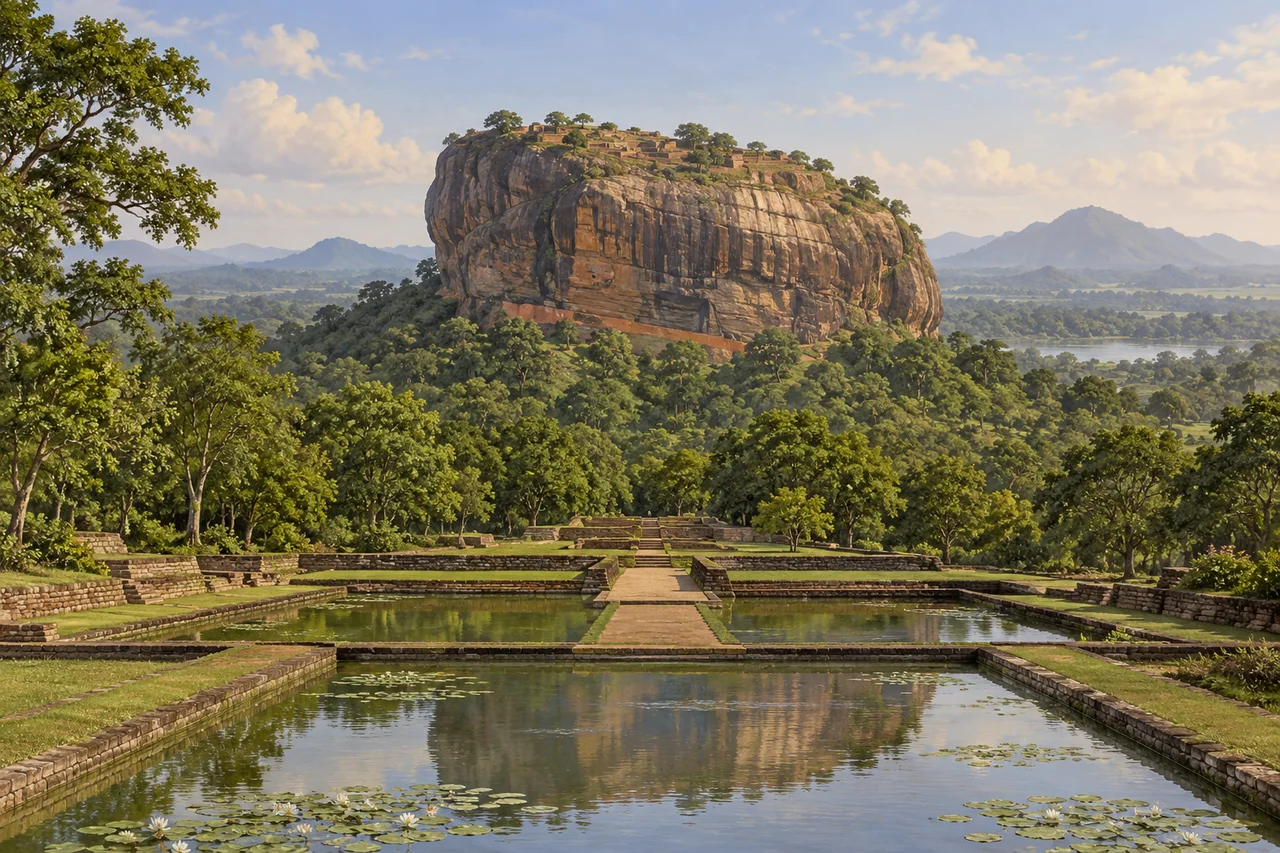
myAudience · original generated illustration · Original generated illustration; interpreted setting, not documentary evidence, current conditions or an authenticated viewpoint.
Sigiriya's great rock makes an immediate visual impression, but the landscape below is essential to understanding the place. Gardens, water features and surviving structures connect a royal complex with its natural setting. The contrast between an abrupt rock face and an ordered foreground can introduce questions about planning, materials and power. An imposing silhouette alone cannot explain how the whole site was used.
UNESCO associates the royal residence with Kassapa I in the late fifth century. The Central Cultural Fund describes water gardens with pools and channels, boulder gardens and terraced areas. These elements suggest different ways of working with the terrain rather than one uniform garden surface. Connecting an individual feature with a construction phase requires archaeological evidence; a general introduction cannot date every surviving fragment.
The site also preserves paintings and historical writing on the Mirror Wall. The Cultural Fund notes differing interpretations of the painted figures, so their identities should not be stated as settled facts. Surviving lion paws recall an entrance that has lost much of its original form. This is a distinction between observed remains and reconstruction: recognising a lost architectural idea does not mean the complete structure is still there.
Our illustration connects rectangular water-garden forms with the rock beyond. Compare the clear foreground lines with the irregular upper surface. How might a measured plan help distinguish an arranged pool from a natural hollow? The image does not show a working hydraulic circuit, authenticate frescoes or reconstruct an intact lion gateway. It is a landscape interpretation, not evidence for an exact height, water pressure or construction sequence.
Conservation has to protect vulnerable surfaces as well as the site's wider setting. Follow current local arrangements and avoid touching protected artwork or adding marks to historic walls. This reading offers no climbing instructions, timing promises or claim that fountains are operating today. It also avoids presenting a dramatic royal legend as a fully verified biography. The interest lies in bringing archaeology, art and landscape together while keeping uncertainty visible where the evidence does not settle a question.
Image: illustration, not a documentary photograph.
Further reading
Sigiriya brings a rock, a garden and a ruined royal complex into one dramatic composition. Pools and straight paths occupy the low ground, while the summit stands far above them. Following that contrast is more revealing than calling the place simply a fortress. Different activities were fitted to different terrain: water and movement could be arranged across the gardens, routes negotiated the steep face, and buildings occupied the top. The scene invites us to connect landscape design with the practical problem of maintaining a settlement across changing levels.
UNESCO associates the citadel with Kashyapa's late-fifth-century capital and describes an approach through galleries and stairs connected with a monumental lion entrance. The Central Cultural Fund presents a broader ensemble of palace, gardens, artworks and later religious use. These descriptions help distinguish a royal episode from the whole site's history. A place can retain material from one period while being reused and interpreted in others. Explaining that sequence is more informative than assigning every surviving feature the same purpose or presenting the most dramatic royal story as the only history worth following.
The Central Cultural Fund distinguishes water gardens, boulder gardens and terraced gardens. Their arrangement does different work: pools and channels organise the lower ground, rock features shape movement, and changes in level create successive spaces. The Fund also describes summit cisterns and a hydraulic network serving fountains. These are connected responses to water and terrain, but they need not all share the same source or operating conditions. A cistern stores water; a channel transports it; a fountain converts pressure into visible motion. Treating those functions separately makes an ancient system easier to understand.
A general fountain model begins with a water surface above an outlet. The pressure difference associated with height can drive water through a passage, while friction and restrictions reduce the available flow. Consider a fictional reservoir with a two-metre head. Using water density 1,000 kilograms per cubic metre and gravitational acceleration 9.8 metres per second squared gives a pressure contribution of 19,600 pascals, or 19.6 kilopascals. This is a calculation for an idealised arrangement, not an excavation result at Sigiriya. It shows how a modest difference in level can matter without requiring a modern electric pump in the model.
Stored water also sets a limit on operation. A fictional 600-litre cistern feeding an outlet at ten litres per minute would last sixty minutes if no water entered and the full volume were usable. Doubling the flow would halve that duration. Real systems add rainfall, seepage, changing pressure and several outlets, so capacity alone cannot establish performance. The example makes a useful connection between a garden's appearance and its water budget: a fountain can be visually impressive while operating intermittently, and a storage tank can matter even when it is not prominent in a distant view.
The Mirror Wall introduces a different kind of surviving evidence. The Central Cultural Fund describes polished plaster carrying visitors' poems and reflections, while the nearby paintings have attracted several interpretations. Material traces of looking can therefore survive alongside the objects people looked at. An inscription offers evidence of a particular expression; its survival does not make its writer representative of every visitor. Similarly, identifying a painted figure requires more than assuming that one familiar interpretation is settled. Reading a site combines structures, texts and images whose evidential strengths are different.
The illustration puts the pools and central approach before the high rock, helping the eye connect lower gardens with the summit. Masonry outlines above suggest ruins rather than a fully reconstructed occupied palace. This is an interpreted scene, not a surveyed plan: it does not locate an excavated pipe, prove a reservoir's capacity or supply a measured elevation difference. Use the visible changes of level to introduce questions about movement and water, then keep technical dimensions and historical identifications tied to records rather than inferred from the rendering.
Check: In the fictional model, a two-metre water head feeds a fountain from a 600-litre usable store at ten litres per minute, with no inflow. Find the pressure contribution and duration, then assess the claim that the fountain could run indefinitely. Answer: Density times gravity times height gives 19,600 pascals; dividing 600 litres by ten litres per minute gives sixty minutes. Continuous operation would require replenishment or a different flow/storage arrangement. Pressure and capacity are different quantities, and both matter. The figures illustrate hydraulic reasoning; they are not measurements or a reconstruction of an identified Sigiriya fountain.