Buenos Aires at La Boca: colour with a working history
By Places and their stories · myAudience
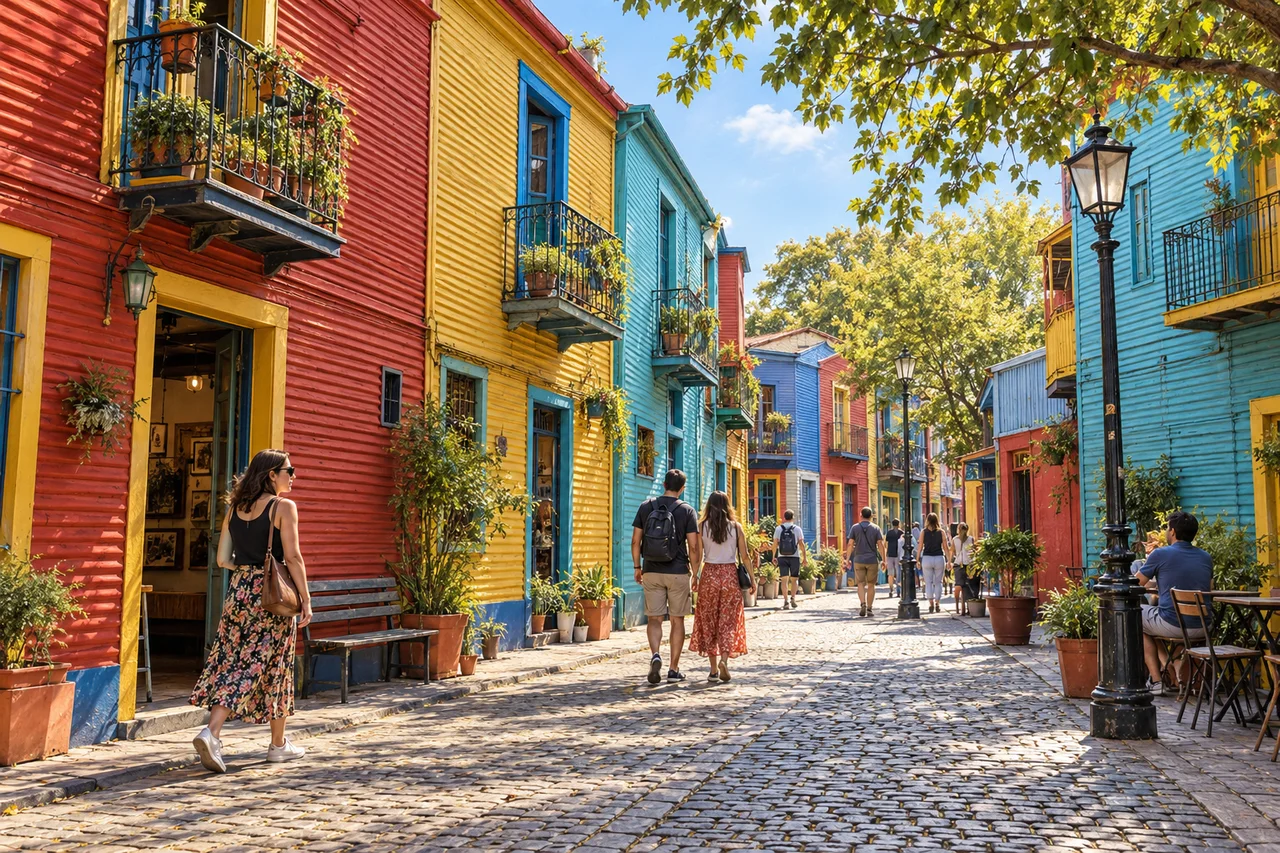
myAudience · original generated illustration · Original generated illustration; interpreted setting, not documentary evidence, current conditions or an authenticated viewpoint.
La Boca's coloured buildings make an inviting first impression, but the neighbourhood is more than a decorative street. Its connection with the port, migration and popular cultural life gives the colour a historical setting. Looking behind a familiar visitor image raises questions about housing, work and the ways a community represents itself. An attractive facade is a starting point for that inquiry rather than a complete account.
The Buenos Aires city government's introduction connects La Boca with late nineteenth-century immigration, especially Italian communities near the port, and with the development of conventillo housing. Shared residential spaces belong within a social history as well as an architectural one. To understand a particular building, ask about its inhabitants and changes of use, not just when a wall was painted or which colour looks most distinctive.
The city's account also connects the neighbourhood with football, tango and popular art. UNESCO's archival description places tango within the traditions of both Buenos Aires and Montevideo, with music, dance and poetry shaped by diverse urban communities. It would therefore be misleading to make La Boca the exclusive origin of the whole tradition. Cultural practices change through performers, teachers, audiences and new settings rather than surviving as one fixed tourist performance.
Our interpreted street shows modest timber and corrugated-metal fronts with bright painted surfaces and small contemporary figures. Compare the facade rhythm with the narrow spaces between buildings. What could photographs, records and residents' accounts reveal about former shared housing? The image does not authenticate a named conventillo, stage a tango performance or reproduce a particular artist's work. Its colour invites further reading without inventing those details.
La Boca is a neighbourhood where people live and work, so attention should extend beyond the visitor-facing scene. Ask before photographing identifiable people and respect private entrances and local arrangements. This reading gives no current route, safety or opening-time assurances. A fuller exploration can connect museums, oral histories and the wider city, allowing the cultural image to become more layered. Colour remains part of the appeal, while housing, labour, migration and living practices help explain why the place matters.
Image: illustration, not a documentary photograph.
Further reading
Buenos Aires can be introduced through a bright neighbourhood street, but colour is only the beginning of its cultural story. Music, dance, lettering and painted decoration connect public appearance to learned practices. A building may provide a setting for those activities without explaining how their skills are transmitted. The useful question is how a living tradition continues when its objects, audiences and places change. That approach brings performers, teachers and craftspeople into the account instead of treating the city as a collection of picturesque surfaces waiting to be photographed.
UNESCO's tango account describes a tradition shared by Argentina and Uruguay, rooted in the popular urban settings of Buenos Aires and Montevideo. It connects music, dance and poetry with interaction among communities of different backgrounds. This is a more accurate frame than assigning tango to one individual or presenting it solely as a stage routine created for tourists. The 2009 inscription recognises living cultural practice. Its continuing community includes musicians, dancers, composers, lyricists and teachers, whose different contributions make the tradition more than a recognisable pose in an image.
A dance sequence can be recorded, but learning to perform it with another person requires more than remembering positions. Timing, listening, balance and responding to a partner contribute to practice. These general distinctions explain why a video and a lesson serve different functions. A recording preserves an example; feedback can address how a learner interprets it. Improvisation is not simply lack of structure: within an established practice, choices can depend on shared conventions. A description of living heritage should leave room for both continuity and variation rather than reducing a tradition to one fixed demonstration.
The municipal account of fileteado porteño describes decorative painting developed around city vehicle workshops, later carried onto other surfaces. Lines, scrolls, flowers, vivid colours and short sayings became part of its vocabulary. The account explicitly notes uncertainty about its precise beginnings, so no single origin anecdote is treated as proven here. Its link with everyday work is important: commissioned decoration addressed the identities and preferences of people using an object. Art on a working vehicle belongs to urban history as much as art selected for a gallery wall.
Decoration is organised rather than being an arbitrary accumulation of flourishes. In a general design exercise, a border can frame a phrase, curved forms can guide the eye and repeated colours can link separate parts. Legibility imposes another constraint: elaborate ornament that overwhelms a word changes how the object communicates. Looking at these relationships teaches composition without copying an identified artisan's design or claiming that every painted sign belongs to fileteado. The distinction between a shared vocabulary and an individual maker's work matters when studying a tradition respectfully.
Changing a support can change both technique and audience. A moving vehicle, a shop sign and a gallery panel place different demands on viewing distance, durability and attention. The city's account describes movement into other formats as the older vehicle-workshop context declined. The general lesson is that safeguarding a practice cannot consist solely of preserving one object. Opportunities to learn, earn a living, commission work and develop new applications can matter alongside a museum collection. Continuity can involve adaptation, while a record of that change helps avoid presenting an invented timeless past.
The illustration shows colourful boards, balconies, street furniture, visitors and trees in a neighbourhood-inspired lane. It introduces urban public space without authenticating a named Caminito viewpoint or depicting a legible example of fileteado. No rendered visitor is identified as a tango performer, and bright paint alone is not evidence of a particular tradition. The small variant retains colour and street rhythm; fine sign content disappears. Sources and practitioners provide the histories behind these practices, while the image acts as an invitation to investigate the city beyond its appealing palette.
Check: A caption calls any colourful building fileteado and says preserving one tango video guarantees that the tradition survives unchanged. Explain the errors. Answer: Fileteado is a learned decorative practice with particular techniques and vocabularies; colour alone does not identify it. A video records an example of tango, but continuing practice also depends on people learning, performing, teaching and adapting it. An object and a living tradition are related without being identical. Recognising shared origins and uncertain details is stronger than assigning a single inventor or treating one tourist image as a complete account of Buenos Aires culture.