Current is a rate of charge flow
By UK GCSE Physics · independent study · myAudience
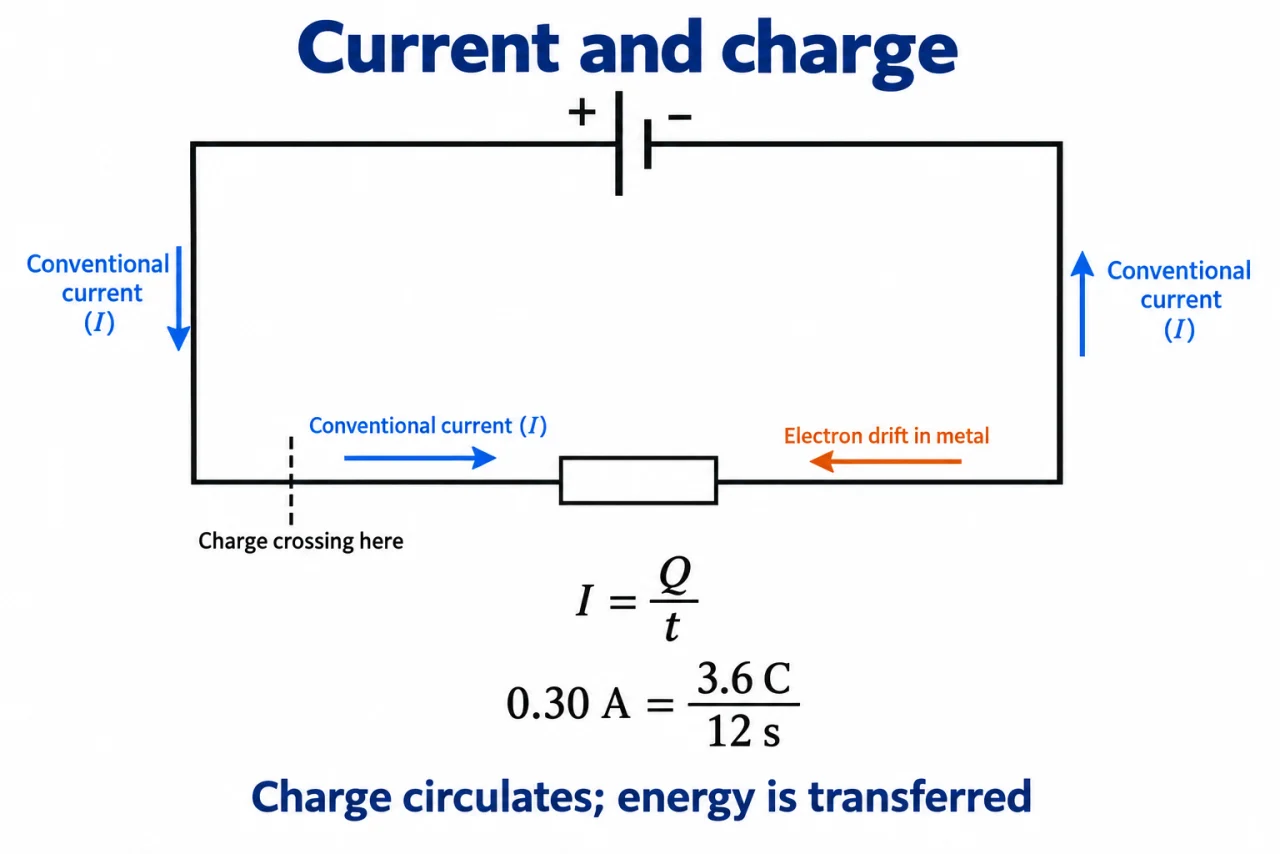
Image: illustration, not a documentary photograph. Original myAudience teaching concept; generated raster independently inspected. · Original generated teaching illustration; source facts attributed in the lesson.
Current is a rate of charge flow
Conducting metal contains electrons that can move through it. A source of potential difference, such as a cell, can drive a current when a conducting path is closed. Charge carriers are already present throughout the wires; the cell does not have to send a new electron all the way round before a lamp responds. Opening the route prevents a steady current in this simple circuit.
Current tells us how much charge passes a chosen point each second. Charge Q is measured in coulombs, C; current I in amperes, A; time t in seconds, s. One ampere means one coulomb per second. For a constant current, Q = It. If current varies, this simple multiplication needs a suitable average rather than a single unrepresentative reading.
In a single steady closed loop, the current is the same before and after a lamp. The lamp transfers energy but does not consume charge. If different amounts of charge entered and left it every second indefinitely, charge would keep accumulating. This charge-conservation argument explains why moving an ammeter around a simple series loop should give the same reading, allowing for measurement uncertainty.
Conventional current is defined in the direction positive charge would move: from the positive supply terminal through the external circuit towards the negative terminal. Electrons in a metal drift in the opposite direction because they are negative. These are two descriptions of the same circuit, not two opposing currents that cancel. Convert milliamperes to amperes and minutes to seconds before using Q = It.
Read plate 01 by tracing the wire from the long positive cell plate down the left side, through the rectangular resistor, and up to the short negative plate. Blue arrows show conventional current; the orange arrow shows the opposite electron drift in the metal. The dashed line is a counting boundary, not a component or an open wire. A steady 0.30 A transfers 3.6 C past that boundary in 12 s. The resistor receives and releases equal charge while transferring energy. The plate intentionally makes no particle-count or static-charge claim.
For a changing current, partition the time into intervals whose current is approximately constant and add each interval’s It. An initial reading multiplied by the whole time is unjustified if the motor warms or its load changes. Charge-conservation checks compare entering and leaving flows over the same interval; they do not equate charge in different branches.
Vocabulary: charge = electrical property carried by particles; current = charge flow per second; ampere = coulomb per second; conventional current = direction defined for positive charge.
Worked example: A small low-voltage motor carries a steady 180 mA for 2.5 minutes. How much charge passes a point in its lead?
180 mA = 0.180 A; 2.5 minutes = 150 s.
Q = It = 0.180 × 150.
Check the units: A × s = C.
Answer: 27 C.
Check your understanding: A current is 0.20 A for 15 s, then 0.50 A for 6.0 s. Find total charge and the single average current over the entire interval. Explain why 0.35 A is not the appropriate average.
Answer: 6.0 C; 6.0/21 ≈ 0.286 A (about 0.29 A).
Why: The transfers are 3.0 C and 3.0 C. Weight the currents by their durations: the two intervals have unequal lengths. Their unweighted arithmetic mean would wrongly predict 7.35 C.