Potential difference and resistance
By UK GCSE Physics · independent study · myAudience
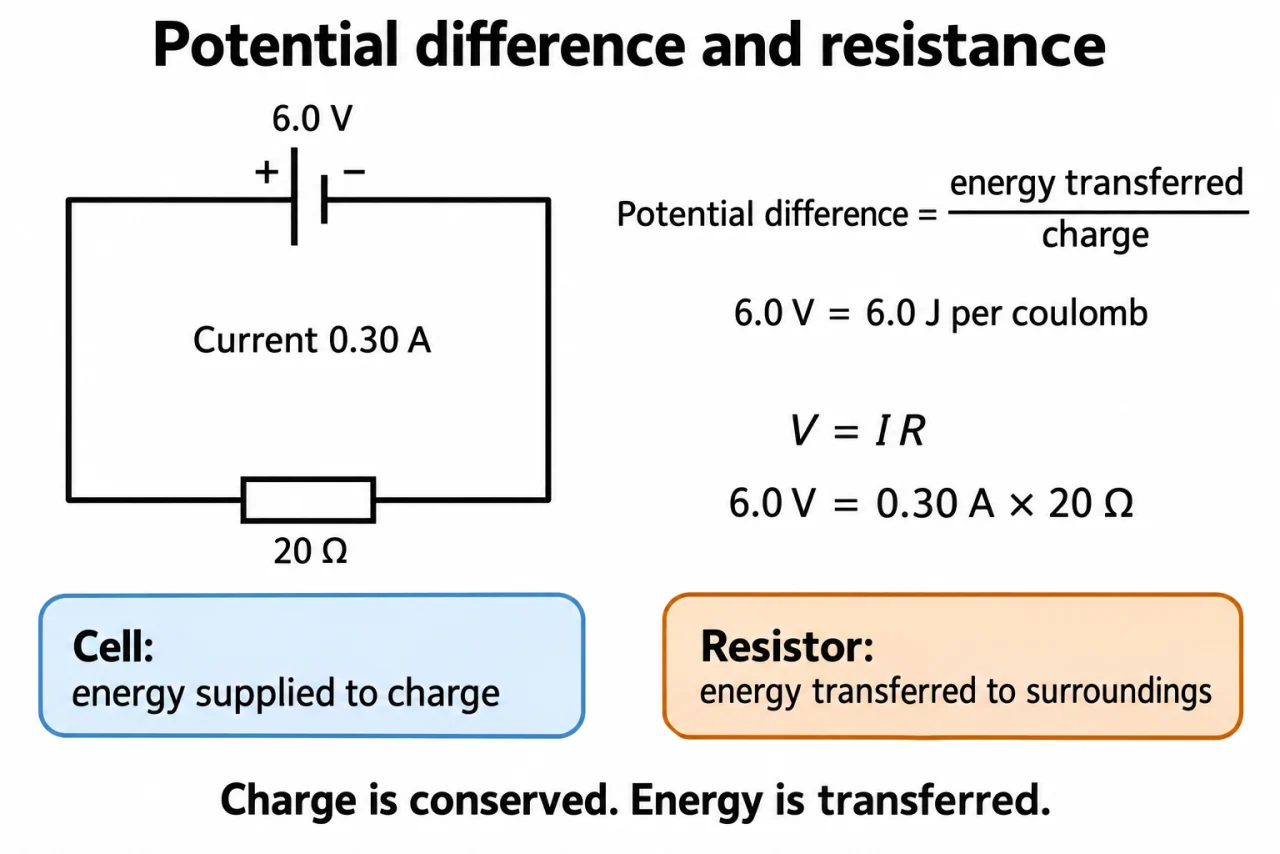
Image: illustration, not a documentary photograph. Original myAudience teaching concept; generated raster independently inspected. · Original generated teaching illustration; source facts attributed in the lesson.
Potential difference and resistance
Potential difference describes the energy transferred per coulomb between two points. A potential difference of 6 V means 6 J is transferred for each coulomb passing between those points. It is measured across a component, not through it. Current describes charge per second, so a high potential difference and a high current are different statements.
Resistance describes how much potential difference is needed for a particular current: R = V/I, or V = IR. Use volts, amperes and ohms, Ω. At a fixed potential difference, a larger resistance gives a smaller current. For example, replacing a resistor with one of greater resistance in a simple low-voltage loop reduces the current, provided the supply potential difference stays the same.
Measure V across the component and I through it at the same operating condition. Dividing a supply reading by an unrelated branch current does not give that component’s resistance. Resistance calculated this way is the value at that operating point. It need not remain constant when the component heats up or its environment changes; V = IR is not proof that every component is ohmic.
Make rearrangement explicit. To find current, divide V by R; to find resistance, divide V by I. A result in the wrong unit can reveal that the division was reversed. Before trusting a measurement, check the connections, instrument ranges and unit prefixes. Real leads and instruments can affect results; the ideal circuit model assumes their effects are small enough to ignore.
Plate 03 shows an ideal cell supplying 6.0 V to a single 20 Ω resistor, with negligible wire resistance. The 0.30 A label is a current, not an amount of stored charge. The right-hand statement 6.0 J per coulomb means energy transferred per charge; the numerical relation 6.0 = 0.30 × 20 checks V = IR. The two cards describe energy supplied by the cell and transferred by the resistor. Charge is conserved: the resistor does not use up 6 coulombs or turn charge into heat.
A valid comparison changes one condition while recording both quantities across and through the same component. At fixed V a doubled R halves I; at fixed I a doubled R doubles V. These statements constrain different quantities. If V and I both change, compute both operating-point ratios rather than deciding resistance from current alone.
Vocabulary: potential difference = energy transfer per unit charge; resistance = potential difference divided by current; ohm = volt per ampere; operating point = particular measured V and I.
Worked example: A component has 3.6 V across it and carries 240 mA. Find its resistance and predict its current at 6.0 V if that resistance remains unchanged.
240 mA = 0.240 A.
R = 3.6/0.240 = 15 Ω.
With unchanged R, I = 6.0/15 = 0.40 A.
Answer: 15 Ω; predicted current 0.40 A.
Check your understanding: A component changes from 2.0 V, 0.10 A to 4.0 V, 0.16 A. Has its resistance fallen because current increased? Quantify your conclusion and explain whether the data alone identify heating.
Answer: No: resistance rises from 20 Ω to 25 Ω, a 25% increase. Heating is a possible explanation, not established by these two readings.
Why: V/I compares matched operating points. Current rose by 60% but voltage doubled, so their ratio rose. Independent temperature evidence or controlled tests are needed to identify the cause.