Density: choose a volume method, then test the result
By UK GCSE Physics · independent study · myAudience
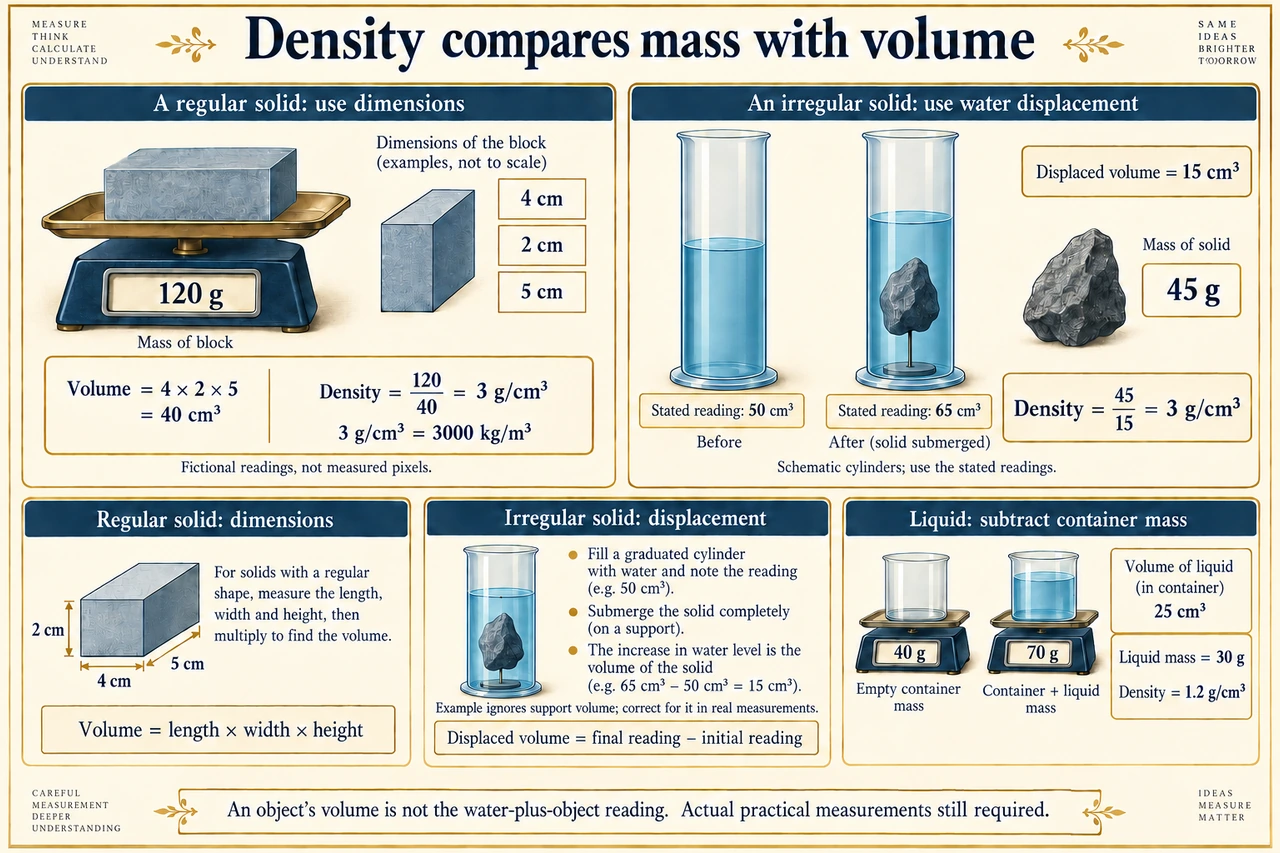
Image: illustration, not a documentary photograph. · Original myAudience generated educational illustration.
Density: choose a volume method, then test the result
Density compares mass with the volume that contains it: ρ = m / V. A large object need not be denser than a small one. Cutting a uniform block in half halves both mass and volume, leaving their ratio unchanged. Adding material without increasing the outer volume would increase average density instead. State exactly which object or material you are measuring: a hollow sealed object has an average density based on its entire displaced volume, which is different from the density of the material in its walls. Temperature and composition matter when comparing real samples; a single ratio does not identify a substance with certainty.
Units belong to the calculation, not just its final line. A mass in kilograms divided by a volume in cubic metres gives kg/m³. Because 1 g = 0.001 kg and 1 cm³ = (0.01 m)³ = 0.000001 m³, 1 g/cm³ = 1000 kg/m³. The centimetre-to-metre conversion is cubed for volume; multiplying a volume by 0.01 is an incorrect length conversion. One millilitre occupies one cubic centimetre. You may calculate consistently in g and cm³, then convert the final density, or convert both inputs first. These two routes must agree. Rearranging gives m = ρV and V = m/ρ; check that each answer has the requested units.
Look first at the regular block in the illustration. Its fictional mass is 120 g and its stated perpendicular dimensions are 4 cm, 2 cm and 5 cm, so V = 40 cm³ and ρ = 3 g/cm³ = 3000 kg/m³. The picture is not a ruler. In a real investigation, zero the balance and measure the actual dimensions with suitable apparatus: a ruler can suit a larger block, whereas callipers or a micrometer may resolve a small dimension more appropriately. Take repeated measurements where the shape permits and examine variation. A block with rounded or damaged corners does not exactly occupy the rectangular bounding box; multiplying those outer dimensions would overestimate its volume and underestimate its density.
For an irregular solid, subtract the initial liquid reading from the final reading after complete immersion. The two uncalibrated cylinder drawings show stated fictional readings of 50 cm³ and 65 cm³, giving an object volume of 15 cm³; 45 g divided by 15 cm³ is 3 g/cm³. The 65 cm³ is water plus object, not the object alone. In real apparatus read the relevant meniscus at eye level, keep the cylinder upright and record the scale resolution. The solid must not dissolve or absorb enough liquid to change the measurement, and trapped bubbles add displaced volume. A submerged support also displaces liquid, so correct for its contribution or select a method that makes it negligible. The pictured object is an immersed solid, not a porous or floating sample for which the simple assumptions fail.
The liquid panel shows why the container must be subtracted: a 40 g empty container becomes 70 g when it contains 25 cm³ of liquid. The liquid mass is 30 g, not 70 g, so its density is 1.2 g/cm³. Alternatively tare the empty container before adding liquid, while checking what the balance now reports. Weigh a clean, dry container and use suitable volume apparatus; spills and liquid left on the outside can change the mass. Repeating the same liquid-volume measurement can expose random variation, but cannot remove a constant zero error. Larger samples can reduce the relative effect of a fixed reading uncertainty, provided the apparatus range and safe handling remain appropriate.
The particle model connects density to arrangement and spacing. For the same amount of a substance, particles much farther apart occupy more volume while retaining their total mass, so the average density is lower. Gas particles are widely separated compared with those in a liquid or solid. Close-packed particle diagrams help explain this difference, but spacing is not the only cause of density differences between different substances: particle masses and structures differ too. Do not claim that every solid is denser than every liquid. Ice is less dense than liquid water under ordinary conditions because its solid structure occupies more volume for the same mass. The next lesson develops that exception and the distinction between a particle and the space around it.
An evaluation must predict the direction of an error. If a solid is only partly immersed, too little liquid is displaced, V is too small and the calculated m/V is too large. An air bubble or uncorrected immersed support makes V too large and the calculated density too small. Using water-plus-object volume also gives a result that is too small. A result can be repeatable yet systematically wrong. the practical study includes making and recording measurements on regular solids, irregular solids and liquids with appropriate apparatus. This lesson supplies reasoning and fictional examples; it does not replace observed practical work, contemporaneous records, an apparatus risk assessment or evidence that a learner can actually perform those measurements.
Worked example: A non-absorbing irregular solid has mass 72 g. A cylinder reading rises from 38 cm³ to 62 cm³ when the solid and a support are immersed. A separate control shows that the immersed part of the support displaces 2 cm³. Find the solid density, then explain whether ignoring the control changes the conclusion. All readings are fictional stated values.
The total displaced volume is 62 − 38 = 24 cm³. This includes the solid and the support.
Subtract the independently measured support contribution: Vsolid = 24 − 2 = 22 cm³.
Use the mass of the solid alone: ρ = 72 / 22 = 3.2727… g/cm³, or 3272.7… kg/m³.
If the support is ignored, 72 / 24 = 3 g/cm³. The numerator is unchanged but the volume is overestimated, so the density is underestimated.
The stated inputs are simplified values, not a claim of this experimental precision. To two significant figures report about 3.3 g/cm³, or 3.3 × 10³ kg/m³; actual reporting would consider apparatus uncertainty.
Answer: About 3.3 g/cm³ after the support correction; ignoring the support gives 3.0 g/cm³ and biases the density downwards.
Check your understanding: An empty cylinder is 50 g; with 35 cm³ of liquid it is 92 g. A student reports 92/35 = 2.63 g/cm³. Correct it. Separately, a solid has mass bounded by 59.5–60.5 g and an independently supplied displacement range 18–22 cm³. Find a conservative density interval and explain why repeating a biased volume method is insufficient.
Answer: Liquid mass = 92 − 50 = 42 g, so ρ = 42/35 = 1.2 g/cm³ = 1200 kg/m³. For the solid the lowest ratio is 59.5/22 = 2.7045… and the highest is 60.5/18 = 3.3611… g/cm³: a conservative outward-rounded interval is 2.70–3.37 g/cm³.
Why: The liquid error includes container mass. For positive masses and volumes, the ratio is smallest with minimum mass and maximum volume, and largest with maximum mass and minimum volume. The supplied bounds, not guessed display precision, justify the interval; it is not a statistical confidence interval. Repetition can assess spread, but cannot correct consistently trapped bubbles, an ignored support or a wrong zero. Identify and change the method before claiming accuracy.