Changes of state: follow particles across a system boundary
By UK GCSE Physics · independent study · myAudience
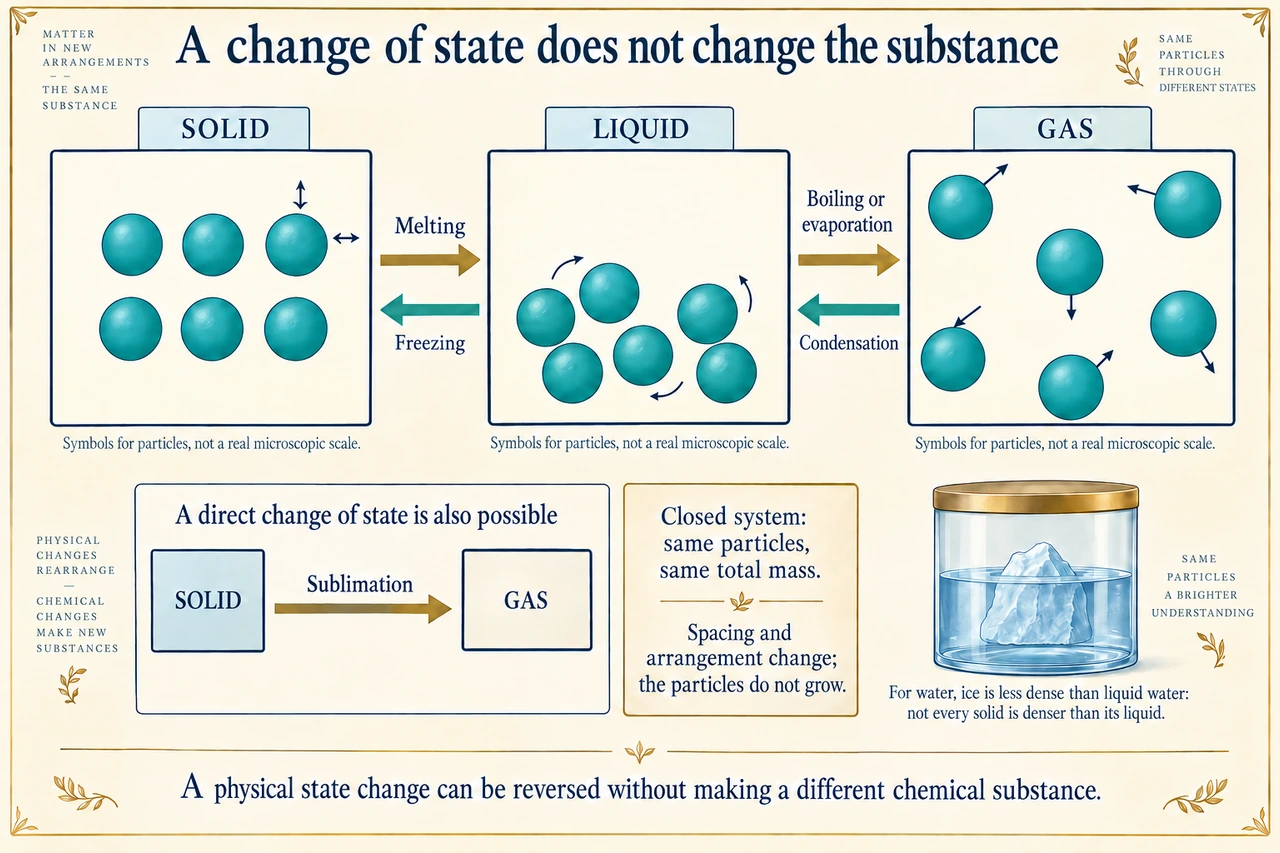
Image: illustration, not a documentary photograph. · Original myAudience generated educational illustration.
Changes of state: follow particles across a system boundary
A physical change of state changes the arrangement and motion of the particles without making a different chemical substance. Water can be ice, liquid water or water vapour; its molecules remain water molecules. Melting is solid to liquid, freezing is liquid to solid, boiling or evaporation is liquid to gas, condensation is gas to liquid, and sublimation is directly solid to gas. Identify both the starting and ending states rather than guessing from whether the surroundings feel warm. Reversing an ordinary state change restores the substance and its state-dependent properties, provided no material has escaped or undergone an additional chemical change.
The illustration deliberately follows six symbolic particles in each of its three main panels. Count them: there are six in the regular solid arrangement, six close together in the disordered liquid, and six widely separated in the gas. The circles are symbols, not images of actual microscopic dimensions or measured spacing. The small solid arrows indicate vibration about positions, not that solids are motionless. Liquid particles can change neighbours while remaining close; gas particles move in many directions between collisions. Wide gaps in the gas do not mean its particles have grown or that a different kind of particle has appeared. There is no claim that a real sample contains only six particles.
Heating transfers energy to a substance, but rising temperature and changing state are different outcomes. Before a state change, a temperature rise is associated with an increase in average particle kinetic energy. During melting or boiling of a pure substance at a fixed pressure, energy transfer can change particle arrangement and interactions without raising temperature. Freezing or condensation releases energy to surroundings as the lower-energy arrangement forms. A solid does not melt because its particles become larger; its particles gain sufficient energy to leave their fixed arrangement. The later internal-energy and latent-heat lessons will quantify these changes; they are not completed by this qualitative introduction.
Mass conservation is a statement about a defined system. If a closed container retains the substance, the total number and kinds of particles do not change during a physical state change, so its total mass remains the same in the GCSE particle model. Volume and density may change. If 90 g of pure water freezes and occupies a larger volume, it is still 90 g of water: m/V falls because V increases. A rigid closed container may constrain the volume occupied by a gas, so do not assume every drawing of wider particle spacing describes a freely expanding container. The diagram illustrates arrangements and the closed-system mass principle; its separate panels are not a single fixed-volume vessel.
An open cup is a different system. As liquid evaporates, water molecules enter the surrounding air; the measured mass of the cup and its remaining liquid decreases. They have crossed the chosen boundary, not been destroyed. Collecting all the vapour with the cup would restore the mass balance for that larger system. Condensation on a cool surface is gas becoming liquid, not water created from nothing. Evaporation can occur from a liquid surface below its boiling point; boiling occurs throughout the liquid when conditions allow bubbles of vapour to form. Loss of mass from an open sample alone is not evidence of a chemical reaction, and a temperature change alone is not enough to identify a state change.
The ice panel is an important test of an over-simple rule. Under ordinary conditions ice has a structure that keeps its molecules farther apart on average than in liquid water, making ice less dense. When ice melts, particles can pack more closely even though their motion becomes less constrained. The individual water molecules do not shrink to explain the smaller volume. Many materials behave differently, so use evidence for the named substance instead of asserting that melting always increases volume. Density depends on both mass and the space occupied; the same mass in a smaller volume has a larger density.
Physical and chemical changes must be separated by what changes in the substance, not by whether heat is involved. Boiling water separates water molecules from one another; it does not split them into hydrogen and oxygen. A chemical reaction rearranges atoms into different substances, requiring evidence for that chemical change. The plate contrasts rearrangement with new substances, but does not imply every chemical process is simply irreversible. When explaining an unfamiliar observation, name the state change, state the boundary used for mass measurement, explain the particle behaviour and identify what additional evidence would distinguish escape, contamination or a reaction. Classroom heating and closed-pressure apparatus require supervised safe procedures; this reading is not an instruction to heat a sealed vessel.
Worked example: A lidded but not sealed cup and its water weigh 250 g. After evaporation they weigh 242 g. The empty cup and lid weigh 180 g. A separate sealed room-temperature water sample of 90 g freezes. Explain the two mass results and compare the ice density if its supplied volume is 98 cm³ with liquid water of supplied volume 90 cm³. Values are fictional; no sealed heating is proposed.
The initial water mass in the cup is 250 − 180 = 70 g; the final water mass is 242 − 180 = 62 g.
The cup system has lost 8 g of water to the air through the unsealed boundary. Evaporation does not destroy 8 g of molecules.
The separate sealed freezing sample retains 90 g of water because its particles remain inside the system.
Using the supplied volumes, liquid density is 90/90 = 1.00 g/cm³; ice density is 90/98 = 0.91836… g/cm³, about 0.92 g/cm³.
The smaller ice density follows from larger volume at the same mass. The numerical volumes are supplied model data, not measurements to read from the artwork.
Answer: The open cup loses 8 g to its surroundings; the separate closed sample remains 90 g and its stated ice density is about 0.92 g/cm³, lower than the stated liquid density.
Check your understanding: A student says: “The gas has larger particles, so water boiling in an open beaker destroys mass. Ice melts because its molecules shrink.” Replace each claim with a particle explanation. Then explain how the same substance can regain its liquid properties after vapour condenses while the original open beaker still weighs less.
Answer: Water molecules do not grow on boiling or shrink on melting. Arrangement, separation and motion change. Escaped vapour explains the open beaker’s lower mass; mass is conserved when the escaped molecules are included in the system. Condensation can restore liquid water elsewhere without automatically returning it to the original beaker.
Why: The explanation must track substance identity and system boundaries together. Changing spacing is not changing molecular size. Recovering liquid properties establishes the reversible state change in the recovered water; it does not prove all the original sample has been recollected. Compare masses for a consistent boundary and account for any water left on surfaces or outside the collected sample. No particle diagram or written answer establishes practical competence.