Following oxygen: metal oxides and extraction
By UK GCSE Chemistry · independent study · myAudience
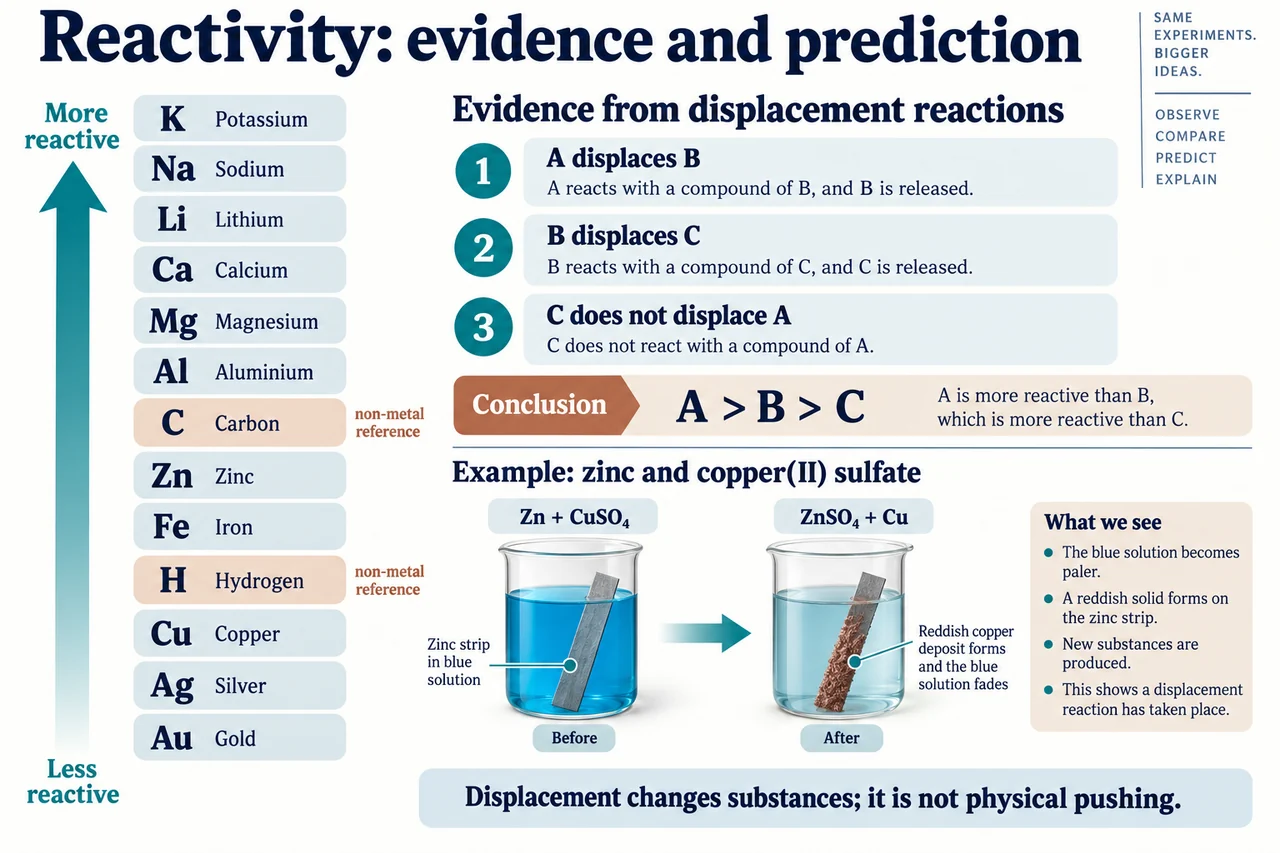
Image: illustration, not a documentary photograph. Original teaching model created for myAudience. · Original generated teaching raster; no exam-board or textbook artwork copied.
Following oxygen: metal oxides and extraction
A metal reacting with oxygen forms a metal oxide. For magnesium the account is 2Mg(s) + O2(g) → 2MgO(s): each magnesium atom ends up associated with oxygen in the ionic solid. In the oxygen definition of oxidation, magnesium is oxidised because it gains oxygen. Reduction is the complementary loss of oxygen. These definitions name a change to a particular substance; they do not mean that every reaction must make the total mass increase or decrease.
The Earth contains both elements and compounds. Gold is sufficiently unreactive that it may occur as the metal, whereas many useful metals occur in ores as compounds. An ore is a material from which extracting a metal can be economically worthwhile. Separating rock mechanically can enrich an ore, but producing metal from its oxide requires a chemical change. Removing surrounding waste rock does not remove the oxygen chemically combined with the metal.
Carbon can remove oxygen from the oxides of metals below carbon in the reactivity series. A constructed copper extraction reaction is 2CuO(s) + C(s) → 2Cu(s) + CO2(g). Copper oxide loses oxygen and is reduced; carbon gains oxygen and is oxidised. The oxygen atoms have been transferred into carbon dioxide, not destroyed. Other conditions can give carbon monoxide, so an extraction equation must match the products specified in the question. Industrial furnace details are not required for this assessed leaf.
The reactivity plate places carbon above zinc, iron and copper but below aluminium and magnesium. Carbon is a reference non-metal, not another metallic member of the series. A metal above carbon has too great an attraction for the oxygen in its oxide for the GCSE carbon route to be suitable. That relative position predicts a feasible method; it does not tell you the ore grade, reaction speed, plant cost or purity of the product. Electrolysis supplies an alternative for sufficiently reactive metals, developed later.
Evaluating a supplied extraction process means using the information rather than repeating that one route is cheaper. A high-grade oxide ore and inexpensive carbon may support reduction, but energy demand, gas emissions, waste and transport also matter. Suppose a question supplies an oxide containing 80% recoverable metal and a 90% recovery rate. A 100 kg feed contains at most 80 kg metal, of which 72 kg is recovered. Multiplying the two fractions separates ore composition from process recovery; neither percentage measures whether the reaction is oxidation.
A common error is to label copper itself as the substance losing oxygen in CuO → Cu. The reactant that contains and loses the oxygen is copper oxide. Another is to call any removal of material reduction, even filtration. A strong answer names the starting species, states whether it gains or loses oxygen, and follows that oxygen into another product. The image is a conceptual ranking and displacement illustration; it does not depict a furnace or certify an extraction experiment.
Transfer challenge (original teaching task, not an examination question): A supplied carbon process recovers 80% of metal from a 50 kg ore containing 40% recoverable metal. A second process recovers 95% but uses twice as much energy and produces less CO2. Calculate both metal outputs and make a conditional route recommendation, stating what data are still needed.
Reasoned answer: First output 16 kg; second 19 kg. The second recovers 3 kg more but doubles energy. No unconditional best route follows without energy price, value of extra metal and emissions/waste priorities. Why this follows: Composition and recovery are independent fractions. A balanced extraction reaction establishes the material account, while selection also needs supplied economic and environmental evidence. Indicative author rubric (5 marks; not an exam-board mark scheme): 50 ×0.40 =20 kg available metal; 20 ×0.80 =16 kg; 20 ×0.95 =19 kg; Weighs additional recovery against energy and CO2 rather than one metric; Names missing price/impact data and gives a conditional recommendation. Reading an answer does not demonstrate independent mastery or performed practical skills.
Worked example: A proposed process uses carbon to extract metal X from X2O3. X lies below carbon. The stated carbon product is CO2. Balance the reaction and identify oxygen transfer; then assess a 200 kg feed containing 60% recoverable X with 75% recovery.
Preserve the supplied formulae: 2X2O3 + 3C → 4X + 3CO2 has four X and six O on each side.
X2O3 loses oxygen and is reduced. Carbon gains oxygen and is oxidised; X below carbon supports this route.
Metal initially available = 200 × 0.60 = 120 kg; recovered metal = 120 × 0.75 = 90 kg. Cost or environmental superiority needs additional data.
Answer: 2X2O3 + 3C → 4X + 3CO2; 90 kg X recovered in the supplied model.
Check your understanding: A student proposes carbon reduction for Al2O3 because carbon can reduce CuO. Critique the transfer and identify the oxidised species in 2CuO + C → 2Cu + CO2.
Answer: The copper example does not establish suitability for aluminium: aluminium is above carbon. Carbon is oxidised in the copper reaction.
Why: Extraction feasibility depends on relative reactivity, not simply on a compound being an oxide. Carbon gains oxygen while copper oxide loses it. A route decision and a redox label answer different questions.