Reactivity from room-temperature evidence
By UK GCSE Chemistry · independent study · myAudience
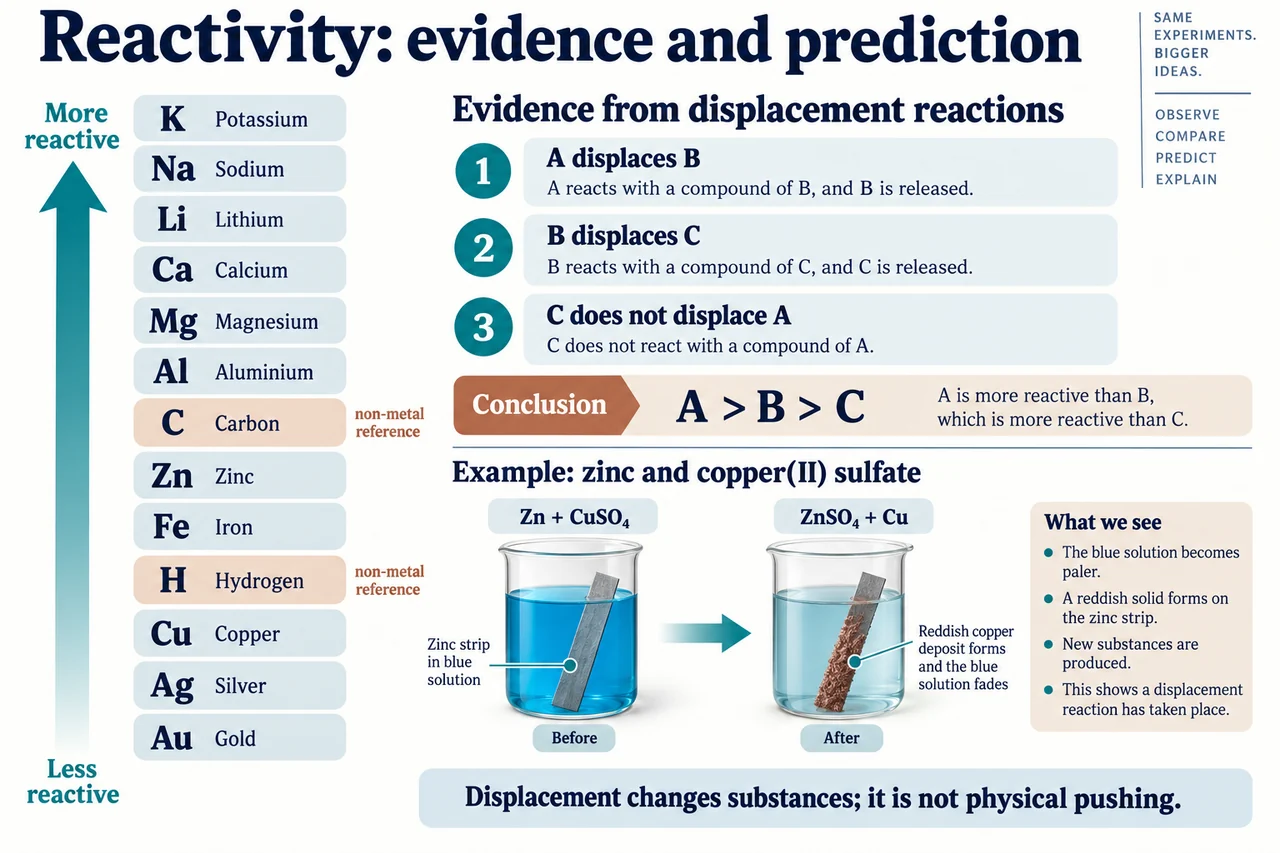
Image: illustration, not a documentary photograph. Original teaching model created for myAudience. · Original generated teaching raster; no exam-board or textbook artwork copied.
Reactivity from room-temperature evidence
Reactivity describes how readily a metal undergoes chemical reaction, including its tendency to form a positive ion. The required relative order is potassium, sodium, lithium, calcium, magnesium, zinc, iron and copper, from greater to lower reactivity. The broader plate also includes aluminium, carbon, hydrogen, silver and gold for extraction and displacement decisions. Carbon and hydrogen are reference non-metals. Do not infer that every neighbouring pair can be ranked from one observation under uncontrolled conditions.
At room temperature, potassium, sodium and lithium react readily with water to form the metal hydroxide and hydrogen; their relative water reactivity is potassium greater than sodium greater than lithium. For sodium, 2Na(s) + 2H2O(l) → 2NaOH(aq) + H2(g). Sodium floats, moves and melts into a ball as heat is released; potassium can ignite, and lithium typically moves less vigorously. These are observations of teacher-controlled demonstrations, not instructions to mix these metals with acids. Calcium reacts with cold water to give hydrogen and calcium hydroxide, often making the water cloudy. The corresponding accounts are 2K + 2H2O → 2KOH + H2, 2Li + 2H2O → 2LiOH + H2 and Ca + 2H2O → Ca(OH)2 + H2. Calcium hydroxide is only sparingly soluble, explaining the cloudy suspension.
Magnesium reacts very slowly with cold water, while zinc, iron and copper show no appreciable reaction with it under ordinary classroom room-temperature conditions. A lack of visible change does not establish that a metal can never react with water under other conditions. Steam reactions are outside this assessed room-temperature demand. With suitable dilute hydrochloric acid, magnesium reacts more vigorously than zinc, iron reacts more slowly, and copper does not liberate hydrogen. Comparing these observations extends the order that cold-water evidence alone cannot resolve.
A more reactive metal tends to form its positive ions more readily in the comparison. That connects the observed reaction to an underlying chemical change instead of saying simply that it has more energy. The tendency concerns loss of electrons from metal atoms, though formal electron redox equations are Higher content. Positive metal ions are not formed by acquiring protons. The number of protons determines the element and remains unchanged in these chemical reactions.
Fair comparison matters. Use comparable exposed surface area, clean surfaces, equal acid concentration and volume, and the same temperature; then compare gas collected in a fixed interval or the time for a fixed amount. Magnesium powder and a thick zinc strip do not isolate reactivity because surface area affects rate. An oxide coating can suppress initial bubbling. Repeated observations can reveal inconsistency, but a mean rate cannot repair a confounded comparison. Practical handling and AT6 evidence require supervised observation.
The plate's three deduction cards give A displacing B and B displacing C, supporting A > B > C under the stated displacement model. C failing to displace A is consistent with that order. In a real investigation, no observed change alone is weaker evidence because slow kinetics or a surface film may hide a thermodynamically possible reaction. A demanding answer distinguishes the ideal exam inference from the evidential limits, rather than treating a mnemonic or bubble count as an explanation. In the plate, A, B and C in the displacement deduction are placeholder metal labels; the separate C in the reactivity series is the element carbon. Do not identify the unknown metal C with carbon merely because the same letter is used.
Transfer challenge (original teaching task, not an examination question): P displaces Q ions and R ions. Q displaces R ions. S shows no visible change with any of them after a short test. Give the justified partial order, explain why S cannot securely be placed from this real observation alone, and improve the investigation.
Reasoned answer: P > Q > R. The short negative observations could reflect slow reaction or a surface layer for S. Use clean comparable surfaces, controlled solutions/time/temperature, repeats and complementary positive evidence. Why this follows: An ideal complete exam table may permit a simple deduction; a real observation with an explicit short duration has evidential limits. The question tests that distinction rather than treating every absent bubble as proof of inertness. Indicative author rubric (5 marks; not an exam-board mark scheme): P above Q; Q above R; Does not claim a secure real-data position for S; Names kinetics/coating or detection limit; Proposes a controlled comparison and complementary evidence. Reading an answer does not demonstrate independent mastery or performed practical skills.
Worked example: Equal cleaned strips P, Q and R are tested with equal dilute acid volumes at the same temperature. P gives 30 cm3 hydrogen in 20 s, Q gives 12 cm3, R gives no visible gas. P displaces Q ions and Q displaces R ions. Deduce the order and evaluate the gas evidence.
Displacement gives P above Q and Q above R, hence P > Q > R in the supplied model.
Mean gas rates are 30/20 = 1.5 cm3/s and 12/20 = 0.60 cm3/s. These are consistent with the order when surface areas and conditions match.
No gas from R alone would not prove absolute non-reactivity; identify detection limit, coating or slow reaction as possible alternatives.
Answer: P > Q > R. Controlled reaction-rate evidence supports, but does not independently prove, that order.
Check your understanding: A student ranks zinc above magnesium because zinc powder bubbles faster than a magnesium ribbon. Give two defects and a corrected comparison. What can cold-water tests alone establish about zinc versus iron?
Answer: Surface area and possibly surface condition differ. Compare equal exposed areas of cleaned samples under identical acid conditions. Cold-water tests do not resolve zinc versus iron when neither visibly reacts.
Why: Rate depends on more than metal identity. Two equal negative results do not establish an order; the required series uses evidence from suitable acid or displacement comparisons as well as water.