Higher: displacement as an electron account
By UK GCSE Chemistry · independent study · myAudience
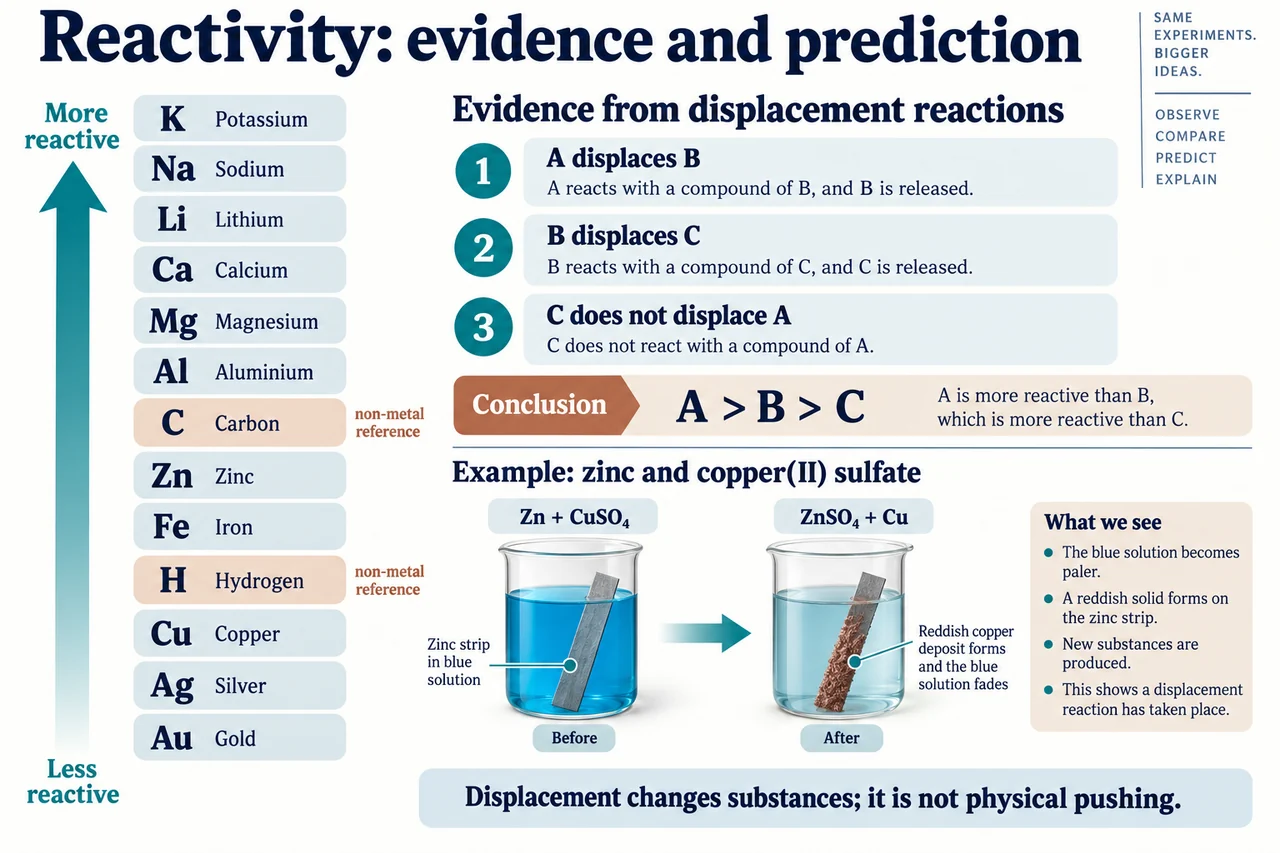
Image: illustration, not a documentary photograph. Original teaching model created for myAudience. · Original generated teaching raster; no exam-board or textbook artwork copied.
Higher: displacement as an electron account
A displacement reaction turns a more reactive metal into its ions while a less reactive metal's ions become metal. For zinc in copper sulfate solution, Zn(s) + CuSO4(aq) → ZnSO4(aq) + Cu(s). Copper is deposited and the blue copper-ion solution fades as Cu2+ is used. These observations support a change of substances; zinc does not physically knock intact copper sulfate molecules out of the water. Dissolved ionic compounds contain separated mobile ions.
The electron definition extends redox beyond reactions involving oxygen. Oxidation is electron loss and reduction is electron gain. Zn → Zn^2+ + 2e^- is oxidation: a neutral zinc atom loses two negative electrons and becomes positively charged. Cu^2+ + 2e^- → Cu is reduction. The two half-equations describe linked changes, with neither an unexplained supply nor an unexplained disappearance of electrons. Here zinc is the reducing agent because it supplies electrons to the species reduced.
To derive the ionic equation, express dissolved ZnSO4 and CuSO4 as their ions. SO4^2- appears unchanged on both sides, so cancel it as a spectator ion. The result is Zn(s) + Cu^2+(aq) → Zn^2+(aq) + Cu(s). Removing a spectator does not mean it is absent from the solution; it means its identity and amount do not change in the net reaction. Cancelling copper ions instead would remove the reacting species and destroy the chemical meaning.
Charge must be conserved as well as atoms. The zinc–copper ionic equation has total charge +2 on each side. In Zn → Zn^2+ + 2e^-, the right side totals +2 − 2 = 0, matching neutral zinc. Placing the electrons on the reactant side would claim both electron gain and formation of a positive ion, which is inconsistent. This check catches errors that an element-only balance cannot detect.
Different ions may need different electron numbers. If a supplied example uses aluminium and silver ions, Al → Al^3+ + 3e^- and Ag^+ + e^- → Ag require the silver half-equation three times. Adding gives Al + 3Ag^+ → Al^3+ + 3Ag. Multiply every term in the chosen half-equation, not just the electrons. Surface oxide may prevent an actual aluminium sample reacting visibly; a balanced electron account describes the specified reaction without proving its observed speed.
The plate's beakers show zinc and copper sulfate becoming zinc sulfate and copper. Its deposit is a conceptual visual cue, not measured evidence of complete conversion or purity. When identifying redox in unfamiliar equations, track a named atom or ion from reactant to product, compare its charge and state what happens to electrons. A more positive ion charge corresponds to electron loss, while movement towards a neutral atom from a positive ion corresponds to gain. Do not infer oxidation from a blue colour alone.
Higher extension (original teaching task, not an examination question): A supplied reaction is Mg + 2AgNO3 → Mg(NO3)2 + 2Ag. Derive its net ionic equation and half-equations, identify spectators, and reject the claim that nitrate is reduced because it moves to a new formula.
Reasoned answer: Mg + 2Ag^+ → Mg^2+ + 2Ag; Mg → Mg^2+ + 2e^- and 2Ag^+ + 2e^- → 2Ag. Nitrate remains NO3^- and is a spectator; Ag+ is reduced and Mg oxidised. Why this follows: A changed formula grouping does not mean nitrate underwent electron transfer. Reacting silver and magnesium species carry the redox account; spectators are cancelled only after their unchanged presence is established. Indicative author rubric (5 marks; not an exam-board mark scheme): Correct net ionic equation; Correct Mg half-equation; Correct doubled Ag half-equation; Nitrate spectator with unchanged identity; Both redox species and charge + 2 each side. Reading an answer does not demonstrate independent mastery or performed practical skills.
Worked example: Iron displaces copper from copper sulfate, forming Fe2+ ions. Derive the ionic equation and both half-equations; identify the spectator and audit charge.
The full equation is Fe + CuSO4 → FeSO4 + Cu. SO4^2- is unchanged and cancels.
Fe → Fe^2+ + 2e^- and Cu^2+ + 2e^- → Cu transfer the same two electrons.
Add and cancel electrons: Fe + Cu^2+ → Fe^2+ + Cu. One Fe and one Cu occur on each side, and charge is +2 on each side.
Answer: Iron is oxidised; Cu2+ is reduced. Sulfate is the spectator ion.
Check your understanding: Complete Al + Ag^+ → Al^3+ + Ag. Explain why adding only 3e^- to one side does not produce a balanced net ionic equation, and identify the oxidised and reduced species.
Answer: Al + 3Ag^+ → Al^3+ + 3Ag. Aluminium is oxidised and Ag+ is reduced; the net equation contains no uncancelled electrons.
Why: One Al supplies three electrons and each Ag+ consumes one. Three silver ions and three silver atoms are therefore required. Both sides have charge +3; free electrons would leave an incomplete combined account.