Metals and dilute acids: salts, hydrogen and redox
By UK GCSE Chemistry · independent study · myAudience
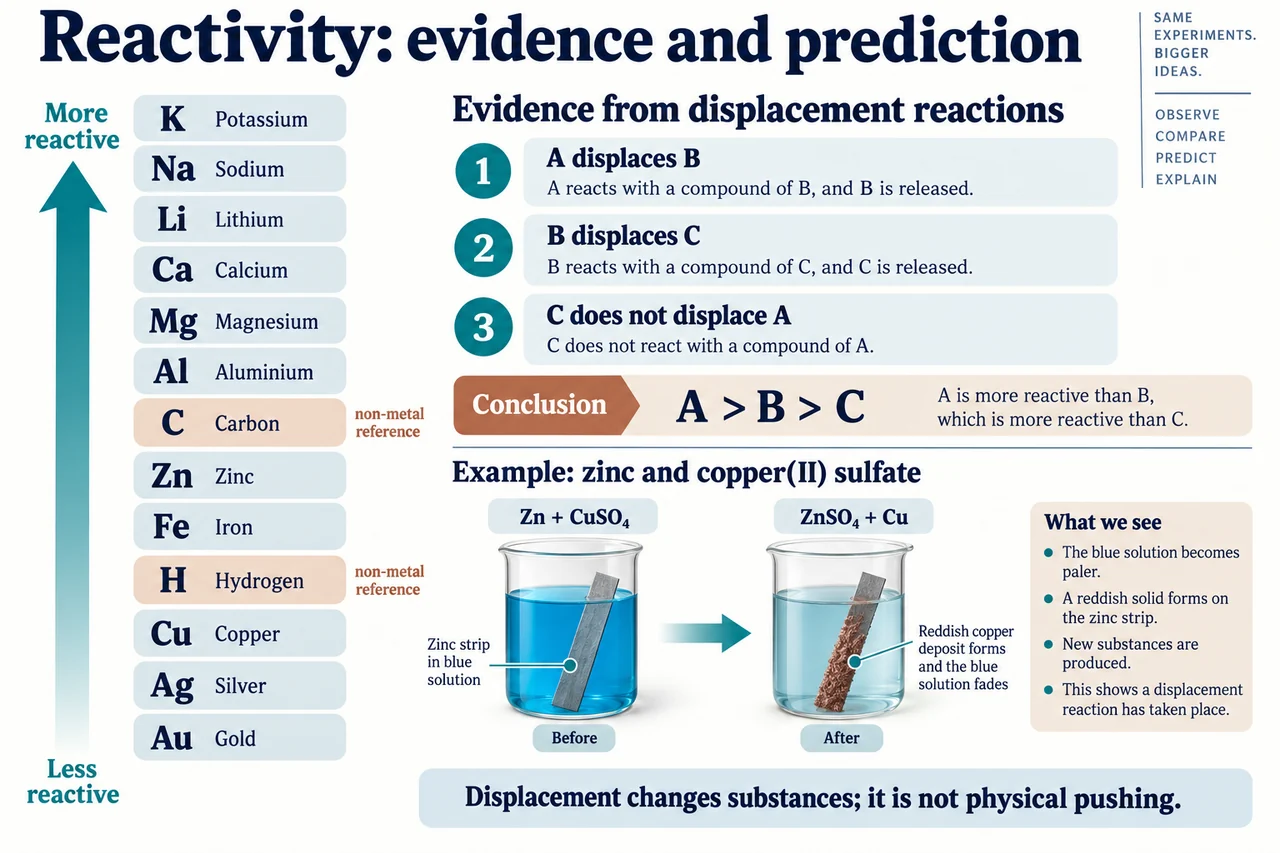
Image: illustration, not a documentary photograph. Original teaching model created for myAudience. · Original generated teaching raster; no exam-board or textbook artwork copied.
Metals and dilute acids: salts, hydrogen and redox
Some metals react with dilute acids to form a salt and hydrogen. The assessed examples here are magnesium, zinc and iron with hydrochloric or sulfuric acid at room temperature. These metals lie above hydrogen in the series. Copper lies below hydrogen and does not give this hydrogen-producing reaction with those dilute acids. The plate's hydrogen reference helps predict the outcome, but this pattern must not be extended blindly to oxidising nitric acid or different experimental conditions.
The acid identifies the negative ion in the salt: hydrochloric acid produces chlorides and sulfuric acid produces sulfates. Magnesium, zinc and iron form Mg2+, Zn2+ and Fe2+ respectively in these dilute-acid examples. Two Cl- ions balance a single 2+ metal ion, giving MgCl2, ZnCl2 and FeCl2. One SO4^2- balances it, giving MgSO4, ZnSO4 and FeSO4. Iron(II) is specified because assigning Fe3+ without evidence would change the formula, coefficients and electron account.
The six equations follow a common structure. Mg + 2HCl → MgCl2 + H2; Zn + 2HCl → ZnCl2 + H2; Fe + 2HCl → FeCl2 + H2. With sulfuric acid they become Mg + H2SO4 → MgSO4 + H2; Zn + H2SO4 → ZnSO4 + H2; Fe + H2SO4 → FeSO4 + H2. Metal is solid, dilute acid and dissolved salt are aqueous, and hydrogen is gas. A chloride needs two acid units per divalent metal atom, while one sulfuric acid unit supplies the two hydrogen atoms and one sulfate ion.
Effervescence is bubbling, not identification of a particular gas. In a supervised gas test, a small hydrogen sample gives a squeaky pop with a lighted splint. Gas volume can measure progress if leaks, temperature and collection losses are considered. Comparing the initial and final mass of an open reacting flask also requires including escaped hydrogen in the full account. The equations predict hydrogen even though its mass is small; small mass does not mean no mass.
Higher extension: write Zn → Zn^2+ + 2e^- and 2H^+ + 2e^- → H2. Zinc is oxidised by losing electrons, while hydrogen ions are reduced by gaining them. Chloride or sulfate stays unchanged as the spectator, giving Zn + 2H^+ → Zn^2+ + H2. The charge is +2 on each side. The neutral hydrogen gas is H2, not H+, and the atom that is oxidised is not an acid hydrogen atom losing a proton.
A transferred problem may mix a product prediction with a mass calculation. First establish that the metal and acid can react, then balance the equation, and only then use any supplied ratio or Higher mole calculation. A hypothetical pure 6.00 g Mg sample with excess acid gives 0.500 g H2 using Mg = 24 and H = 1, because 24 g Mg corresponds to 2 g H2. This is a complete-reaction prediction, not an observed yield. Displacement artwork explains the series logic; it does not depict acid handling or a performed hydrogen test.
Transfer challenge (original teaching task, not an examination question): A table predicts FeCl3 and hydrogen from iron plus dilute HCl, CuSO4 and hydrogen from copper plus dilute H2SO4, and ZnSO4 with water from zinc plus dilute H2SO4. Correct all three. Higher: give the zinc net ionic account.
Reasoned answer: Iron gives FeCl2 and H2; copper has no specified hydrogen-producing reaction with the dilute sulfuric acid; zinc gives ZnSO4 and H2. Higher: Zn + 2H^+ → Zn^2+ + H2. Why this follows: The metal route differs from oxide neutralisation, and formula charge cannot be guessed. Copper's balanced-looking proposed reaction fails chemical feasibility under the stated conditions. Indicative author rubric (5 marks; not an exam-board mark scheme): FeCl2 rather than FeCl3; Iron equation Fe + 2HCl → FeCl2 + H2; Rejects copper/hydrogen prediction using series; ZnSO4 and H2, not water; Higher charge-balanced ionic account (shared-tier task omits this mark). Foundation 4; Higher 5. Reading an answer does not demonstrate independent mastery or performed practical skills.
Worked example: Predict the salt and gas from iron and excess dilute sulfuric acid. Write the balanced equation. Higher: identify the electron changes and calculate ideal hydrogen mass from 5.60 g Fe using Fe = 56 and H = 1.
Iron forms Fe2+, so the salt is iron(II) sulfate, FeSO4. Fe + H2SO4 → FeSO4 + H2.
Higher: Fe → Fe^2+ + 2e^-; 2H^+ + 2e^- → H2. Iron is oxidised and hydrogen ions are reduced.
Higher: 5.60/56 = 0.100 mol Fe gives 0.100 mol H2; hydrogen mass = 0.100 × 2 = 0.200 g.
Answer: Iron(II) sulfate and hydrogen; ideal hydrogen mass 0.200 g in the Higher calculation.
Check your understanding: Explain why Cu + 2HCl → CuCl2 + H2 is an inappropriate prediction for dilute hydrochloric acid at room temperature. For zinc instead, identify the salt and, at Higher, the species reduced.
Answer: Copper is below hydrogen and does not displace it from this acid. Zinc forms ZnCl2 and H2; H+ is reduced.
Why: Balancing atoms does not establish that a reaction occurs. Zinc is above hydrogen; it loses two electrons which two hydrogen ions gain to form one H2 molecule. Chloride is not reduced.