From ions to a named salt: neutralisation routes
By UK GCSE Chemistry · independent study · myAudience
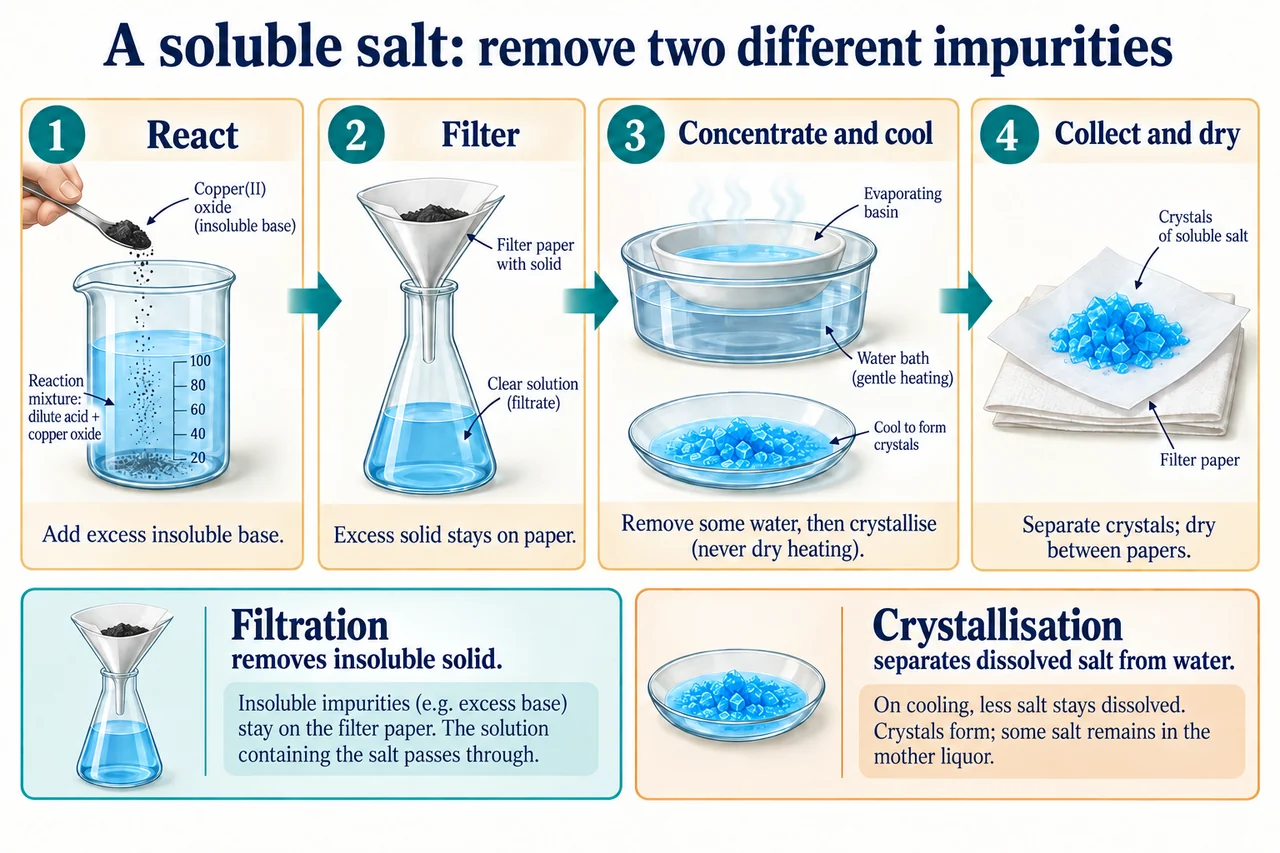
Image: illustration, not a documentary photograph. Original teaching model created for myAudience. · Original generated teaching raster; no exam-board or textbook artwork copied.
From ions to a named salt: neutralisation routes
A base neutralises an acid. An alkali is a base that dissolves in water to give hydroxide ions, so all alkalis are bases but not all bases are alkalis. Copper(II) oxide is an insoluble base; sodium hydroxide is an alkali. Metal oxides and hydroxides react with acids to make salt and water. Carbonates also neutralise acids but release carbon dioxide as an additional product. These routes differ from the metal route, which produces hydrogen instead of water.
Salt naming follows the ions retained in the product. Hydrochloric acid provides chloride, Cl-; nitric acid provides nitrate, NO3-; sulfuric acid provides sulfate, SO4^2-. The metal oxide, hydroxide or carbonate supplies the positive ion. Calcium carbonate and nitric acid therefore produce calcium nitrate, water and carbon dioxide. Naming the acid alone is insufficient: hydrochloric acid with sodium hydroxide gives sodium chloride, while with magnesium oxide it gives magnesium chloride.
A salt formula must have zero total charge. Ca2+ needs two NO3- ions, so calcium nitrate is Ca(NO3)2. Brackets show that the complete nitrate group occurs twice; CaNO32 would not express the same atom inventory. Al3+ and SO4^2- need a common charge of six, giving Al2(SO4)3. These are composition formulae for ionic substances, not pictures of discrete molecules. Balance charge to deduce a formula before balancing an equation; changing a subscript later would change the substance.
For an oxide example, CuO(s) + H2SO4(aq) → CuSO4(aq) + H2O(l). With a hydroxide, Mg(OH)2(s) + 2HCl(aq) → MgCl2(aq) + 2H2O(l). With a carbonate, CaCO3(s) + 2HNO3(aq) → Ca(NO3)2(aq) + H2O(l) + CO2(g). Notice how the carbonate supplies carbon for carbon dioxide; an oxide cannot produce CO2 unless some other carbon-containing reactant is present. A squeaky pop would instead indicate hydrogen and suggest a different route.
The salt-preparation plate uses an insoluble oxide because an excess can be physically removed. Once copper oxide has consumed all the acid, additional oxide remains as solid; filtration separates that solid from dissolved copper sulfate. This connects product chemistry to purification. If excess soluble sodium hydroxide were used, it would remain dissolved with the salt and would pass through the paper. The same neutralisation principle can therefore require a different preparation method when the base is soluble.
Neutralisation is not automatically an electron-transfer reaction. In H+ + OH- → H2O, total charge changes from +1 − 1 = 0 to neutral water without electrons appearing as reactants or products. Hydrogen ions and hydroxide ions combine; that is not the metal–acid redox account. Nor does every salt solution necessarily have pH 7. For this strong-acid/strong-alkali treatment, exact reacting amounts can give a neutral solution, whereas excess acid or alkali determines the final pH.
Transfer challenge (original teaching task, not an examination question): Use Mg2+, NO3^- and OH^- to deduce magnesium hydroxide and nitrate formulae. Predict products when the hydroxide reacts with nitric acid, balance, and explain why no carbon dioxide is expected.
Reasoned answer: Mg(OH)2 and Mg(NO3)2; Mg(OH)2 + 2HNO3 → Mg(NO3)2 + 2H2O. Products are magnesium nitrate and water; there is no carbon-containing reactant. Why this follows: Hydroxide and nitrate brackets repeat complete ion groups. Predicting a carbonate product from a hydroxide would introduce carbon atoms without a source. Indicative author rubric (5 marks; not an exam-board mark scheme): Charge balance Mg(OH)2; Charge balance Mg(NO3)2; Correct salt and water products; Balanced coefficients 1:2:1:2; Carbon inventory excludes CO2. Reading an answer does not demonstrate independent mastery or performed practical skills.
Worked example: Predict and balance magnesium carbonate reacting with nitric acid. Deduce the salt formula from ion charges and explain the extra gaseous product.
Mg2+ requires two NO3- ions, giving Mg(NO3)2. Carbonate with acid produces salt, water and CO2.
MgCO3 + 2HNO3 → Mg(NO3)2 + H2O + CO2. The nitrate groups are kept together while balancing.
Audit Mg 1, C 1, N 2, H 2 and O 9 on each side. Carbon dioxide contains the carbonate's carbon.
Answer: Magnesium nitrate, water and carbon dioxide; MgCO3 + 2HNO3 → Mg(NO3)2 + H2O + CO2.
Check your understanding: A learner writes AlSO4 for aluminium sulfate and predicts hydrogen from copper oxide plus sulfuric acid. Correct both claims and explain each correction.
Answer: Aluminium sulfate is Al2(SO4)3. Copper oxide plus sulfuric acid gives copper sulfate and water, not hydrogen.
Why: Two 3+ ions balance three 2− ions. An oxide neutralisation supplies oxygen for water; hydrogen evolution belongs to suitable metal–acid reactions. Salt charge balance and route identification must both be correct.