This practical study: reasoning towards pure, dry crystals
By UK GCSE Chemistry · independent study · myAudience
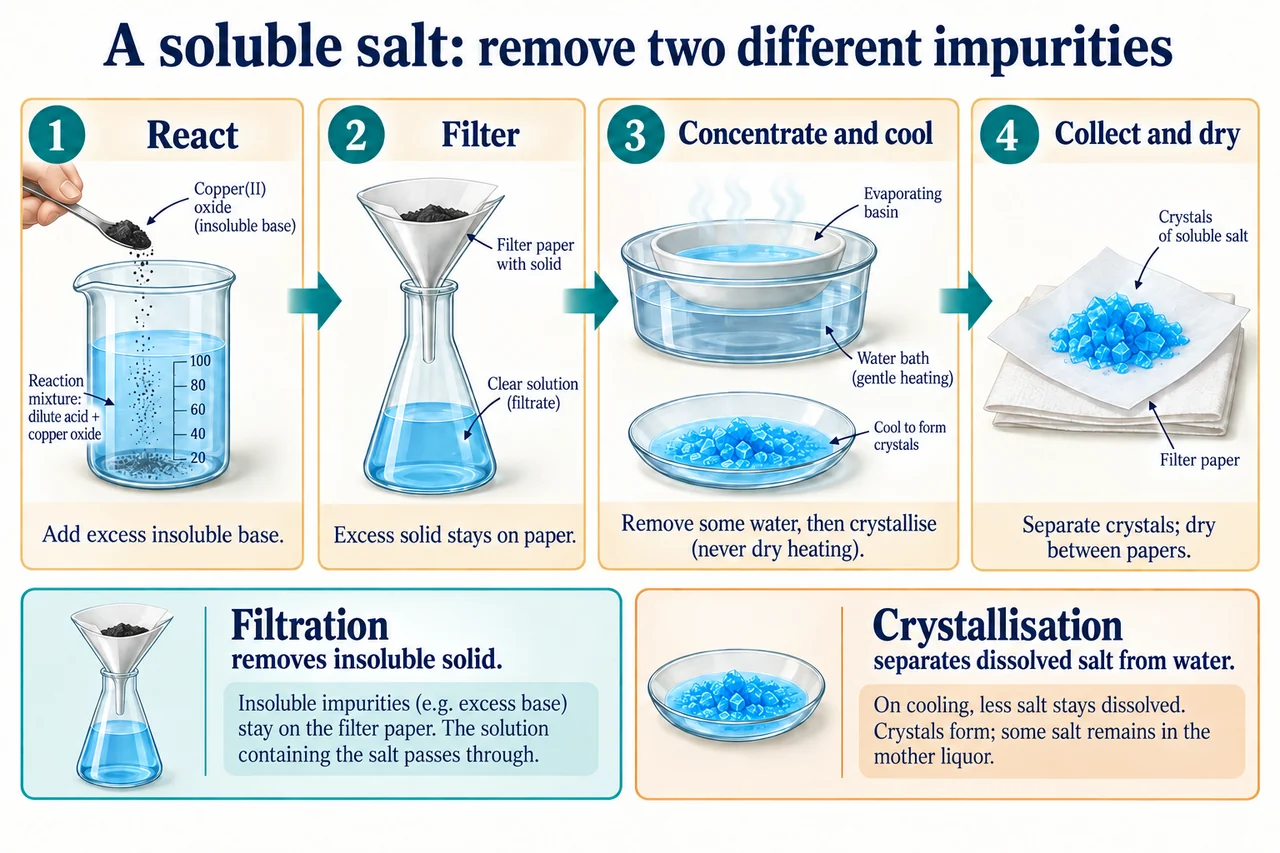
Image: illustration, not a documentary photograph. Original teaching model created for myAudience. · Original generated teaching raster; no exam-board or textbook artwork copied.
This practical study: reasoning towards pure, dry crystals
A pure, dry soluble salt sample needs reaction and separation. Consider copper sulfate from insoluble copper oxide and dilute sulfuric acid. CuO + H2SO4 → CuSO4 + H2O creates the dissolved salt, but the reaction mixture may also contain unreacted acid, excess oxide and water. The four panels in the salt plate follow the impurity removed at each stage. They are a conceptual sequence, not evidence that anyone has carried out the required practical.
Under the teacher's risk assessment, dilute acid is warmed in the approved setup using a Bunsen burner for the specified required-practical method and small portions of oxide are added with stirring. Warming helps the reaction proceed; controlled addition limits splashing. Continue until solid persists despite stirring, so the insoluble base is in excess and the acid has been consumed. The chemical endpoint is not that every particle of oxide disappears. An oxide coating, poor mixing or an insufficient wait can make solid persist too early, so observations must be interpreted carefully.
Filter the mixture to remove unreacted insoluble oxide. The solid on the filter is the residue; the blue salt solution passing through is the filtrate. Filter paper separates suspended particles, not dissolved ions. Keeping the residue instead of the filtrate discards the desired soluble salt. Filtering before the acid has been fully neutralised leaves acid dissolved in the filtrate, which filtration cannot remove. This is why the sequence is excess addition followed by filtration rather than the reverse.
Gently evaporate some water from the filtrate using a water bath or electric heater, then allow the concentrated solution to cool so crystals grow as solubility falls. Do not evaporate to dryness to imitate crystallisation: harsh heating can damage hydrated crystals and makes controlled separation harder. Collect crystals by filtration, remove surface solution with a small appropriate cold-water rinse where the approved method calls for it, and dry between filter papers. Excess washing dissolves product; omitting drying leaves water which inflates the apparent mass.
The same reasoning transfers to magnesium sulfate from magnesium carbonate and sulfuric acid: MgCO3 + H2SO4 → MgSO4 + H2O + CO2. Add small portions because gas evolution can cause frothing. Excess insoluble carbonate can be removed like excess oxide. A reactive metal can also make some salts, but gas generation and the suitability of the metal must be considered. An insoluble product or two soluble reactants would require another method; do not present this route as a universal salt recipe.
Purity, dryness and yield are different claims. Filtration can remove oxide, but it does not remove every soluble contaminant. Crystals wet with mother liquor may contain dissolved impurities on their surfaces. A low yield may reflect salt remaining in the mother liquor or dissolving during washing, while a mass above the predicted dry amount suggests water or impurity rather than atom creation. Required AT2, AT3, AT4 and AT6 include heating, conducting reactions, separation and handling; a written explanation supports these skills but cannot certify observed technique or safe performance.
Transfer challenge (original teaching task, not an examination question): Given that magnesium hydroxide is an insoluble base and magnesium nitrate is soluble, propose a pure dry magnesium nitrate preparation from nitric acid. Explain the roles of excess base, filtration, cooling and drying, and one cause of low recovered mass.
Reasoned answer: Under the approved supervised method, warm dilute acid appropriately, add/stir small portions of hydroxide until excess persists, filter to retain salt solution, concentrate gently and cool, collect and dry crystals. Excess consumes acid; filtration removes insoluble base; cooling crystallises salt; drying removes surface solution. Salt remaining in mother liquor can lower recovery. Why this follows: This transfers the separation logic to an insoluble hydroxide rather than repeating the copper oxide picture. It is written method reasoning and needs real supervised technique evidence before practical study completion. Indicative author rubric (6 marks; not an exam-board mark scheme): Suitable controlled reaction; Excess base consumes acid; Wanted filtrate, not residue; Gentle concentration then cooling; Collection and drying without claiming performed skills; Reasoned salt loss to mother liquor/washing. Reading an answer does not demonstrate independent mastery or performed practical skills.
Worked example: An apprentice filters immediately after adding a small amount of CuO, boils the filtrate to dryness, and weighs the damp solid. Explain three consequences and repair the method.
Too little oxide may leave acid; add and stir small portions until excess oxide remains, then filter it away.
Concentrate gently using the approved bath or heater and cool to crystallise instead of harshly heating to dryness.
Separate the crystals from mother liquor and dry them appropriately before weighing. Damp mass is not dry salt mass.
Answer: Use excess insoluble base, filter after neutralisation, concentrate and cool, then collect and dry crystals. Each stage addresses a different impurity or measurement problem.
Check your understanding: Why can an excess of CuO be removed from CuSO4 solution, whereas an excess of NaOH cannot be removed from NaCl solution by the same filter? Why can correct technique still give less than the theoretical yield?
Answer: CuO is insoluble and is retained; dissolved NaOH passes through with dissolved NaCl. Salt can remain in mother liquor or be lost during separation and washing.
Why: Filtration discriminates by physical state and particle size, not by whether a substance is wanted. Incomplete recovery is compatible with a pure dry sample and conserved atoms.