pH, hydrogen ions and what neutralisation consumes
By UK GCSE Chemistry · independent study · myAudience
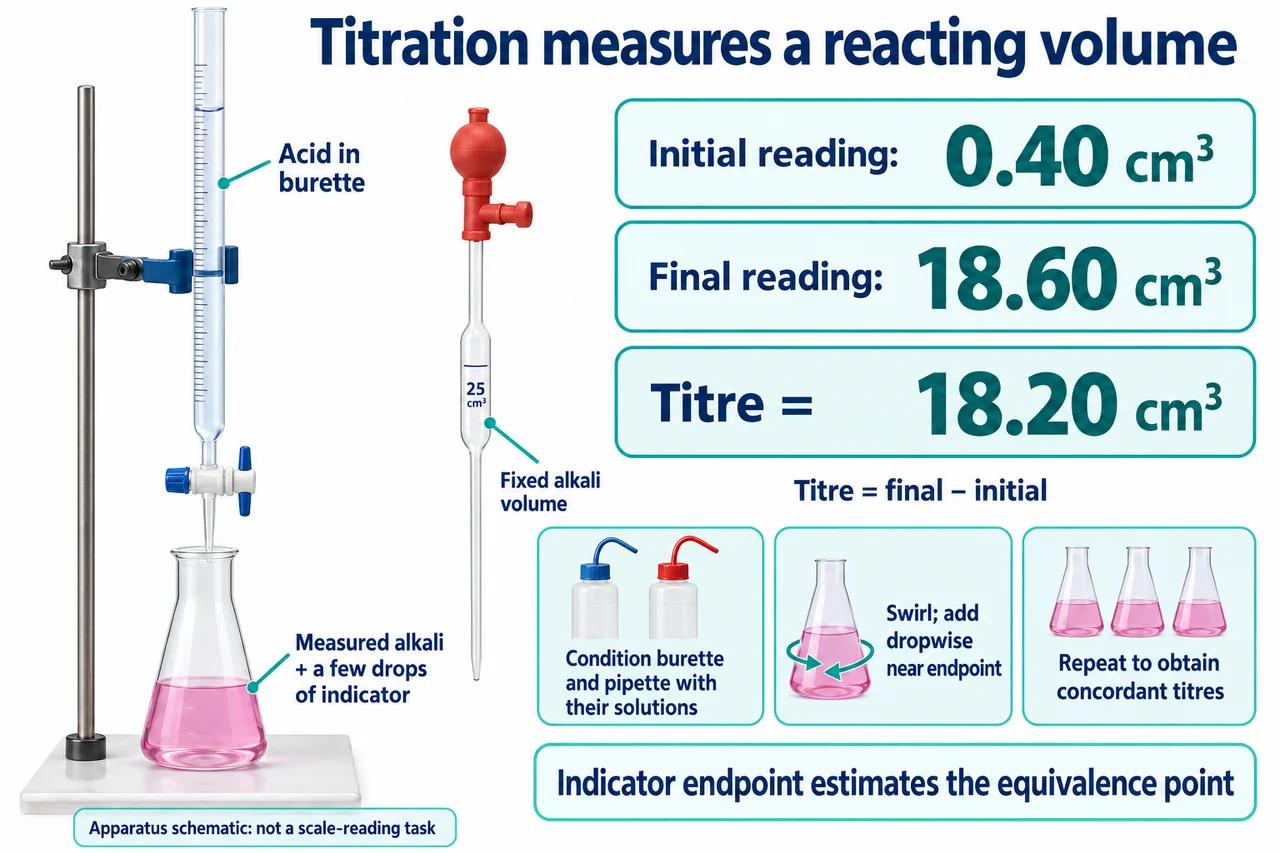
Image: illustration, not a documentary photograph. Original teaching model created for myAudience. · Original generated teaching raster; no exam-board or textbook artwork copied.
pH, hydrogen ions and what neutralisation consumes
An aqueous acid produces hydrogen ions, written H+(aq) in this GCSE model. An aqueous alkali contains hydroxide ions, OH-(aq). Water is the solvent, so aqueous is not interchangeable with molten: a solution can contain ions originating from several substances. The taught pH scale runs from 0 to 14; below 7 is acidic, 7 is neutral and above 7 is alkaline for the ordinary school conditions used here. More advanced solutions can lie outside that interval, but that is not needed to classify these examples.
Universal indicator is a mixture that changes colour across a range of pH values. Put a small sample in suitable clean apparatus, add the indicator or use the approved indicator paper, and compare the result with its supplied colour chart. Red or orange suggests acidic, green near neutral, and blue or purple alkaline, but exact shades and ranges depend on the chart. A single colour provides an approximate pH, not an exact hydrogen-ion concentration. Strongly coloured samples can make colour comparison unreliable.
A pH probe provides a numerical reading. Calibration using appropriate known buffers, rinsing between samples and allowing the reading to stabilise improve the measurement. Extra decimal places on its display do not prove extra accuracy. A contaminated probe or an uncalibrated one may give repeated but systematically wrong results. Compare methods using the needs of the investigation: a probe can follow small numerical changes, while a wide-range indicator efficiently classifies a set of clearly different solutions.
In acid–alkali neutralisation, H+(aq) + OH-(aq) → H2O(l). One hydrogen ion combines with one hydroxide ion; the oxygen and two hydrogen atoms form water, and total charge is zero on both sides. Sodium and chloride ions in hydrochloric acid–sodium hydroxide neutralisation remain in solution as the salt's ions. The reaction does not remove all ions or necessarily stop the solution conducting. It changes the amounts of the reacting H+ and OH-.
If alkali is added gradually to strong acid, pH rises as hydrogen ions are consumed. Before the equivalence point acid remains in excess; after it hydroxide is in excess. Equal volumes alone do not establish equivalence because concentrations and reaction ratios can differ. The titration image shows a fixed alkali aliquot and a measured acid addition: the endpoint colour estimates a reacting amount, rather than proving that any two equal liquid heights give pH 7. Universal indicator's many colour transitions are unsuitable for a precise single endpoint.
The neutral point is not an arithmetic average of starting pH values. Mixing equal volumes of pH 2 acid and pH 12 alkali may be neutral under specified strong-acid/strong-alkali and temperature conditions, but adding their pH values and dividing by two is not a valid general rule. pH describes ion concentration on a non-linear scale, with that quantitative relationship treated at Higher later. For shared-tier explanations, identify the ion in excess and the reaction consuming it, rather than relying on volume, colour brightness or a memorised average.
Transfer challenge (original teaching task, not an examination question): A coloured liquid gives an ambiguous universal-indicator result; a pH probe repeatedly reads 8.2, but it reads 8.2 in a known pH7 buffer too. Evaluate the two measurements and choose a recovery action before classifying the unknown.
Reasoned answer: Sample colour may mask indicator colour. Repeated probe readings demonstrate consistency, not accuracy; the buffer check suggests calibration/contamination error. Clean/rinse and calibrate appropriately, verify buffers, then remeasure rather than declaring the unknown alkaline. Why this follows: Neither a digital decimal nor repetition guarantees a valid pH. The recovery decision follows the known reference result rather than averaging an invalid measurement. Indicative author rubric (4 marks; not an exam-board mark scheme): Indicator interference; Systematic probe problem identified; Precision does not establish accuracy; Calibration/cleaning verification and remeasurement before classification. Reading an answer does not demonstrate independent mastery or performed practical skills.
Worked example: Constructed approximate pH-probe readings for adding strong alkali to 20 cm3 strong acid are: 0 cm3, pH 2.0; 10 cm3, pH 2.5; 20 cm3, pH 7.0; 25 cm3, pH 11.0. Classify each solution and interpret the change without averaging pH. These are rounded teaching values, not performed observations.
The first two samples are acidic because their pH values are below 7; the 20 cm3 sample is neutral and the last alkaline.
H+ is consumed by OH- to form water. At the specified neutral reading neither strong reactant remains in excess in this model.
At 25 cm3 the added alkali is in excess. The supplied 20 cm3 neutral volume is evidence for these particular solutions, not a rule for all acids and alkalis.
Answer: Acidic, acidic, neutral, alkaline. The pattern reflects the changing excess of H+ or OH-.
Check your understanding: A learner claims neutralised hydrochloric acid cannot conduct because all ions became water. Correct the claim using the ionic equation, and explain why a green indicator colour cannot certify exact pH 7.00.
Answer: Only H+ and OH- combine to form water; dissolved spectator ions remain mobile. Universal indicator gives an approximate pH range.
Why: Na+ and Cl- survive sodium hydroxide–hydrochloric acid neutralisation. Conductivity needs mobile charged particles, not excess acid. Colour comparison has limited resolution and may be affected by sample colour or technique.