Chemistry only: an accurate reacting-volume titration
By UK GCSE Chemistry · independent study · myAudience
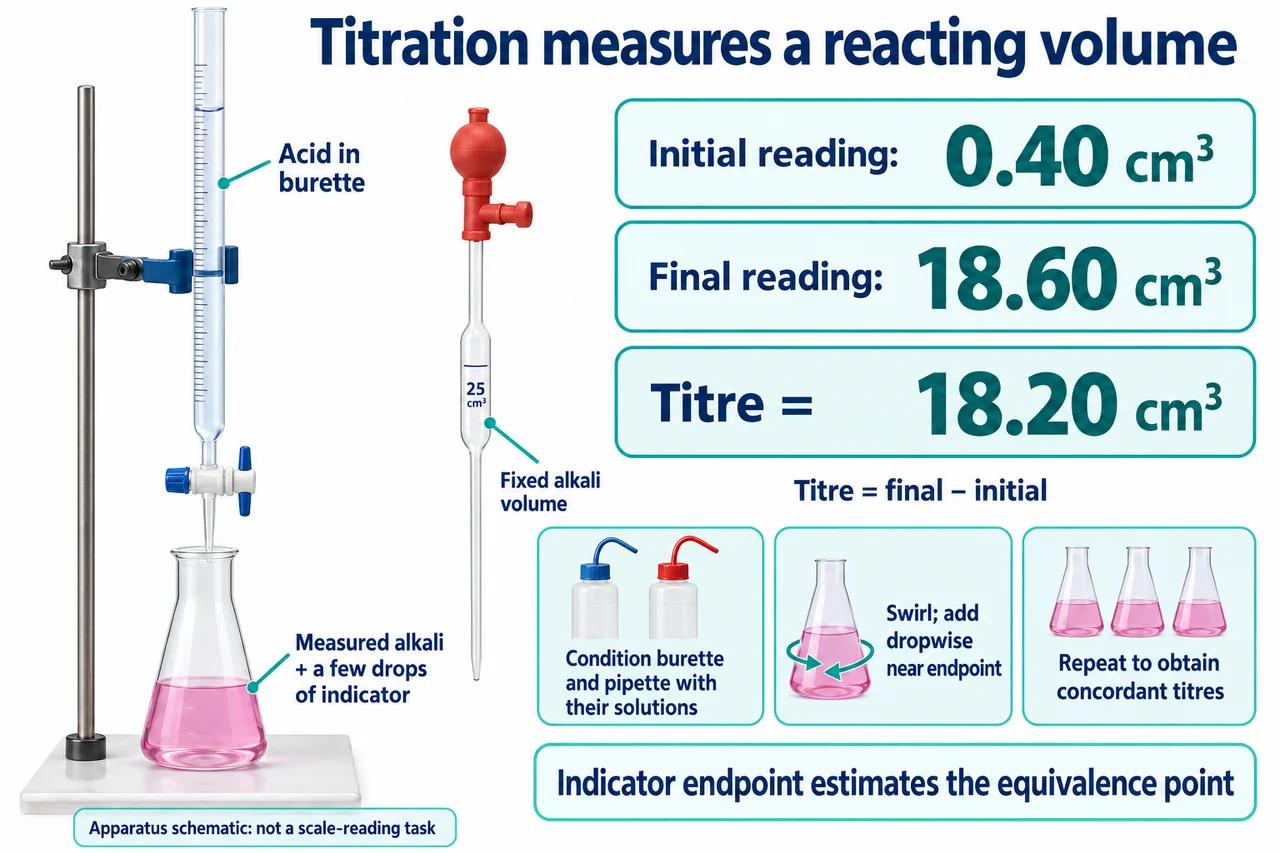
Image: illustration, not a documentary photograph. Original teaching model created for myAudience. · Original generated teaching raster; no exam-board or textbook artwork copied.
Chemistry only: an accurate reacting-volume titration
Titration finds the volume of one solution that reacts with a measured volume of another. In the assessed Chemistry-only practical, use a strong acid and a strong alkali, with hydrochloric, nitric or sulfuric acid as specified. A volumetric pipette measures a fixed aliquot; a burette delivers a variable accurately read volume. The titration plate keeps these jobs distinct. A measuring cylinder is generally less precise for the fixed aliquot, and the flask's graduations are not used to measure the titre.
Clean the apparatus and condition the burette with the acid it will contain and the pipette with the alkali it will measure, so residual water does not dilute either stock solution. Use a pipette filler, never the mouth. The conical flask may be rinsed with distilled water: added water changes concentration but not the amount of alkali delivered by the pipette. Rinsing that flask with alkali would add an unmeasured extra amount and increase the reacting acid volume.
Clamp the burette vertically, fill it safely, allow solution through the tip to remove air bubbles, and remove the filling funnel before taking readings. Read the bottom of a colourless solution's meniscus at eye level to reduce parallax. Burette values normally increase downwards as solution is delivered, so titre is final reading minus initial reading. The plate's 18.60 − 0.40 = 18.20 cm3 is a difference between readings, not the final volume left inside the burette.
Put the measured alkali in the flask on a white tile and add a few drops of suitable indicator. Phenolphthalein is pink in alkali and becomes colourless as acid reaches its endpoint; methyl orange changes from yellow towards its endpoint colour when acid is added. Both can suit a strong-acid/strong-alkali titration. A wide-range universal indicator passes through many colours and does not give the same sharply judged endpoint. Swirl and add acid dropwise near the endpoint so one addition does not overshoot it.
First perform a rough titration to locate the transition, then repeat carefully with fresh measured aliquots. Record initial and final readings, calculated titres, indicator and endpoint observation for every run. For this constructed teaching task, concordant means titres within 0.10 cm3; that chosen tolerance must not be presented as a universal rule. Average the justified concordant accurate runs, retaining excluded rough or suspect data in the record. Close agreement supports precision but cannot remove a systematic dilution error.
An endpoint is the observed indicator transition; the equivalence point is the exact stoichiometric reacting amount. A suitable indicator makes them close, but they are conceptually different. If making a pure soluble salt from an acid and an alkali, first establish the reacting volumes, then repeat those measured volumes without indicator before concentrating and crystallising; indicator would contaminate the product. This written practical study reasoning is accessible to both tiers. Observed pipetting, burette control, reading, safety and contemporaneous laboratory records remain required practical evidence, not outcomes of reading.
Transfer challenge (original teaching task, not an examination question): Readings for three constructed accurate titrations are 0.20/22.35, 1.00/23.20 and 0.10/22.70 cm3. The stated concordance tolerance is 0.10 cm3. Select a mean, retain the excluded evidence and explain why averaging all three is not automatically better.
Reasoned answer: Titres 22.15,22.20,22.60 cm3. First two are concordant; mean 22.175, reported 22.18 cm3 under the chosen two-decimal convention. Retain 22.60 and investigate overshoot/technique; further accurate repeats are appropriate. Three-run mean 22.316... would be biased by the discordant run. Why this follows: The selected tolerance is supplied for this original task, not attributed as a universal rule. Averaging unjustified runs can hide a technique problem and does not recover an accurate reacting volume. Indicative author rubric (5 marks; not an exam-board mark scheme): Correct three subtractions; First two selected with0.05 spread; Mean22.18 cm3 and rounding explained; Retains discordant record and proposes investigation/repeats; Rejects larger count as automatic accuracy. Reading an answer does not demonstrate independent mastery or performed practical skills.
Worked example: Constructed accurate runs use initial/final readings 0.40/18.60, 1.10/19.35 and 0.20/18.40 cm3; a rough run was 19.00 cm3. Use a stated 0.10 cm3 concordance tolerance. Find the justified mean and explain the exclusions.
Accurate titres are 18.20, 18.25 and 18.20 cm3, calculated as final minus initial.
Their spread is 0.05 cm3, within the stated tolerance, so average these three: 54.65/3 = 18.2166... cm3.
Report 18.22 cm3 to the chosen two-decimal reading precision. Exclude the rough scouting run from the mean, but retain its record and role.
Answer: Mean reacting acid volume 18.22 cm3 from the three concordant accurate runs.
Check your understanding: Predict the direction of titre error if the pipette contains distilled water when filled with alkali, versus if the flask is rinsed with alkali. Why does a little distilled water added to the flask not have the same effect?
Answer: A water-wet unconditioned pipette dilutes the aliquot and lowers the acid titre. Alkali rinsing adds unmeasured alkali and raises it. Distilled water in the flask adds no alkali amount.
Why: Reacting volume follows the amount of alkali, not its final diluted concentration in the flask. Both technique errors can produce repeatable titres, so concordance alone does not establish accuracy.