Higher Chemistry only: titration quantities and error direction
By UK GCSE Chemistry · independent study · myAudience
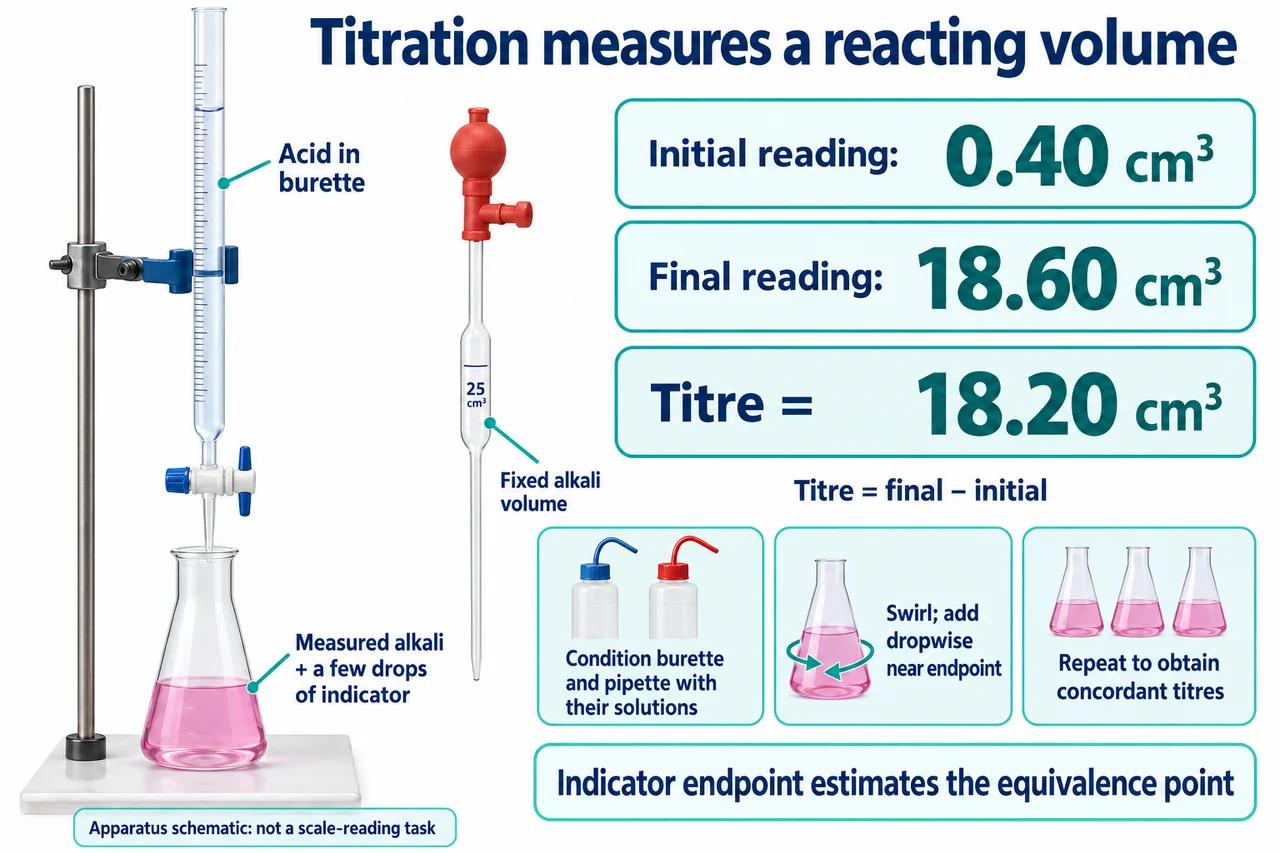
Image: illustration, not a documentary photograph. Original teaching model created for myAudience. · Original generated teaching raster; no exam-board or textbook artwork copied.
Higher Chemistry only: titration quantities and error direction
A titration calculation links a measured volume to an amount of substance through the balanced equation. Concentration c in mol/dm3 is amount n divided by solution volume V in dm3, so n = cV. The measured titre and fixed aliquot belong to different solutions; label them before substituting. Convert cm3 to dm3 by dividing by 1000. Using a value in cm3 with a concentration per dm3 introduces a factor-of-1000 error even if every following algebra step is correct.
For HCl + NaOH → NaCl + H2O, acid and alkali amounts react 1:1. At equivalence c(acid)V(acid) = c(alkali)V(alkali). Sulfuric acid differs: H2SO4 + 2NaOH → Na2SO4 + 2H2O has a 1:2 ratio, so the alkali amount is twice the acid amount. Equal concentrations therefore require twice as much alkali volume as sulfuric acid volume. Memorising cV = cV without reading the equation silently erases that chemical ratio.
Suppose 25.00 cm3 sodium hydroxide reacts with 20.00 cm3 sulfuric acid of concentration 0.100 mol/dm3. Acid amount is 0.100 × 0.02000 = 0.00200 mol. The equation requires 0.00400 mol NaOH. Divide by the alkali aliquot volume, 0.02500 dm3, giving 0.160 mol/dm3. To express the same NaOH concentration in g/dm3, multiply by molar mass 40 g/mol to obtain 6.40 g/dm3. Multiplying by the acid's formula mass would answer a different question.
The titration plate shows how readings yield a titre; the stoichiometric calculation begins only after choosing valid accurate titres. The difference 18.60 − 0.40 = 18.20 cm3 remains positive because the burette scale increases downwards. Work with the unrounded mean if supplied, and round the final calculated concentration to a justified precision. A titre based on two readings has reading uncertainty from both, so a small reacting volume generally has greater relative reading uncertainty than a large one on the same burette.
Systematic technique errors can be traced through n = cV. If acid in the burette is accidentally diluted but its old nominal concentration is used, more volume is needed to neutralise the aliquot. The calculation then overestimates the alkali amount and concentration. If an air bubble initially in the tip disappears during delivery, part of the indicated volume fills the tip instead of reaching the flask; the recorded titre is too large and the same overestimate can result. Repeating such an error may give concordant but inaccurate values.
The calculation supports written practical study reasoning; it does not establish that an endpoint was observed, an instrument was handled correctly or an unknown concentration was actually measured. Supplied titres are constructed data. A successful transfer answer connects the balanced coefficient ratio, volume conversion, chosen mean, units and error mechanism. Each link matters: the right numerical answer from an unexplained cancellation is weak evidence of understanding, while an apparently plausible concentration may still contain a doubled or halved reaction ratio.
Higher extension (original teaching task, not an examination question): 25.00 cm3 NaOH at 8.00 g/dm3 is titrated with 0.100 mol/dm3 H2SO4. Use M(NaOH)=40 g/mol to predict the acid titre, then show the different answer produced by wrongly assuming a 1:1 equation.
Reasoned answer: NaOH c=8.00/40=0.200 mol/dm3; n=0.200×0.02500=0.00500 mol. H2SO4 amount0.00250 mol; V=0.00250/0.100=0.0250 dm3=25.0 cm3. A wrong 1:1 account predicts 50.0 cm3. Why this follows: A reverse calculation tests whether concentration, reacting coefficients and volume are connected. The correct predicted titre comes from amount conservation at equivalence, not equal starting volumes. Indicative author rubric (5 marks; not an exam-board mark scheme): Mass-to-molar concentration; Correct aliquot conversion and amount; Acid amount halved from1:2 ratio; 25.0 cm3 with units; Wrong ratio gives50.0 cm3 and reason identified. Reading an answer does not demonstrate independent mastery or performed practical skills.
Worked example: 25.00 cm3 KOH reacts with 16.00 cm3 H2SO4 of concentration 0.125 mol/dm3. Calculate KOH concentration in mol/dm3 and g/dm3 using K = 39, O = 16, H = 1. Predict the error if the acid is diluted unknowingly.
H2SO4 + 2KOH → K2SO4 + 2H2O. Acid amount = 0.125 × 0.01600 = 0.00200 mol.
KOH amount = 2 × 0.00200 = 0.00400 mol; concentration = 0.00400/0.02500 = 0.160 mol/dm3.
M(KOH) = 56 g/mol, so mass concentration = 0.160 × 56 = 8.96 g/dm3. Diluted acid requires a larger titre; using 0.125 would overestimate KOH concentration.
Answer: 0.160 mol/dm3 and 8.96 g/dm3; unnoticed acid dilution biases the calculated KOH concentration upwards.
Check your understanding: A student obtains 0.0800 mol/dm3 for that KOH by equating acid and alkali amounts. Locate the error. Would adding distilled water to the correctly measured KOH in the flask cause the same error?
Answer: The student omitted the 1:2 acid:alkali coefficient ratio. Water in the flask does not change KOH amount or the acid volume needed at equivalence.
Why: The acid gives two reacting hydrogen ions per formula unit in this strong-acid model. The pipetted amount remains fixed when diluted in the flask; reaction ratio errors and flask dilution are distinct mechanisms.