Higher: strong, weak, concentrated and dilute acids
By UK GCSE Chemistry · independent study · myAudience
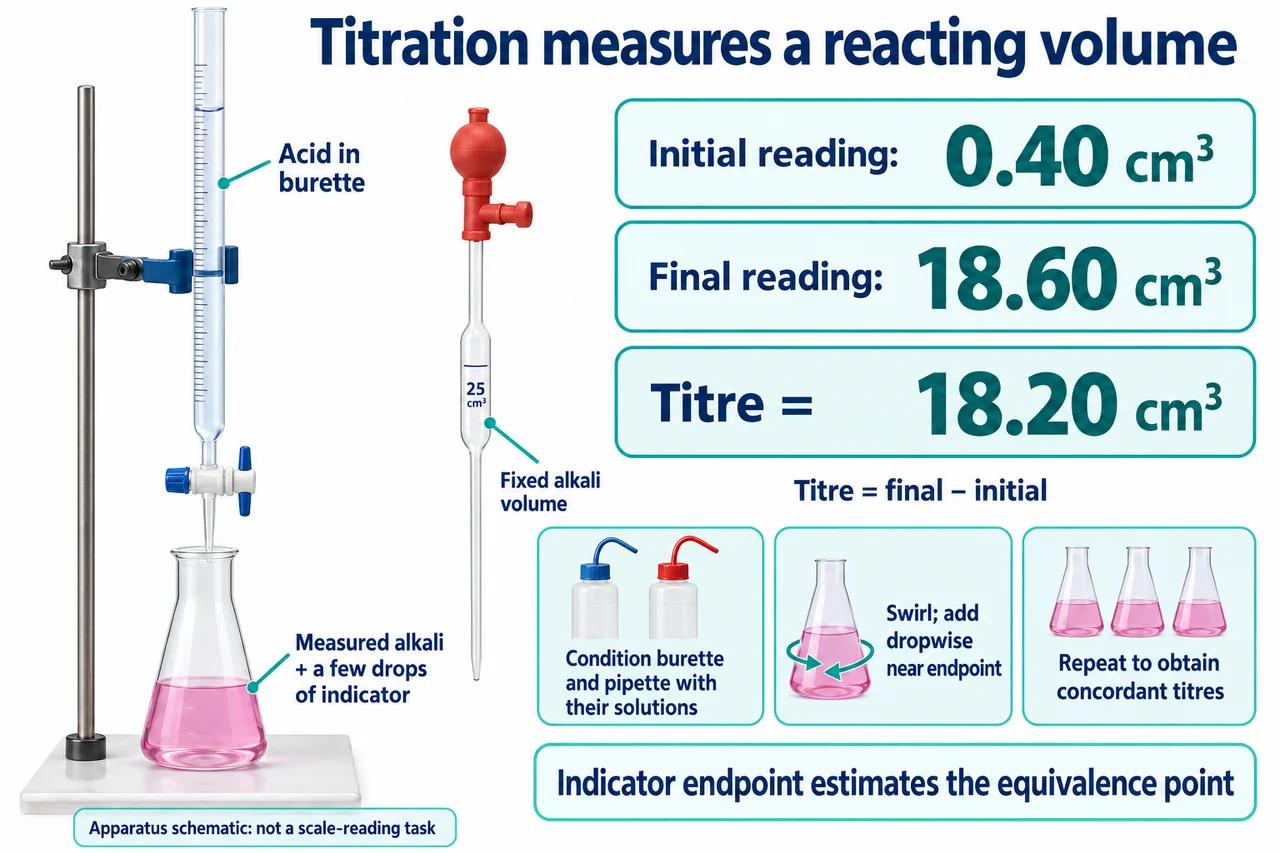
Image: illustration, not a documentary photograph. Original teaching model created for myAudience. · Original generated teaching raster; no exam-board or textbook artwork copied.
Higher: strong, weak, concentrated and dilute acids
Acid strength describes the degree of ionisation in water. In the GCSE model, hydrochloric, nitric and sulfuric acids are strong because their ionisation is treated as complete. Ethanoic, citric and carbonic acids are weak because only a proportion of their acid entities ionise. For ethanoic acid, CH3COOH(aq) ⇌ H+(aq) + CH3COO-(aq) expresses a reversible ionisation: many acid molecules remain un-ionised alongside some ions. Weak does not mean that no hydrogen ions are produced.
Concentration describes the amount of dissolved substance per solution volume; dilute and concentrated compare that quantity. Strength and concentration answer independent questions. A dilute strong acid can contain a small total acid amount, nearly all ionised, while a concentrated weak acid can contain a larger acid amount with only a fraction ionised. Neither strong nor concentrated alone gives a full account of corrosive hazard or reaction rate. Comparing pH requires actual ion concentration and conditions, not just one adjective.
At equal concentration for a like-for-like acid comparison, the stronger acid supplies more H+ and has lower pH. A constructed equal-volume particle account with 100 monoprotic acid entities can represent a strong acid as 100 hydrogen ions and 100 negative ions, while a weak acid with 10% ionisation has 10 of each ion plus 90 intact acid molecules. Charge remains neutral overall in both. This is an explanatory count model, not a claim that real ethanoic acid is always 10% ionised; that fraction depends on concentration and conditions.
A fall of one whole pH unit means a tenfold rise in hydrogen-ion concentration. A solution at pH 2 therefore has 100 times the hydrogen-ion concentration of one at pH 4. The direction is easy to reverse: lower pH corresponds to more H+, not less. A solution at pH 7 is neutral in the ordinary school-temperature model because hydrogen-ion and hydroxide-ion concentrations balance; neutral water does not contain zero ions. The assessed arithmetic here uses whole-number pH differences rather than logarithm calculations.
Dilution lowers the amount of acid per unit volume by adding solvent, while retaining the acid amount if none is removed or reacted. A tenfold dilution of a strong monoprotic acid can raise pH by roughly one while acidic behaviour dominates, but one should not extend that indefinitely through neutrality or apply it unchanged to a weak acid: weak-acid ionisation fraction changes on dilution. The titration artwork illustrates measured solution volumes only. It contains no microscopic ionisation diagram, and its colourless endpoint must not be read as evidence that a weak acid became strong.
A controlled pH comparison holds acid concentration and temperature constant, uses appropriately calibrated apparatus, and identifies whether comparisons are like-for-like. Universal indicator may classify acidity but often cannot resolve a small numerical difference; a pH probe is more informative when appropriately calibrated. A demanding explanation states which variable is changed and whether the conclusion concerns ionisation, amount per volume or H+ concentration. Reading this comparison supplies AT8 reasoning, while actual preparation, probe use and measured observations remain unperformed skills.
Higher extension (original teaching task, not an examination question): Solution A at pH 3 and B at pH 5 contain different acids at unknown formal concentrations. Compare H+ concentration, state what cannot be inferred about strength, and explain how to make a controlled strength comparison.
Reasoned answer: A has 100 times B's H+ concentration. Their degree of ionisation cannot be inferred because formal concentrations differ or are unknown. Compare like-for-like acids at equal known formal concentration and temperature with reliable pH measurements, using the supplied ionisation model. Why this follows: pH directly compares hydrogen-ion concentration. Degree of ionisation is a separate quantity, so a concentrated weak acid can be more acidic than a sufficiently dilute strong one. Indicative author rubric (4 marks; not an exam-board mark scheme): 100-fold factor; Correct more-H+ direction; No strength inference from unequal unknown concentrations; Controlled concentration/temperature and reliable measurement. Reading an answer does not demonstrate independent mastery or performed practical skills.
Worked example: A and B are hypothetical monoprotic acids at equal formal concentration and temperature. A is fully ionised; B is 1% ionised. The supplied measured pH values are 2 and 4. Explain their relationship and compare a third solution C at pH 5.
A is stronger in this supplied comparison; it produces more H+ per equal acid amount. B still produces ions despite being weak.
The pH difference 4 − 2 = 2 gives a factor 10^2 = 100; A has 100 times B's H+ concentration.
A versus C differs by three units, giving 10^3 = 1000. Those pH values alone do not identify C's acid strength or formal concentration.
Answer: A has 100 times B's and 1000 times C's H+ concentration. Strength follows the supplied ionisation information, not pH alone.
Check your understanding: A concentrated weak acid has lower pH than a very dilute strong acid. Does this refute the definition of strong acid? Explain, and state the H+ concentration ratio for pH 3 compared with pH 6.
Answer: No: formal concentrations differ, so pH cannot alone compare degree of ionisation. pH 3 has 1000 times the H+ concentration of pH 6.
Why: Strength concerns the fraction ionised; concentration concerns acid amount per volume. The three-unit pH gap implies a factor of 10 × 10 × 10, in the direction of more H+ at lower pH.