Electrolysis: completing a circuit with two charge carriers
By UK GCSE Chemistry · independent study · myAudience
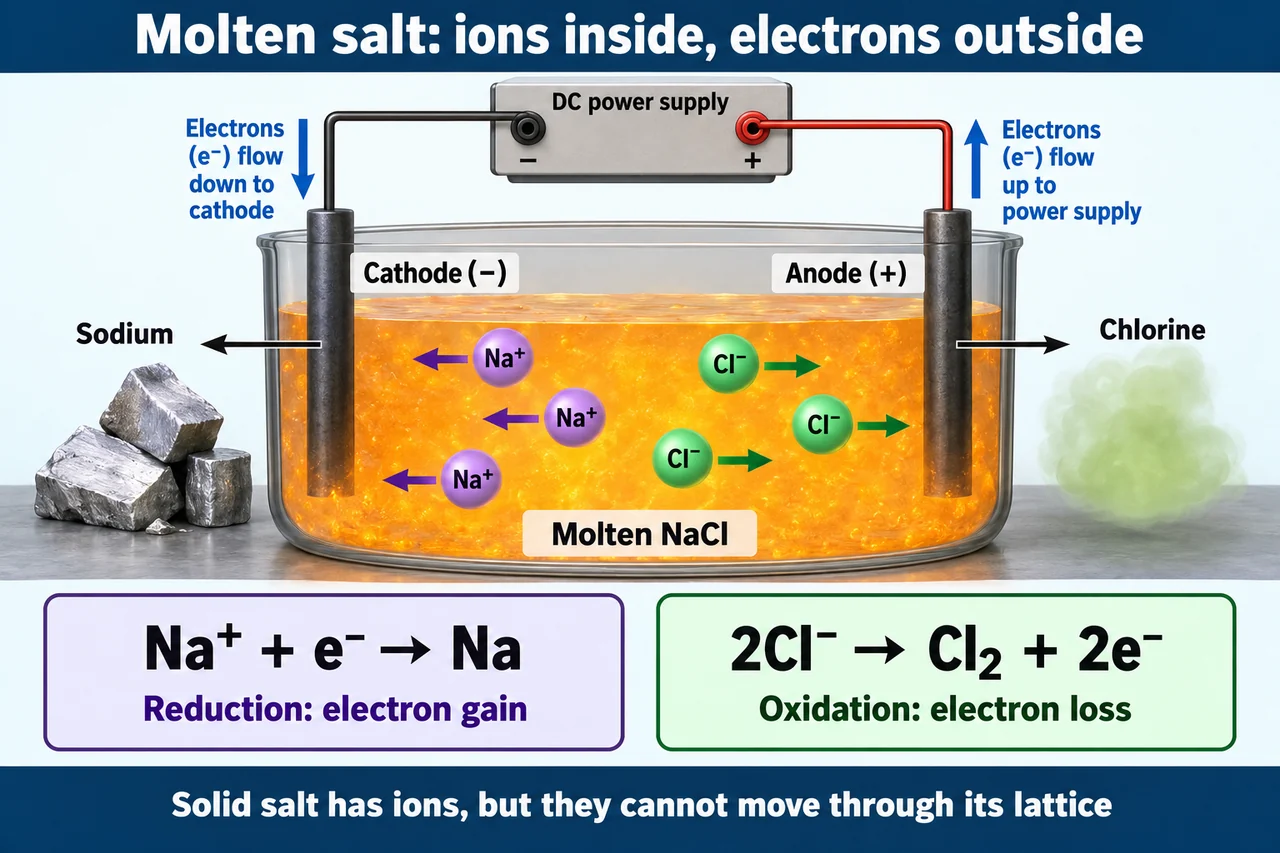
Image: illustration, not a documentary photograph. Original teaching model created for myAudience. · Original generated teaching raster; no exam-board or textbook artwork copied.
Electrolysis: completing a circuit with two charge carriers
Electrolysis uses electrical energy to bring about decomposition of an electrolyte. An electrolyte contains mobile ions when molten or dissolved. Solid sodium chloride already contains Na+ and Cl- ions, but they are held in lattice positions and cannot move through the solid to carry a sustained current. Melting allows the ions to move; dissolving separates them into an aqueous solution. Conductivity is therefore about mobile charge carriers, not simply the presence of charged particles or a liquid appearance.
An electrode connects the external electrical circuit to the electrolyte. For an electrolytic cell powered by a direct-current supply, the cathode is connected to the negative terminal and the anode to the positive terminal. Oppositely charged particles attract: positive cations move towards the negative cathode, and negative anions move towards the positive anode. The signs apply to electrolysis here; electrode names describe reaction roles and should not be transferred to battery signs without checking the type of cell.
The transport plate places the cathode on the left and anode on the right solely for clarity. Na+ arrows lead left and Cl- arrows right inside the molten salt. Electrons move through the metallic wires and conducting electrodes; ions carry charge through the liquid. Electrons do not swim across the molten salt from one electrode to the other, and sodium ions do not move up the wire to the supply. Both parts of the circuit must support charge transfer for electrolysis to continue.
At an electrode, an ion is discharged when electron transfer changes it into a neutral product. At the cathode sodium ions gain electrons and form sodium; at the anode chloride ions lose electrons and form chlorine. The power supply delivers electrons to the cathode and removes electrons from the anode. It is not used up as a chemical reagent, but energy is transferred to drive the change. A visible product at an electrode is evidence to investigate; bubbling by itself does not identify that product.
Higher extension: the plate's cards show Na+ + e^- → Na and 2Cl- → Cl2 + 2e^-. Cathode reduction gains electrons, so electrons appear on the left; anode oxidation loses them, so electrons appear on the right. Each half-equation balances atoms and charge separately. Multiplying the sodium account by two gives equal electron transfer before combining. The resulting 2NaCl → 2Na + Cl2 is a decomposition account for molten salt, not a prediction for sodium chloride solution.
A complete explanation connects physical state, carrier motion, electrode attraction and discharge. Calling an electrolyte a substance containing free electrons confuses it with metallic conduction. Calling the positive anode the destination of positive ions confuses the electrode sign with the particle's sign. Pure molecular liquids generally lack enough mobile ions for this model of conduction; water in an aqueous electrolyte adds possible electrode reactions, developed later. The plate is a conceptual carrier diagram, with exaggerated particle sizes and no safe operating apparatus or performed experiment. The solid-looking sodium icon outside the vessel identifies the element after collection, not its state in the working melt: sodium would be liquid at molten-salt operating temperatures. The vessel is schematic, not safe hot-salt apparatus.
Transfer challenge (original teaching task, not an examination question): In the molten NaCl plate the wires are swapped. Identify the new cathode/anode and ion movement, then trace electrons outside the liquid. Explain why calling the left rod permanently the cathode is wrong.
Reasoned answer: Left becomes anode(+) and right cathode(−). Na+ moves right and Cl− left. Electrons leave the left anode for positive supply and arrive from negative supply at the right cathode. Electrode role follows connection/reaction, not page position. Why this follows: The plate's initial orientation is a convention for one circuit. Reversing the supply reverses roles and product locations while ionic versus electronic conduction remains distinct. Indicative author rubric (5 marks; not an exam-board mark scheme): New left anode positive; New right cathode negative; Correct opposite ion directions; Correct external electron directions; No electrons crossing electrolyte; names not tied to left/right. Reading an answer does not demonstrate independent mastery or performed practical skills.
Worked example: A circuit contains solid NaCl between conducting rods connected to DC. Explain why it does not sustain electrolysis, predict the change on melting, and trace each charge carrier from supply to product.
Solid lattice ions cannot move through the electrolyte, so electron-conducting wires alone do not complete the conducting path.
On melting, Na+ moves to the negative cathode and Cl- to the positive anode. Electrons arrive at the cathode through the wire and leave the anode through the other wire.
Higher: Na+ gains one electron to form Na; two Cl- each lose one electron and form Cl2. The liquid carries ions rather than a stream of electrons.
Answer: Mobile molten ions complete the electrolyte part of the circuit; sodium forms at cathode (−) and chlorine at anode (+).
Check your understanding: Correct this account: 'The battery sends electrons through the salt solution, carrying Na+ to the positive electrode.' State what moves in each circuit region and why.
Answer: Electrons move in the external wires and conducting electrodes. Na+ moves through the electrolyte towards the negative cathode; negative ions move towards the positive anode.
Why: Positive and negative charges attract. An ionic liquid conducts by mobile ions, and electrode electron transfer creates products; cations do not travel through the wire attached to the supply.