Molten binary compounds: predict products before balancing
By UK GCSE Chemistry · independent study · myAudience
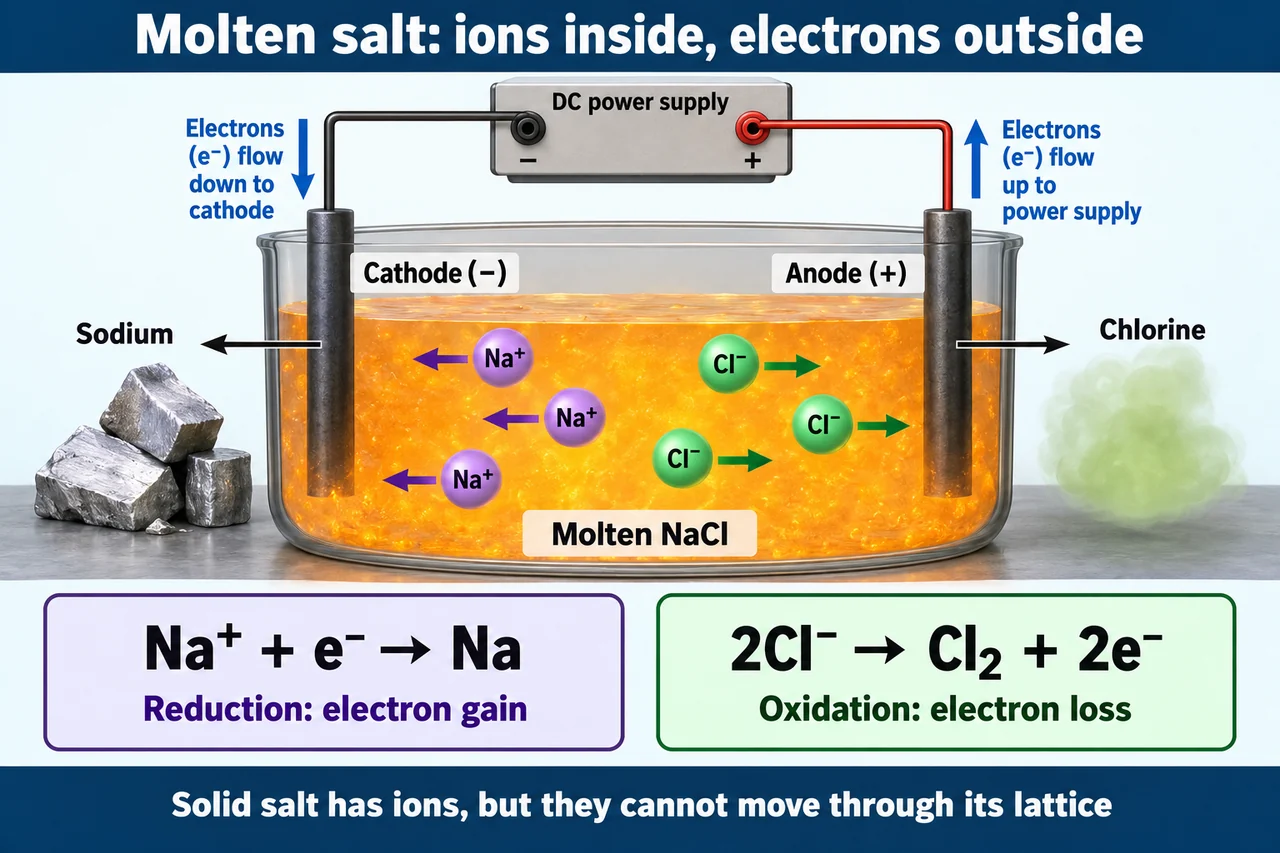
Image: illustration, not a documentary photograph. Original teaching model created for myAudience. · Original generated teaching raster; no exam-board or textbook artwork copied.
Molten binary compounds: predict products before balancing
A binary ionic compound contains ions of two elements. When the pure compound is molten and inert electrodes are used, the positive metal ions form metal at the cathode and the negative non-metal ions form the non-metal at the anode. Inert means the electrode is treated as not reacting with the electrolyte or products under the specified conditions. The molten state removes water as a competing source of hydrogen and oxygen; that is the reason product prediction is simpler here.
For molten lead bromide, PbBr2, lead forms at the negative cathode and bromine at the positive anode. The formula means Pb2+ and two Br- per composition unit, not one neutral lead bromide molecule shuttling between rods. Bromine is diatomic Br2, so a balanced overall equation is PbBr2 → Pb + Br2. The positive ions do not form a gas merely because their electrode is negative. Product state depends on conditions, and bromine formation is a toxic-product context for supervised teaching, not a home practical.
The transport plate uses sodium chloride instead of lead bromide to show the same carrier logic. Sodium ions gain electrons at the negative rod and chloride ions lose them at the positive rod. The symbols refer to a conceptual molten electrolyte. In an aqueous sodium chloride solution, the cathode product is hydrogen under the prediction model, so a student must read the physical state before selecting products. Melting and dissolving both permit ion motion but give different species available for discharge. The solid-looking sodium icon is not the product state in the hot cell; sodium would be liquid at the operating temperature, and the drawn glass vessel is not a safe apparatus specification.
Higher extension: Pb^2+ + 2e^- → Pb is reduction and 2Br^- → Br2 + 2e^- is oxidation. Each side of the cathode account has charge zero; each side of the anode account has charge −2. Adding cancels two electrons and gives Pb^2+ + 2Br^- → Pb + Br2. Ionic notation exposes the reacting charges; the compound equation expresses the same composition more compactly. Do not place electrons in the final combined equation.
For a supplied molten aluminium oxide account, Al^3+ + 3e^- → Al and 2O^2- → O2 + 4e^- transfer three and four electrons respectively. Use the lowest common multiple, twelve: multiply the aluminium account by four and the oxygen account by three. The combined equation is 2Al2O3 → 4Al + 3O2. This is the simplified oxide-ion model for the specified reaction, not a routine classroom practical using pure molten alumina. Industrial aluminium extraction uses a lower-temperature electrolyte mixture and carbon anodes which consume the oxygen, developed in the next lesson.
Product prediction and balancing are separate tests. An equation can conserve atoms while naming the wrong electrode product or assuming the wrong state. Start by listing the specified ions, match their charge signs to electrodes, name neutral products, then balance atoms and, for Higher, electron transfer. A demanding unfamiliar task may supply ion charges instead of a familiar salt name. The method still works because it uses charge and diatomic-element knowledge rather than a memorised lead bromide diagram.
Transfer challenge (original teaching task, not an examination question): A supplied pure molten MgO cell uses inert electrodes. Predict products and signs. Higher: balance both half-equations and combine. Explain why sulfate or hydrogen cannot appear in the resulting account.
Reasoned answer: Magnesium at cathode(−), oxygen at anode(+). Higher: Mg^2+ + 2e^- → Mg and 2O^2- → O2 + 4e^-. Double the Mg account:2MgO → 2Mg + O2. No sulfur or hydrogen atoms occur in the supplied melt. Why this follows: A molten oxide extends the method beyond halide examples. Binary state and ion charges determine products and electron ratio; water-based hydrogen is unsupported in the specified pure melt. Indicative author rubric (5 marks; not an exam-board mark scheme): Correct metal and cathode sign; Correct oxygen and anode sign; Higher correct individual half-equations; Higher matching four electrons/overall2:2:1; Element inventory rejects extra products. Foundation 3; Higher 5. Reading an answer does not demonstrate independent mastery or performed practical skills.
Worked example: A supplied molten ionic MgCl2 cell uses inert electrodes. Predict both products and electrode signs. Higher: derive half-equations and the overall equation, rather than importing an aqueous prediction.
Mg2+ moves to cathode (−) and Cl- to anode (+). Products are magnesium and chlorine because the electrolyte is molten.
Mg^2+ + 2e^- → Mg; 2Cl^- → Cl2 + 2e^-. Both transfer two electrons and each separately conserves charge.
Cancel electrons: MgCl2 → Mg + Cl2. There is one Mg and two Cl atoms on each side; no water supplies H+ or OH-.
Answer: Magnesium at cathode (−), chlorine at anode (+); MgCl2 → Mg + Cl2.
Check your understanding: Complete the Higher anode equation Br^- → Br2, including electrons, and explain why a claim that molten PbBr2 produces hydrogen at its cathode is unsupported.
Answer: 2Br^- → Br2 + 2e^-. Lead, rather than hydrogen, is the cathode product of the specified pure molten compound.
Why: Two bromide ions supply two bromine atoms and charge −2, matched by two product electrons. The molten binary electrolyte contains no water-derived hydrogen ions in the model.