Aluminium: why the melt is a mixture and anodes wear away
By UK GCSE Chemistry · independent study · myAudience
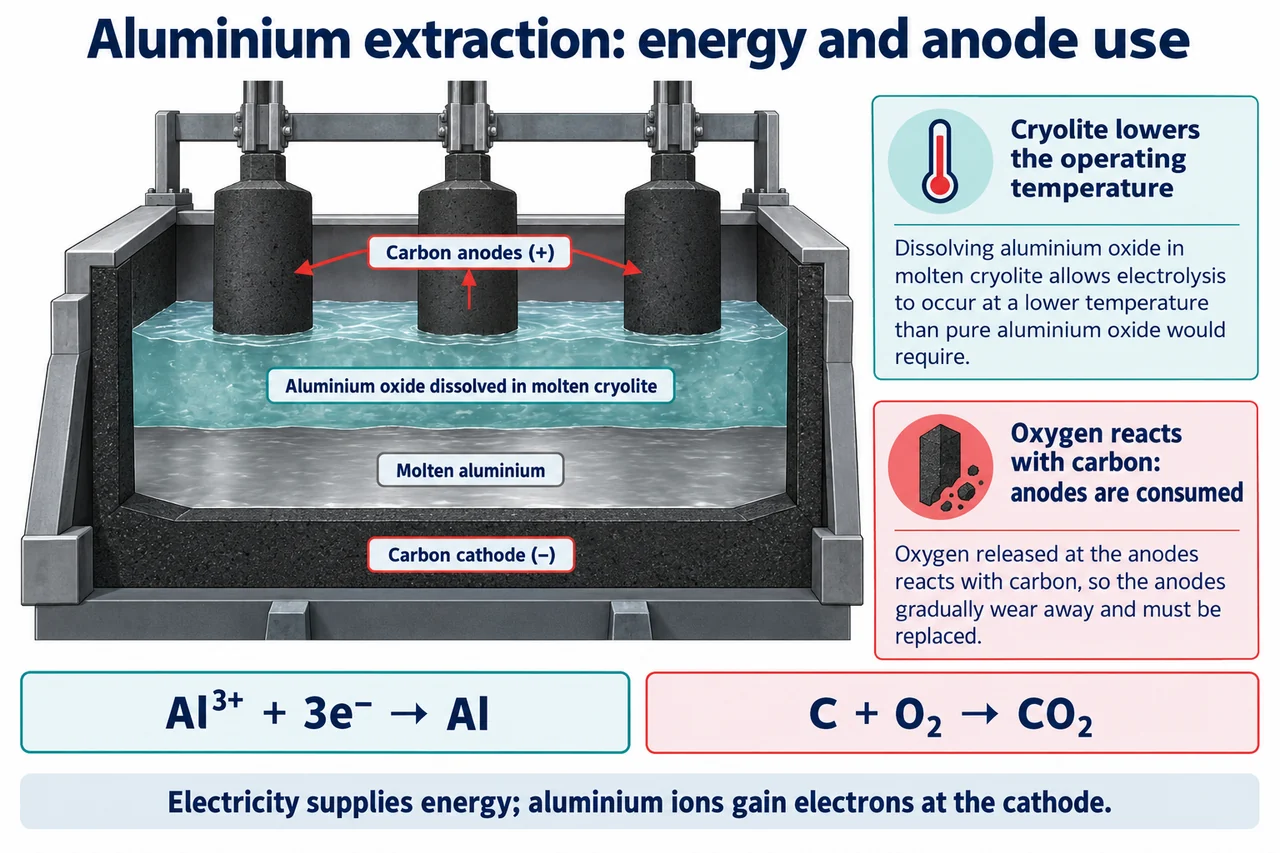
Image: illustration, not a documentary photograph. Original teaching model created for myAudience. · Original generated teaching raster; no exam-board or textbook artwork copied.
Aluminium: why the melt is a mixture and anodes wear away
Aluminium is above carbon in the reactivity series, so carbon reduction is unsuitable for its oxide in the GCSE extraction model. Metals may also need electrolysis if reaction with carbon would contaminate the product. Electrolysis supplies energy to separate a reactive metal from its compound, rather than making carbon a more powerful reducing agent. The aluminium plate shows a molten industrial electrolyte, not an aqueous solution or a battery that generates electricity spontaneously.
Pure aluminium oxide has a very high melting temperature. Industrial extraction dissolves it in molten cryolite, creating an electrolyte mixture that operates at a lower temperature than would be needed for pure molten alumina. Less heating energy is then required. Cryolite is not the aluminium oxide feed being converted into the desired metal in this teaching account, and it is not water. Saying that the mixture makes the ions mobile is incomplete: pure molten oxide would already have mobile ions; the mixture's important advantage is the lower operating temperature.
The positive carbon anodes dip into the electrolyte while the carbon lining is the negative cathode. Aluminium forms at the cathode and accumulates as a denser molten layer beneath the electrolyte. The image separates these layers so it does not imply that aluminium forms on the upper positive rods. The electrodes conduct electrons while the molten electrolyte carries ionic charge. Large amounts of electrical energy are needed to drive the process as well as thermal energy to maintain the molten conditions.
Oxygen formed at the anodes reacts with their carbon. In the simplified account C + O2 → CO2, so carbon atoms leave the electrode as gaseous carbon dioxide. The anodes are consumed and must be replaced continually; they do not simply melt away because they are positive. Real operation can involve additional emissions and electrode reactions, so the diagram is a GCSE mechanism rather than a complete industrial emissions inventory. The carbon electrode is reactive here, unlike the ideal inert electrode in simple molten-product predictions.
Higher extension: Al^3+ + 3e^- → Al is cathode reduction, and 2O^2- → O2 + 4e^- is the simplified oxide-ion anode oxidation. Match twelve electrons by multiplying the first account by four and the second by three. This gives 2Al2O3 → 4Al + 3O2 before oxygen consumes carbon. Combining with 3C + 3O2 → 3CO2 gives the simplified overall account 2Al2O3 + 3C → 4Al + 3CO2. Charge and atom balance do not make the actual complex melt a collection of isolated free oxide ions; these equations are the assessed model.
A process evaluation should distinguish feasibility from cost and environmental choice. A supplied lower-temperature electrolyte saves heating but does not eliminate electrical demand or carbon consumption. Recycling aluminium avoids repeated extraction from oxide and can reduce energy demand, but collection and processing data are needed for a numerical claim. The plate's two equations explain cathode electron gain and anode consumption separately. They are not a complete combined equation, and their position on the page does not represent an electron travelling through the electrolyte.
Transfer challenge (original teaching task, not an examination question): Supplied metal T lies below carbon, but at extraction temperature reacts with carbon to form an unwanted carbide. A molten electrolysis route requires more electricity and avoids that impurity. Explain why the simple series shortcut is insufficient, and evaluate the route using the supplied facts.
Reasoned answer: Being below carbon supports oxide reduction feasibility, but the product can react further with carbon and become contaminated. Electrolysis is chemically suitable where carbon causes this problem. The extra electricity is a cost/environment tradeoff against purity and possible separation costs; more data are needed for an unconditional choice. Why this follows: The official electrolysis choice includes metals reacting with carbon as well as those above it. A single feasibility rule cannot substitute for process information supplied in an evaluation task. Indicative author rubric (5 marks; not an exam-board mark scheme): Below-carbon route prediction stated; Secondary metal-carbon reaction identified; Impurity/purity consequence; Electrolysis addresses carbon contact; Conditional energy/purity evaluation. Reading an answer does not demonstrate independent mastery or performed practical skills.
Worked example: Explain why using cryolite and replacing carbon anodes solve different problems. Higher: use the simplified overall equation to predict carbon dioxide from 54.0 kg aluminium using Al = 27, C = 12 and O = 16, assuming all anode carbon forms CO2.
Cryolite lowers the operating temperature; replacement restores carbon lost when oxygen reacts with the anodes.
2Al2O3 + 3C → 4Al + 3CO2 gives 108 mass units Al to 132 CO2.
54.0 × 132/108 = 66.0 kg CO2. This is a stipulated stoichiometric estimate, not a measured full industrial footprint.
Answer: The mixture reduces heating demand; replacement addresses chemical consumption. The simplified Higher estimate is 66.0 kg CO2.
Check your understanding: Evaluate: 'Cryolite removes oxygen from alumina, and positive carbon anodes gain electrons to make aluminium.' Correct each part and explain why electricity is still required at a lower temperature.
Answer: Cryolite enables a lower-temperature molten mixture. Aluminium ions gain electrons at the negative cathode; oxygen forms at the positive anode and consumes carbon. Electricity still drives the decomposition.
Why: Electrolyte choice changes the heating requirement, not the need for cathode reduction and anode oxidation. The anode sign and the site of aluminium production must be kept distinct.