Aqueous electrolysis: water introduces competing products
By UK GCSE Chemistry · independent study · myAudience
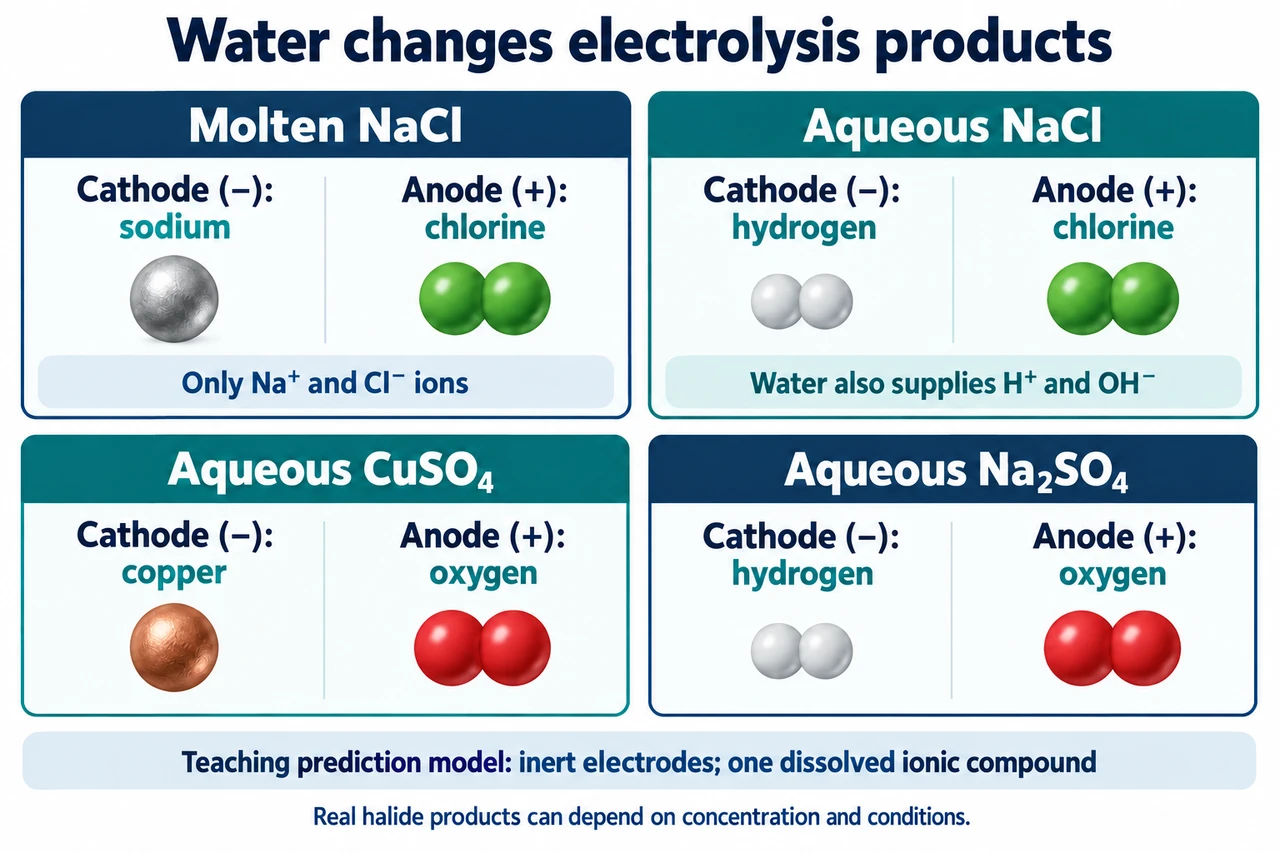
Image: illustration, not a documentary photograph. Original teaching model created for myAudience. · Original generated teaching raster; no exam-board or textbook artwork copied.
Aqueous electrolysis: water introduces competing products
Dissolving an ionic compound makes its ions mobile, but water also participates in aqueous electrolysis. In the model, H+ and OH- from water provide possible hydrogen and oxygen products. Thus aqueous sodium chloride cannot be predicted by copying the molten sodium chloride result. State, electrolyte composition and electrode material are essential information; all predictions in this lesson assume inert electrodes and one dissolved ionic compound unless another condition is explicitly supplied.
At the negative cathode, compare the metal with hydrogen in the reactivity series. If the metal is more reactive than hydrogen, hydrogen is produced instead of that metal. If the metal is less reactive, its ions form the metal. Sodium sulfate solution therefore gives hydrogen rather than sodium; copper sulfate solution gives copper. Saying that positive ions move to the cathode is correct but insufficient: movement towards an electrode does not prove which species is discharged there.
At the positive anode, the assessed rule gives a halogen if halide ions such as chloride, bromide or iodide are present, and otherwise oxygen. Sulfate and nitrate are not halides. Aqueous copper sulfate therefore gives copper and oxygen, while copper chloride gives copper and chlorine. Sodium chloride gives hydrogen and chlorine, leaving sodium ions in solution. This prediction rule is an assessment model, not a universal electrochemical law: real halide product competition depends on concentration, electrode and operating conditions, particularly in dilute chloride solutions.
Read the aqueous comparison plate card by card. Molten NaCl gives sodium and chlorine because only the salt's ions are present in the model. Aqueous NaCl gives hydrogen and chlorine because water adds a competing cathode pathway. Aqueous CuSO4 gives copper and oxygen; aqueous Na2SO4 gives hydrogen and oxygen. The product pictures are schematic and not evidence of gas identity, amount or yield. They do not show metal ions turning into hydrogen atoms; the metal ions can remain in solution while water-derived species react.
Higher extension: copper reduction is Cu^2+ + 2e^- → Cu; hydrogen reduction can be written 2H^+ + 2e^- → H2. Chloride oxidation is 2Cl^- → Cl2 + 2e^-; hydroxide oxidation is 4OH^- → O2 + 2H2O + 4e^-. The hydroxide account contains four oxygen and four hydrogen atoms on each side and charge −4 on each side. Omitting the water gives an unbalanced account. In alkaline conditions, the equivalent hydrogen account 2H2O + 2e^- → H2 + 2OH^- explicitly shows the water consumed.
Product predictions should be checked experimentally with appropriate tests in a supervised investigation. Copper deposition may be visually identifiable, but colour and bubbles alone are limited. If copper electrodes replace inert ones in copper sulfate, anode copper can dissolve instead of oxygen forming; that changed condition lies outside the simple inert-electrode rule. A strong transfer explanation states its assumptions and then applies the correct branch at each electrode. It neither exports a molten rule to a solution nor treats every negative ion as a halide.
Transfer challenge (original teaching task, not an examination question): Predict the four electrode products for aqueous CuBr2 and aqueous KNO3 with inert electrodes under the rule, then explain what replacing the inert anode with a reactive metal would change about your reasoning.
Reasoned answer: CuBr2: copper cathode, bromine anode. KNO3: hydrogen cathode, oxygen anode. A reactive metal anode may itself oxidise/dissolve, so the inert-electrode anion prediction no longer suffices; supplied electrode chemistry is needed. Why this follows: Two independent branches use metal reactivity and halide presence. Nitrate is not a halide, and product rules are conditional on the electrode being inert. Indicative author rubric (5 marks; not an exam-board mark scheme): CuBr2 cathode copper; CuBr2 anode bromine; KNO3 cathode hydrogen; KNO3 anode oxygen; Changed electrode assumption identified rather than applying table blindly. Reading an answer does not demonstrate independent mastery or performed practical skills.
Worked example: Compare molten and aqueous MgCl2 using inert electrodes and the stated aqueous rule. Predict products and write Higher half-equations for the aqueous case.
Molten MgCl2 gives magnesium at cathode (−) and chlorine at anode (+). No water competes in the binary melt model.
In solution magnesium is more reactive than hydrogen, so hydrogen forms at cathode; chloride gives chlorine at anode.
Higher aqueous accounts: 2H^+ + 2e^- → H2 and 2Cl^- → Cl2 + 2e^-. Alternatively the alkaline water form may represent the hydrogen reaction.
Answer: Molten: Mg and Cl2. Aqueous model: H2 and Cl2; the negative electrode changes product because water participates.
Check your understanding: Predict both products for aqueous silver nitrate and aqueous sodium sulfate with inert electrodes. Explain why nitrate cannot be treated as a halide and why sodium ions do not become hydrogen.
Answer: Silver nitrate gives silver at cathode and oxygen at anode. Sodium sulfate gives hydrogen at cathode and oxygen at anode.
Why: Silver is below hydrogen, sodium above. Neither solution contains halide, so oxygen is the anode prediction. Hydrogen comes from water-derived species; sodium ions remain sodium ions rather than changing element.