Higher: construct, audit and combine electrode half-equations
By UK GCSE Chemistry · independent study · myAudience
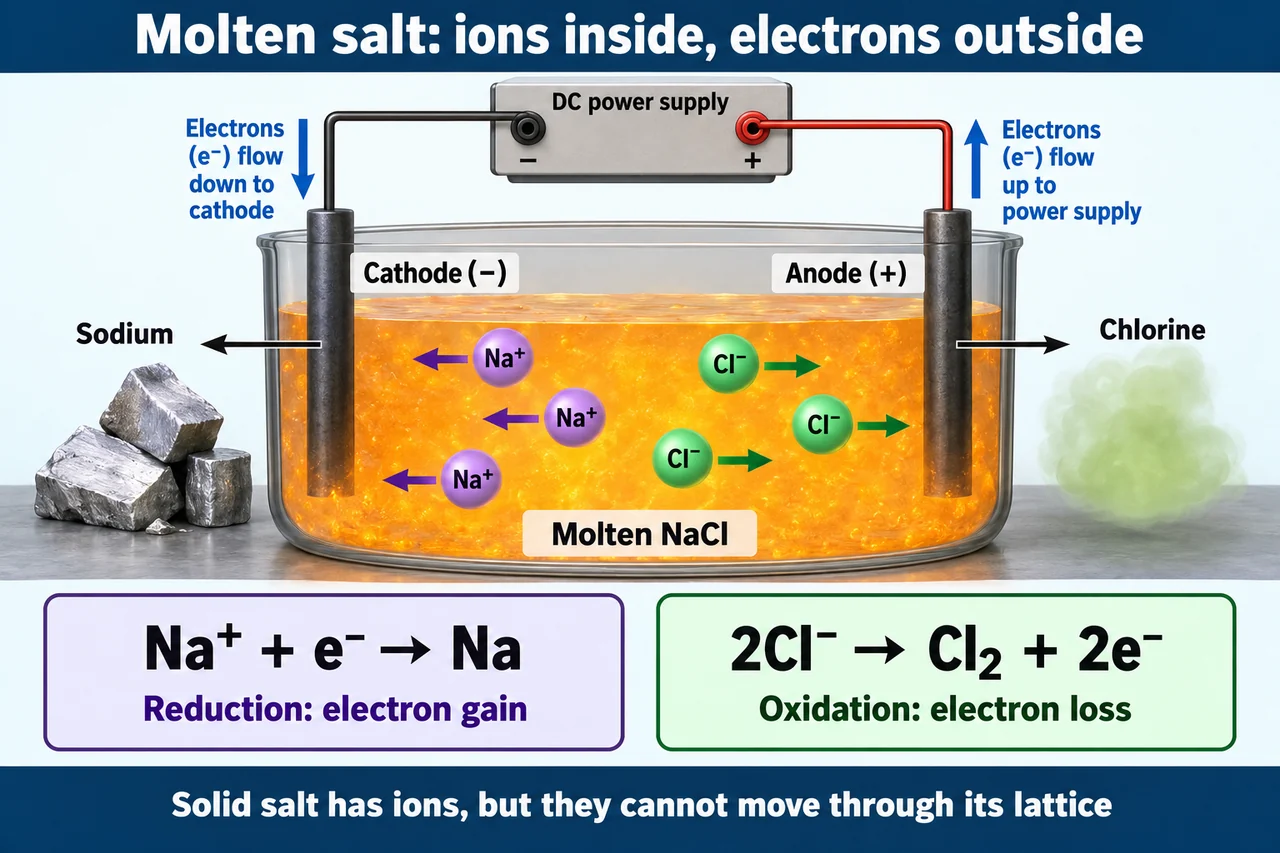
Image: illustration, not a documentary photograph. Original teaching model created for myAudience. · Original generated teaching raster; no exam-board or textbook artwork copied.
Higher: construct, audit and combine electrode half-equations
A half-equation records one electrode reaction with an explicit electron account. Begin by identifying the species discharged and the product from the supplied state and conditions. Then balance element atoms, and finally balance charge by adding electrons to the correct side. At the electrolytic cathode electrons are consumed in reduction; at the anode electrons are released in oxidation. This method addresses the Higher demand to write, complete and balance half-equations throughout electrolysis, not merely to memorise two examples.
For a supplied metal ion M3+, M^3+ + 3e^- → M conserves one M atom and charge zero. A divalent ion needs two electrons, not three, because each electron has charge −1. The subscript in a compound formula is not the number of electrons a metal gains: MgCl2 supplies Mg2+, and that charge is the reason for two electrons. The transport plate's Na+ card is the one-electron case. It shows electrons arriving through the cathode wire, not travelling through the liquid.
Diatomic non-metal products require a pair of atoms. Start Cl^- → Cl2 by putting 2 before Cl-, then add 2e^- to the products to retain charge −2. For oxide ions, 2O^2- → O2 + 4e^- balances two oxygen atoms and charge −4. In an aqueous oxygen equation using hydroxide, 4OH^- → O2 + 2H2O + 4e^- also preserves hydrogen. An equation can have the right electron side and still fail its atom account; check every element and charge independently.
For aqueous hydrogen, 2H^+ + 2e^- → H2 is the GCSE hydrogen-ion form. The water form 2H2O + 2e^- → H2 + 2OH^- is useful when describing an alkaline cathode environment. These are alternative representations for appropriate environments, not equations to add as if both independently make an extra gas yield. Water-derived H+ is the GCSE shorthand for hydrated hydrogen ions, not a bare proton drifting alone through a wire. Preserve the supplied question's notation when completing it.
To combine half-equations, multiply complete equations to make electron numbers equal and then cancel the electrons. Doubling 2H^+ + 2e^- → H2 and adding 4OH^- → O2 + 2H2O + 4e^- gives 4H^+ + 4OH^- → 2H2 + O2 + 2H2O. Using 4H^+ + 4OH^- → 4H2O as the ion-combination identity reduces this to 2H2O → 2H2 + O2. Equal electron transfer leads to twice as many hydrogen molecules as oxygen molecules in the ideal overall account.
A half-equation is not evidence of which reaction dominates in an unspecified mixture. Cu2+ can be balanced correctly, yet the actual electrode material or competing species might change a real experiment. Nor does a correct combined equation establish practical gas-volume measurements: dissolution, leaks and conditions can affect collection. A demanding response first gives the chemical prediction under explicit assumptions, then provides independently conserved half-equations, and finally distinguishes stoichiometric amounts from observed output.
Higher extension (original teaching task, not an examination question): Complete and audit the molten-ion templates Al^3+ → Al and O^2- → O2. Match electron transfer and derive the oxide decomposition equation before carbon anode consumption is considered.
Reasoned answer: Al^3+ + 3e^- → Al;2O^2- → O2 + 4e^-. Multiply by 4 and 3 respectively to match 12 electrons, giving 2Al2O3 → 4Al + 3O2. Cathode reduction and anode oxidation each conserve atoms and charge. Why this follows: Matching three and four electrons tests transfer beyond divalent halides. The formal decomposition model precedes oxygen consumption by carbon and is not the final industrial overall equation. Indicative author rubric (5 marks; not an exam-board mark scheme): Correct aluminium reduction; Correct oxide oxidation; Separate atom and charge audits; Common12 electrons with complete coefficient multiplication; Correct combined equation excluding uncancelled electrons. Reading an answer does not demonstrate independent mastery or performed practical skills.
Worked example: For aqueous sodium sulfate with inert electrodes, complete OH^- → O2 + H2O and H^+ → H2. Audit each and derive the gas molecule ratio; transfer the electron account to 0.0500 mol O2.
Anode: 4OH^- → O2 + 2H2O + 4e^-; O 4, H 4 and charge −4 on both sides. Cathode: 2H^+ + 2e^- → H2; H 2 and charge 0 on both sides.
Double the cathode account to consume four electrons per oxygen molecule. This gives the ideal H2:O2 ratio 2:1 and overall 2H2O → 2H2 + O2.
0.0500 mol O2 corresponds to 4 × 0.0500 = 0.200 mol electrons transferred and 0.100 mol H2 in the ideal account. Electron amount is a stoichiometric extension, not a required Faraday-law calculation.
Answer: Anode oxidation and cathode reduction; ideal 0.100 mol H2 accompanies 0.0500 mol O2, with 0.200 mol electrons transferred.
Check your understanding: Diagnose both defects in 2OH^- + 2e^- → O2 + H2O. Then write the correct account and explain why oxygen formation is oxidation despite its negative-ion reactant.
Answer: It has wrong atom counts and electrons on the wrong side. Correct: 4OH^- → O2 + 2H2O + 4e^-.
Why: The proposed left has O 2 and H 2, but the right O 3 and H 2, and charge −4 versus 0. Hydroxide ions lose electrons at the positive anode; oxidation describes electron loss, not a requirement that the starting species be positive.