This practical study: hypotheses, product tests and evidence limits
By UK GCSE Chemistry · independent study · myAudience
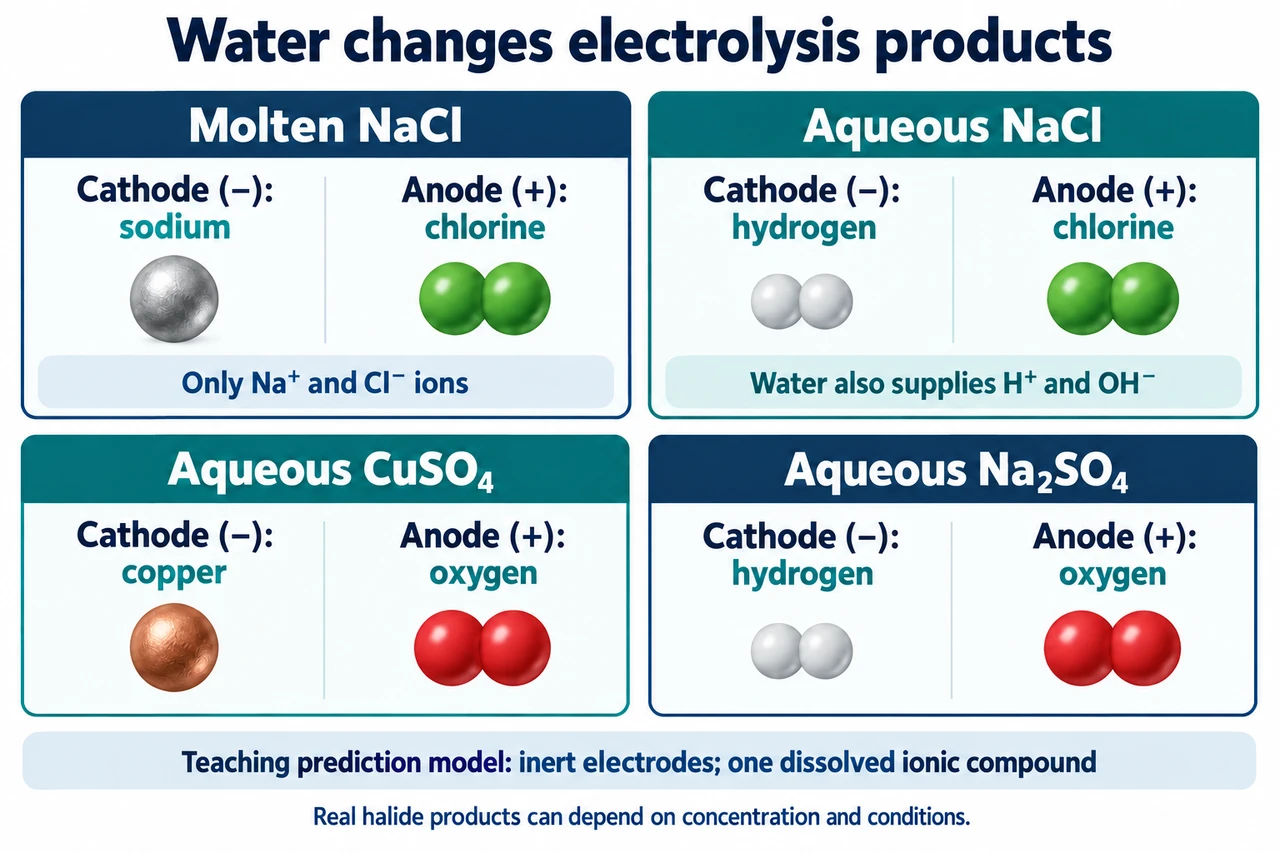
Image: illustration, not a documentary photograph. Original teaching model created for myAudience. · Original generated teaching raster; no exam-board or textbook artwork copied.
This practical study: hypotheses, product tests and evidence limits
This practical study investigates aqueous electrolysis using inert electrodes and includes developing a hypothesis. A hypothesis is a testable prediction with a scientific reason: for example, changing copper sulfate to sodium sulfate should change the cathode product from copper to hydrogen because copper is below hydrogen but sodium above it. Both should give oxygen at the anode in the stated model. The aqueous plate supplies those predictions; it contains no observations collected from an actual experiment.
A written plan uses a teacher-approved low-voltage DC supply, separate inert electrodes and suitable electrolyte volumes. Keep electrode material, immersion depth, spacing, solution volume, concentration, temperature and comparison time consistent where relevant. Record actual current or other specified electrical conditions because different electrolytes need not draw equal current at one supply setting. The independent variable for this hypothesis is electrolyte identity and the dependent result is product identity, not simply bubble count. Clean and rinse apparatus between solutions to avoid ion contamination.
Product tests need their own evidence. Under supervised approved procedures, hydrogen gives a squeaky pop with a lighted splint, oxygen relights a glowing splint, and chlorine bleaches damp litmus paper. Chlorine testing must use the teacher's assessed small-scale setup and ventilation; smell is not a test and gas is not inhaled. A reddish cathode deposit can support a copper prediction, but appearance alone is weaker than a chemically justified identification. Record which electrode produced each sample so a correct gas test is not attached to the wrong polarity.
Use a results table containing electrolyte, electrode sign, predicted product, actual observation, identification test and conclusion. Constructed evidence such as a copper-coloured deposit at the negative rod and a relit splint from the positive rod is consistent with copper sulfate giving copper and oxygen. A white-looking electrode or bubbles without tests supports a much narrower conclusion. If predicted and observed products differ, inspect polarity, electrode material, contamination, gas sampling and, for halides, concentration-dependent competing reactions before declaring the model disproved.
Higher extension: link the copper prediction to Cu^2+ + 2e^- → Cu and oxygen to 4OH^- → O2 + 2H2O + 4e^-. These equations explain why the two electrode reactions are reduction and oxidation. If comparing gas volumes, the ideal sodium sulfate hydrogen:oxygen amount ratio is 2:1, but unequal gas solubility, leaks, incomplete collection or different conditions can distort measured volumes. A 2:1 expectation is a reasoned hypothesis, not permission to discard a result merely because it differs.
A rigorous evaluation separates validity, precision and safety. Repeated tests can reveal inconsistency and a blank can reveal contamination, but repetition does not transform untested bubbles into identified gases. Isolation of a variable supports a causal comparison; complete contemporaneous records support traceability. AT3 concerns reaction technique, AT7 the electrochemical apparatus and AT8 product identification. This lesson offers written planning, interpretation and recovery reasoning only. Safe setup, actual observation, gas testing and competent apparatus use must be observed in a real supervised laboratory before practical skills can be recorded as completed.
Transfer challenge (original teaching task, not an examination question): Constructed sodium sulfate gas volumes are44 cm3 at the negative electrode and20 cm3 at the positive electrode. Approved tests suggest hydrogen and oxygen respectively. Compare the ratio with the model, propose two measurement explanations and design a repeat. Higher: relate the theoretical ratio to electron coefficients.
Reasoned answer: Measured ratio 2.2:1 differs from ideal 2:1, with negative volume 10% above 40 cm3 expected if 20 cm3 O2 is taken as the reference. Dissolution or a positive-side leak can reduce collected oxygen; unequal conditions/collection can also matter. Repeat with checked matched collection apparatus, polarity, conditions and recorded approved tests rather than deleting the mismatch. Higher oxygen uses 4 electrons and H2 uses 2 per molecule, hence 2 H2 per O2. Why this follows: An expected stoichiometric ratio is not an observed laboratory result. The numerical deviation cannot establish wrong gas identity without examining measurement conditions and tests; this is a constructed interpretation task, not practical study completion. Indicative author rubric (6 marks; not an exam-board mark scheme): Measured2.2:1; Ideal2:1 with stated reference assumption; One plausible collection explanation; Second distinct measurement explanation; Controlled repeat retaining discrepant data; Higher electron-ratio explanation (shared-tier task uses product-test evidence instead). Foundation 6; Higher 6. Reading an answer does not demonstrate independent mastery or performed practical skills.
Worked example: Constructed results for 'copper sulfate with inert electrodes' show a reddish deposit on the negative electrode, bubbles from the positive electrode, and a glowing splint that relights in the positive sample. A second team used copper electrodes and saw no anode gas. Interpret both without pretending they are performed results.
The first team's constructed observations and oxygen test support copper at cathode and oxygen at anode, matching the inert-electrode model.
The second team changed electrode material. A copper anode can dissolve, so the original inert-electrode prediction is no longer a controlled comparison.
Restore matched inert electrodes, record polarity and conditions, clean apparatus and repeat approved product tests. Retain the discrepant record and explanation.
Answer: The first record is consistent with the hypothesis; the second tests a changed system. No actual practical study performance or laboratory completion is evidenced.
Check your understanding: A student records equal bubbles at two rods as proof of equal hydrogen and oxygen amounts, then switches the wires but keeps the original rod labels. Give three reasons the conclusion is insecure and one improvement for each.
Answer: Bubbles are not gas identification: use approved tests. Bubble size and collection differ: measure suitable gas samples under matched conditions. Rod polarity changed: label each electrode by its current supply connection.
Why: Electrode names follow their reaction and connection in electrolysis, not a permanent left/right position. Product identity, measured amount and polarity each need evidence. The ideal 2:1 amount ratio does not specify a visible bubble-count ratio.